home · author
The team
Chen Hui Yi
Senior Tea Expert (White, Green & Yellow Tea Varieties)
Guangdong
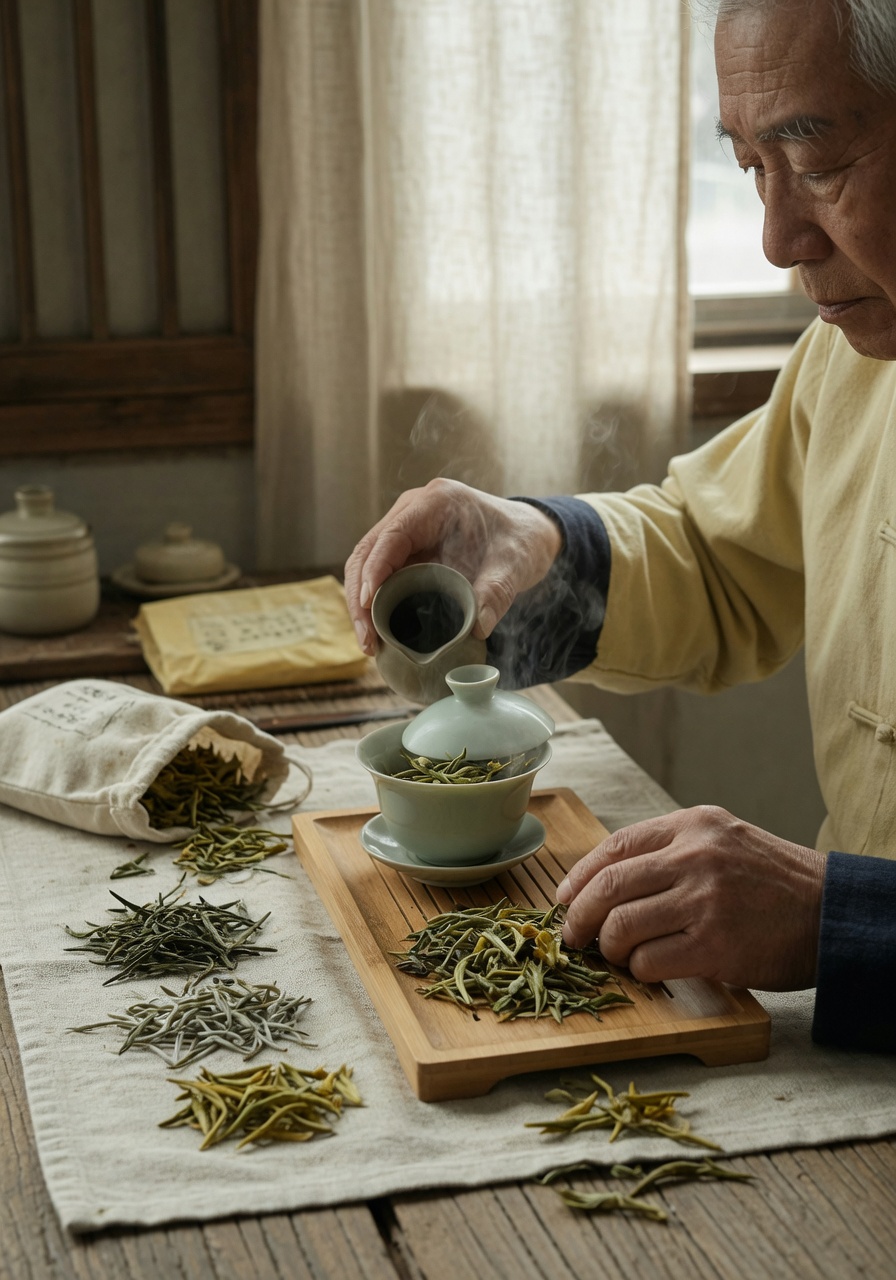
Chen Hui Yi works out of a small cupping room in Chaozhou, eastern Guangdong, but her professional life has always pointed north — towards the white-tea hills of Fujian and the older sun-drying traditions that survive in pockets of Guangdong's own Dapu and Raoping counties. She trained first as a green-tea sorter at a state-owned factory in Meizhou in the late 1990s, then spent four formative years apprenticing under Lin Zhencheng, a Fuding Bái Háo Yín Zhēn (白毫银针) maker who insisted his students learn withering by the smell of the bamboo trays before they were allowed to touch a thermometer. Lin's discipline — wither by nose, finish by hand — still shapes how Chen approaches every white tea that crosses her bench.
Her technical focus is the chemistry and sensory drift of aged whites. Between 2011 and 2019 she built a reference vault of 184 Shòu Méi (寿眉) and Bái Mǔ Dān (白牡丹) cakes, pressed in single years from named gardens in Guanyang, Diantou and Panxi, and re-cupped on a fixed annual schedule. The dataset underpins much of her writing on tea.degree, including the six-week calibration programme she designed for new tasters — a structured sequence that pairs blind triangles against a fixed reference cake so that students learn to separate genuine age from storage artefact. The programme is now also taught on tea.school as part of the white-tea path.
Chen's Guangdong base gives her an unusually wide sensory vocabulary. The province's Fèng Huáng Dān Cōng (凤凰单丛) oolongs share aromatic territory — orchid, honey, stone fruit — with high-grade Bái Mǔ Dān, and she has spent years sitting at Dan Cong tables in Wudong village to refine her palate for the floral-fruit boundary. That work feeds directly into her tea.degree entry on telling orchid from longan aroma, which uses Dan Cong samples as the contrast set against Fuding whites. Her piece on smoky character — defect or terroir — draws on the same comparative approach, using Zhenghe pine-withered whites alongside Wuyi rock teas to argue that smokiness is rarely a single phenomenon.
She contributes to the constellation in several roles. On shop.thetea.app she is the senior vendor curator for white, green and yellow varieties, signing off lot-level quality reports before any cake or loose-leaf batch is listed. On tea.doctor and puerh.app she writes the white-tea sections — particularly entries on long-stored whites and the overlap with Shēng Pǔ'ěr (生普洱) aroma profiles after fifteen-plus years. For tea.degree she leads vocabulary work on aged whites, moonlight white, and the underrepresented Huáng Yá (黄芽) yellows from Mengding and Junshan.
Her working method is documentary. Every cupping is logged with water source, vessel weight, infusion times and a 10-axis score, and she expects her co-authors to do the same. She is sceptical of romantic vocabulary that cannot be reproduced across three tasters, and her editing tends to strip articles down to claims that can be verified against GB/T 22291-2017 (white tea) and GB/T 14487-2017 (sensory terminology). When she does allow a poetic phrase, it is usually borrowed from Lin Zhencheng — most often his observation that a properly withered silver needle should smell, on the dry leaf, like the inside of a cedar drawer at the end of summer.
Specialties
- white tea
- green tea
- yellow tea
- yinzhen
- shou mei
- bai mu dan
- moonlight white
- aged whites