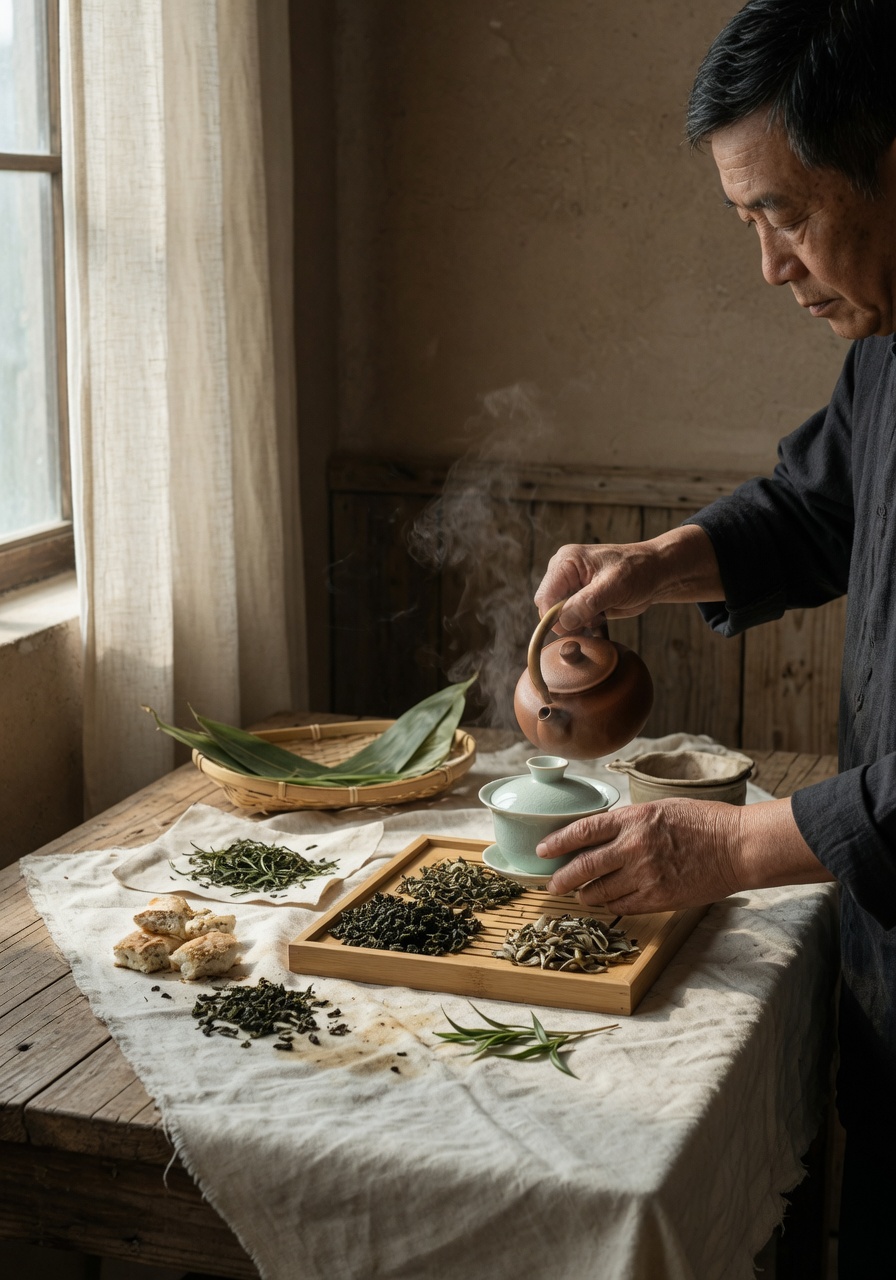
Fang Ting grew up in Xinyang, the southernmost prefecture of Henan, where the Dabie mountains catch the last northern edge of subtropical climate and Xìnyáng Máojiān (信阳毛尖) has been pressed into the local economy for eleven centuries. Her grandmother kept a five-mǔ plot above Dongjiahe village; Fang's earliest tea memory is sorting frost-bitten leaves at age seven, paid in candied hawthorn. That northern-fringe upbringing shaped the analytical habit she now brings to tea.degree — she learned green tea in a climate that makes green tea barely viable, where every degree of qīngmíng (清明) week matters and every leaf is interrogated for what the season took or gave.
She trained formally between 2009 and 2013 at the Xinyang Agricultural and Forestry University tea science department under Professor Guo Guimei, whose work on amino-acid ratios in Máojiān (毛尖) still anchors the GB/T 22737-2008 reference profile. After graduation Fang spent four seasons at the Wuyishan Tea Research Institute in northern Fujian, an unusual move for a Henan native; she wanted to understand yánchá (岩茶) processing from the inside rather than translate it secondhand. Her mentor there was Chen Dehua, a fifth-generation Shuǐ Xiān (水仙) roaster from Tongmu valley, who taught her the three-charcoal bèihuǒ (焙火) cycle and — more importantly — taught her to score roast intensity against returning sweetness rather than against surface aroma.
That lesson became the spine of her work at tea.degree. Her article Huígān — the returning sweetness, scored lays out a six-point rubric distinguishing simple residual sugar from true huígān (回甘), the throat-rising sweetness that follows astringency by twelve to forty seconds. She built the rubric across 340 cupping sessions between 2019 and 2022, with reference samples drawn from Wuyi Ròu Guì (肉桂), Yiwu spring gǔshù (古树) pu-erh, and her own Henan Máojiān. The scoring framework is now used by the tea.school examiner panel and feeds the radar component on the tea.degree compare view.
Her second contribution, Temperature curves across the six categories of Chinese tea, was written after a 2023 disagreement with three colleagues over whether 85 °C or 92 °C better expressed a Mengku autumn raw pu-erh. Rather than argue, Fang ran the cupping at eleven temperatures from 70 to 100 °C and plotted catechin extraction against perceived bitterness. The resulting curves — one per category, with sub-curves for aged versus young pu-erh — are now baked into the tt-sensory-wheel-pro calibration defaults.
Fang holds the National Senior Tea Evaluator certificate (一级评茶师, 2017) and sits on the Henan provincial tea expo judging panel. She appears as senior expert on shop.thetea.app and shop.puerh.app for oolong and pu-erh selections, contributes diagnostic pieces to tea.doctor on over-roasted and waterlogged leaf, and leads the intermediate oolong and introductory pu-erh paths at tea.school. She still returns to Dongjiahe every April for the qīngmíng pluck, where her grandmother's plot is now managed by a cousin and yields roughly forty-two kilograms of finished Máojiān a year — most of which Fang uses as her northern-green reference baseline when scoring.
Specialties
- oolong
- green tea
- pu-erh
- Henan teas
- cross-category cupping