Why mouthfeel is the harder half of tasting
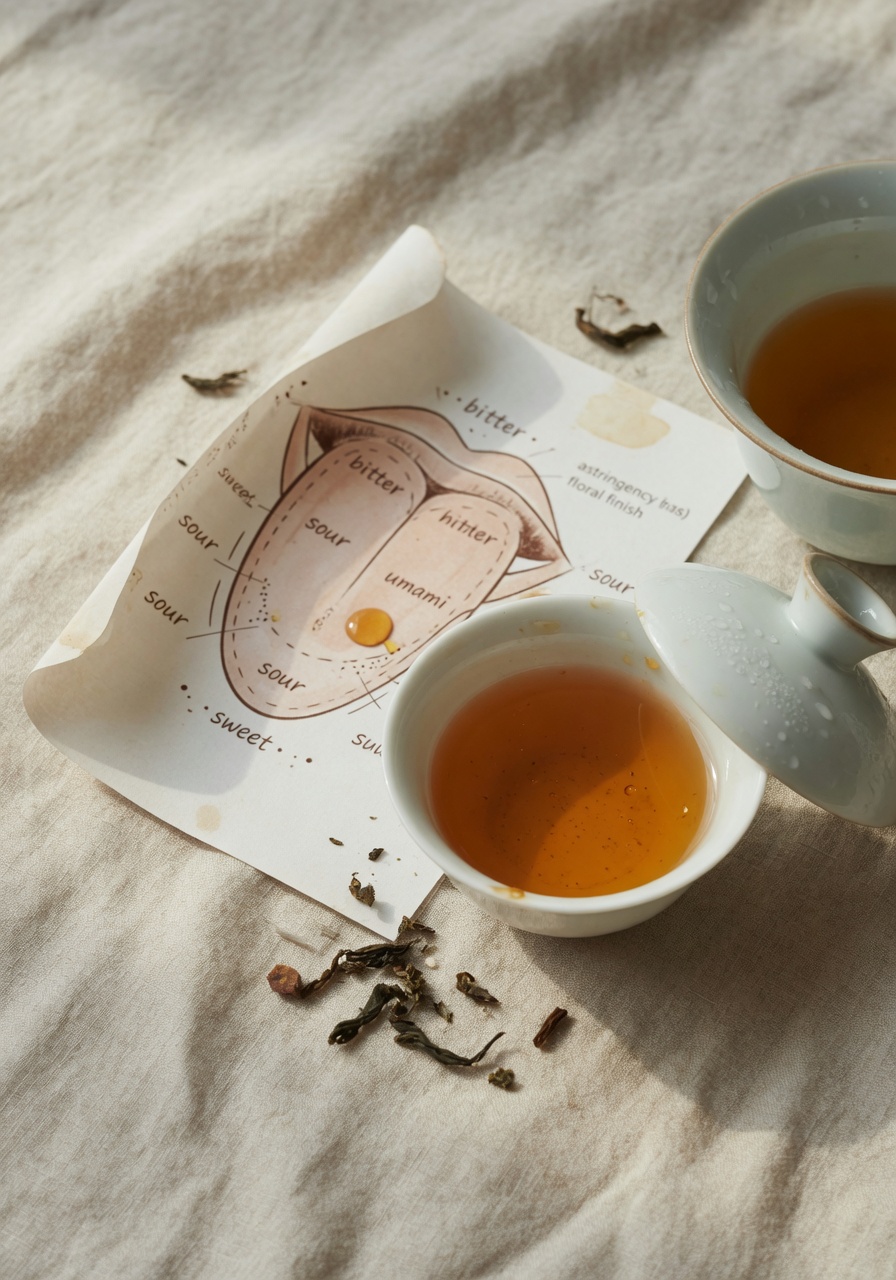
Aroma vocabulary travels easily — orchid, honey, roasted chestnut. Mouthfeel does not. The sensations that linger after the swallow — drying along the gum line, a velvet weight across the middle tongue, a sweetness that arrives twenty seconds late — sit in tactile and chemo-aesthetic territory that few drinkers have language for. Chinese tea grading has had that language for centuries, and the work of this topic is to anchor each term to a reproducible cup.
The formal vocabulary descends from the cupping protocol codified in GB/T 23776–2018, the national standard for sensory evaluation of tea. It distinguishes sè (色, color), xiāng (香, aroma), wèi (味, taste), and yùn (韵, lingering character) — a four-axis frame that predates Western tasting wheels by several centuries and still organizes how state graders score Longjing, Tieguanyin, and shou pu-erh. Within wèi and yùn sit the terms a sensory analyst needs to operationalize: astringency (sè wèi, 涩味), bitterness (kǔ, 苦), throat feel (hóu yùn, 喉韵), body (chá tāng nóng hòu, 茶汤浓厚), and the returning sweetness that the article Huígān — the returning sweetness, scored treats in clinical detail.
Regional grading houses have refined the language further. At the Phoenix Mountain (Fenghuang Shan) dancong cooperatives in Chaozhou, Guangdong, the term huó (活, liveliness) describes a mouthfeel that pulses rather than coats, and gān (甘) is distinguished from tián (甜): both translate as ‘sweet’ in English but the first is structural, the second is sugar-like. Henan green-tea graders use shuǎng (爽, crisp-clean) for the snap of a young Xinyang Maojian leaf, a term that has no clean English equivalent and is usually mis-rendered as ‘refreshing.’ Translation loss is the central problem this topic addresses.
The practical method is calibration against reference cups. A grader cannot use ‘astringent’ meaningfully until they have tasted a 2-minute over-steeped Anji Baicha and a 30-second restrained pour of the same leaf side by side — the gap between them is the working definition. The same applies to body: pulling a 5-gram and an 8-gram pour of identical Wuyi yancha from the 2019 spring harvest at the Zhengyan core reserves teaches nóng hòu (浓厚, thick weight) in a way no glossary can.
For practitioners moving between the cupping table and service, tea.school carries the calibration drills in lesson form, and thetea.app lets a taster log sessions against the same vocabulary so that scores remain stable across months. The articles in this topic — beginning with Huígān — the returning sweetness, scored — are built to be read with a cup in hand, not in the abstract.
The goal is not poetic description. It is repeatability: two trained graders, tasting the same Lao Banzhang sheng from the 2021 spring harvest, should disagree by less than one point on a ten-axis scale. That standard is achievable, and the vocabulary is the instrument that makes it so.