home · How a cup is <em>scored</em> — the mathematics of tea evaluation
Scoring rubrics
100-point vs 20-point rubric — when each is right
Bǎi fēn zhì vs èr shí fēn zhì · 百分制与二十分制
A tea buyer faces the same question every morning: is this tea an 87 or an 89? The answer can shift a price per kilogram by hundreds of yuan. But when does that fine grain matter, and when does a simpler 20-point scale serve the taster better? We unpack the two dominant scoring rubrics in Chinese tea appraisal and show where each earns its keep.
Walk through any major tea competition in China — the Feng Huang Dancong King of Teas contest in Chaozhou, the national premium green tea appraisal in Hangzhou, or a blind buy for a boutique shop in Guangzhou — and you will see judges hunched over score sheets, pencils in hand, working through a lattice of numbers. Some carry a clipboard with a hundred-point grid, each attribute parsed to a single digit. Others slide a small laminated card with four categories, each worth a maximum of five. One rubric demands that a jade-green Xīhú Lóngjǐng (西湖龙井) be judged on the shape of its bud, the evenness of its tips, the hue of its liquor, the persistence of its chestnut aroma; the other asks simply: appearance, aroma, taste, overall impression — rate each on a scale of one to five. Both systems are used daily in professional tasting rooms across China, yet they map to radically different intentions. The question that matters is not which rubric is more precise — it is what you plan to do with the number. Are you grading tea to set a transaction price or training your palate to detect the difference between a 3 and a 4? This article dissects the anatomy, the history, and the best-use scenarios for the 100-point and 20-point scoring systems, drawing on the GB/T national standard, interviews with working buyers, and the calibration tools built at tea.degree.
The origins of numerical tea scoring
Long before standardised rubrics, tea quality was communicated through poetry and reputation. A Song dynasty scholar might describe a lóng fèng tuán chá (龙凤团茶) as “pressing moonlight onto a jade tray” — beautiful, but useless for contractual trade. The shift to numerical scoring came with the demands of modern commerce and state quality control. By the 1950s, China’s tea research institutes began developing formalised sensory evaluation protocols, culminating in the national standard GB/T 23776-2018 Methodology of sensory evaluation of tea. That document enshrines a weighted 100-point system, with appearance, liquor colour, aroma, taste, and infused leaf weighted differently for each of the six tea categories. A parallel, simplified system emerged in trade schools and daily buying practice, often using a total of 20 points — four attributes each scored out of five — prized for its speed and lower cognitive load. New graders are usually started on a 20-point card for the first two weeks: sensory memory has to be calibrated before the numbers carry meaning.
Anatomy of a 100-point rubric
The GB/T 23776-2018 100-point scale divides sensory evaluation into five categories. For a green tea, the weights are typically: appearance (外形) 25 points, liquor colour (汤色) 10 points, aroma (香气) 25 points, taste (滋味) 30 points, infused leaf (叶底) 10 points. A black tea might shift aroma to 30 and taste to 25; a white tea like Bái Háo Yín Zhēn places more weight on appearance and less on infused leaf. Judges work with specific descriptors: for green tea appearance, a score above 22 points requires “tight, slender, evenly shaped buds with a dewy green gloss”; below 16 points signals “coarse, uneven, and dull”. Taste is parsed along a gradient of freshness (鲜度), sweetness (甜度), thickness (厚度), and aftertaste (回甘). An 85–89 is a first-grade tea; 90–94 is premium; 95–100 is extraordinary and rare. The precision exists to distinguish a lot that will sell at ¥480 per 500g from one at ¥520 — a difference that adds up across a 200-kilo purchase.
Weightings by tea category
The standard prescribes different weightings for each category. For oolong, aroma and taste each carry 30 points, appearance 20, with liquor colour and infused leaf at 10 each. For dark tea (hēi chá), taste climbs to 35 points, reflecting its role as a post-fermented, mouth-coating brew. Regional competitions often further tweak these weights: at the Fenghuang town competition, dancong aroma weight can reach 35 points, because a single orchid note might double the per-kilo price. Understanding these weightings is essential before attempting to use a 100-point card — without them, a taster can easily overweight appearance and underweight taste, distorting the final score.
The danger of mid-point inflation
A common pattern among inexperienced graders is to cluster scores between 80 and 85. This so-called “charity zone” erases the discrimination the rubric is designed to capture. If everything lands between 80 and 85, you might as well use a 5-point smiley face. To counter this, tea.degree’s calibration module (see ‘A six-week sensory calibration programme’) forces tasters to rank three reference samples before assigning numbers, anchoring 80, 90, and 95 to actual taste memory.
When 100 points shine
The 100-point scale becomes indispensable in three contexts: competition judging, high-value procurement, and quality-control batch monitoring. At the 2023 Chaozhou Dancong King of Teas competition, 217 entries were scored to a single decimal place, with only the top twenty advancing. A 0.5-point difference separated the gold from the silver medalist, reflecting a gap in the longevity of the aftertaste that even seasoned tea drinkers might miss. In procurement, a buyer for a Shanghai specialty shop might use the 100-point card to negotiate down a consignment of Qímén hóng chá that scores 81 on taste due to a slightly sharp astringency — a flaw that a 4 out of 5 on a 20-point scale would gloss over. The granularity also allows for tracking improvement: a tea garden that moved from 84 to 88 in three years signals meaningful investment in picking standards and processing hygiene.
The 20-point simplicity
The 20-point system often groups sensory dimensions into four overarching categories: appearance (outer shape, colour, tip integrity), aroma (dry leaf and wet leaf, cup aroma), liquor (colour, clarity, taste, mouthfeel, aftertaste), and infused leaf (colour, evenness, tenderness). Each category is scored from 1 to 5, with 5 representing excellent and 1 representing defective. Total scores thus range from 4 (unfit for consumption) to 20 (perfect). This rubric appeared in the training programmes of many provincial tea schools in the 1990s, where students needed a quick-check tool for daily purchase rounds. A blank 20-point card still earns its place in a tasting notebook: when twelve Tieguanyin samples from a new farmer in Anxi have to be evaluated before lunch, there is no time for decimal-place nuance — what is needed is a go/no-go gate, and anything below 14 is set aside. The 20-point scale forces a taster to make categorical judgments rather than sliding along a continuum, which can be more reliable when palate fatigue sets in.
Calibration and consistency across scales
Neither system works without calibration. A 100-point rubric is only as reliable as the shared reference samples that define what an 86 tastes like. The tea.degree calibration programme pairs tasters with a set of reference teas — green, oolong, black — scored by a panel of three senior experts. Over six weeks, users learn to align their internal scales, reducing inter-rater variance from an average of 6.2 points to 2.1 points on the 100-point scale. The same principle applies to the 20-point card: two buyers must agree that a Tieguanyin with a light floral note and a clean finish is a ‘4’ in aroma, not a ‘3’. Cross-scale translation tables are sometimes used, where a total score of 16–18 on the 20-point map roughly corresponds to 85–92 on the 100-point. However, the scales cannot be converted mathematically. A tea that scores 4, 4, 4, 4 on the 20-point is a bland, middle-of-the-road tea — an 80 on the 100-point. A tea that scores 5, 5, 5, 5 is a 95-plus, but the 100-point card can also reveal a tea with a 5 appearance and a 2 taste that the simple sum would mask.
Choosing the right rubric for your context
The decision tree is straightforward. Use the 100-point rubric when: you are competing, buying at auction, negotiating a contract over ¥500 per kilo, or contributing data to a quality-monitoring programme (like the traceable batches on puerh.app). Use the 20-point rubric when: you are a shop assistant doing a quick trade-acceptance tasting, a student learning to discriminate, or a teacher running a group exercise where speed and consensus matter more than decimal points. Tea.degree’s scoring tool allows users to toggle between the two systems, storing both raw scores and a normalised radar plot. For example, a buyer at thetea.app might use the 100-point card to vet a new harvest of Huángshān Máofēng, then switch to the 20-point card for the daily quality check of the top ten teas in stock. Having both rubrics at your fingertips — and knowing when each will protect your palate from noise or sharpen your discrimination — is the mark of a professional taster.
References
- GB/T 23776-2018, Methodology of sensory evaluation of tea — Standardization Administration of China
- The Sensory Evaluation of Tea: Principles and Practice — Wang Xingguo, China Agriculture Press, 2015
- Rules of the 2023 Chaozhou Fenghuang Dancong King of Teas Competition — Chaozhou Tea Industry Association
Read next
Related articles
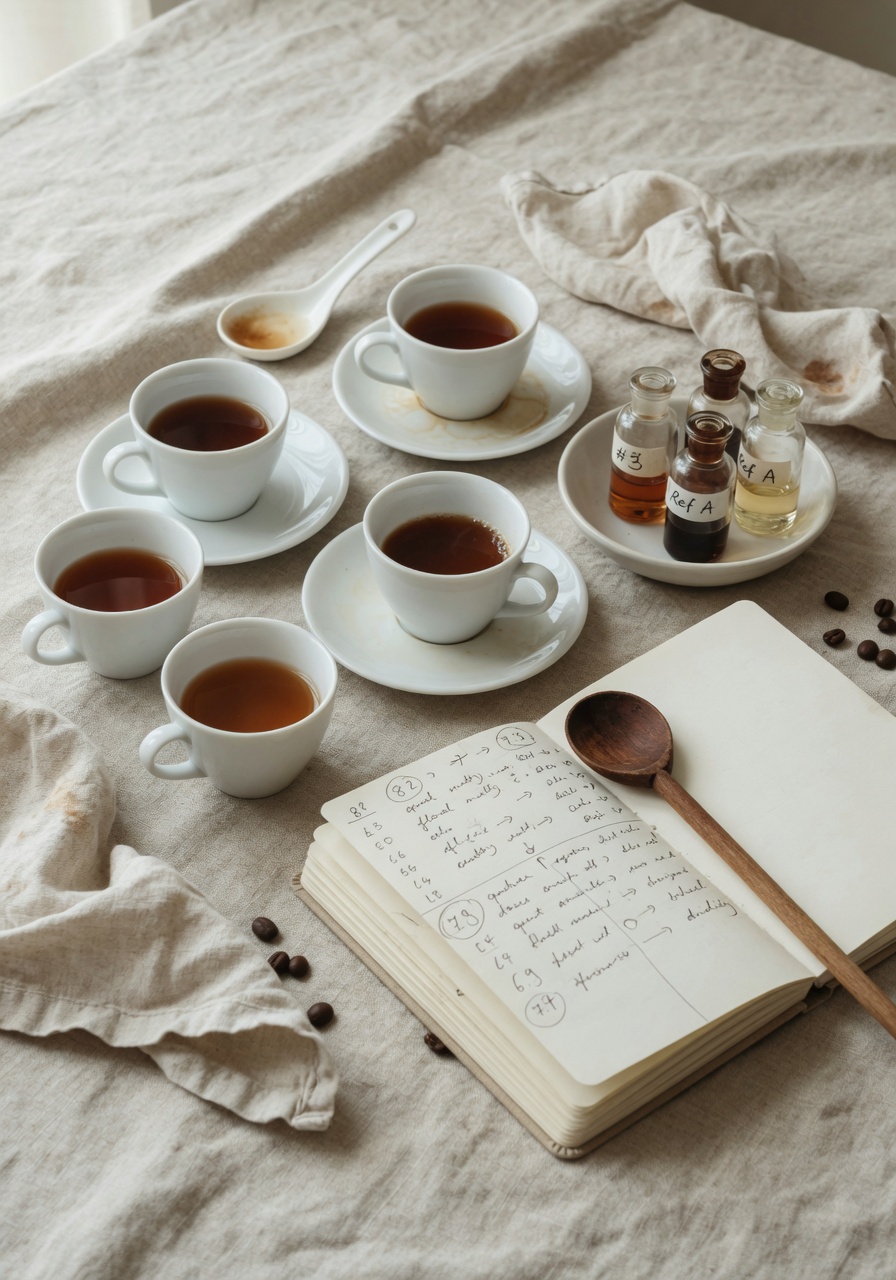
A six-week sensory calibration programme
Six weeks, six reference teas, one notebook. A structured programme to align your tasting scale to the GB/T standard — and to the cuppers who set it.
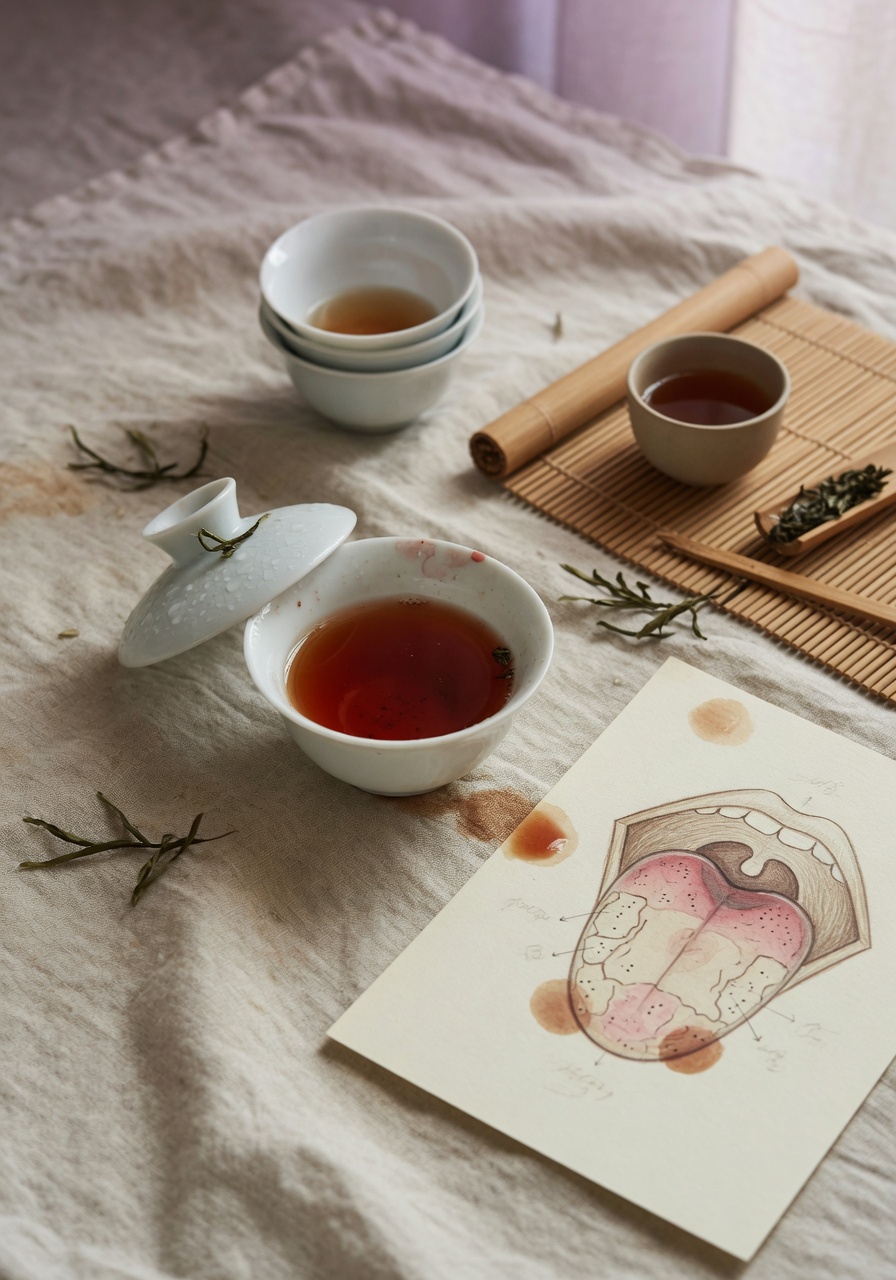
Huígān — the returning sweetness, scored
The sweetness that arrives after the tea is gone is the most discussed and least defined sensation in Chinese tasting rooms. Here is how to anchor it on a 10-axis rubric.
Body and mouth-coating — calibrating the heavyweight teas
Why some teas feel like velvet, others like water. A technical calibration of body and mouth-coating in heavyweight teas, from pu-erh to dark teas.
Astringency and mouth-feel — building a 5-point scale
Astringency is the tactile sensation that shapes a tea's architecture — not a taste, but a mouth-feel. Professional graders score it on a scale from silky absence to harsh grip. Here's how to build a calibrated 5-point scale that works across white, green, yellow, and beyond.