home · Six weeks to a <em>standard palate</em>
Calibration protocol
A six-week sensory calibration programme
Six weeks, six reference teas, one notebook. A structured programme to align your tasting scale to the GB/T standard — and to the cuppers who set it.
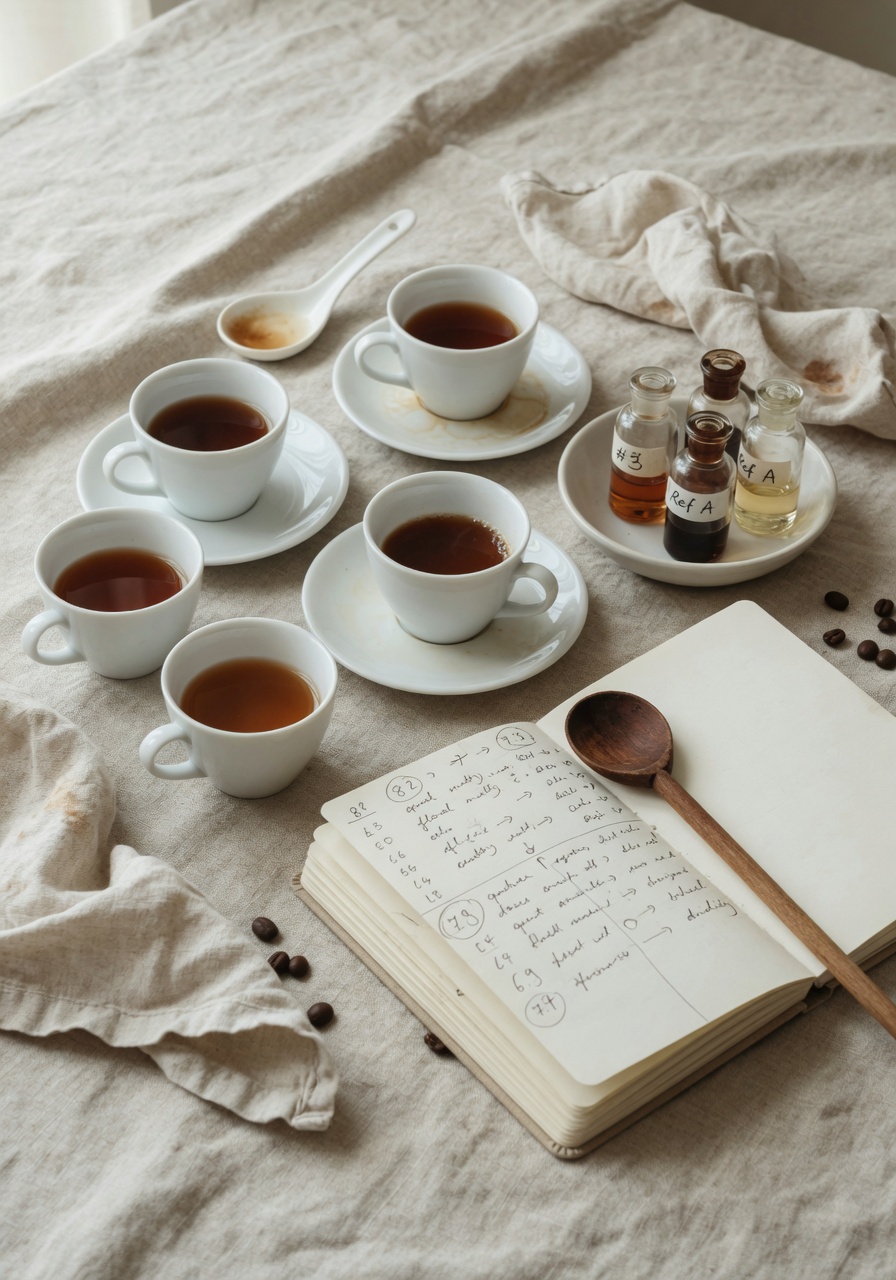
Most tasters drift. After a year of cupping, the scale you started with — where a 7 meant “clearly above average” and a 9 meant “reference-grade” — has slid quietly toward whichever teas you’ve been drinking most. If your shelf has skewed toward heavy-roast Wǔyí oolong, your threshold for “roasted” creeps up and a properly fired Shuǐ Xiān (水仙) starts to read as restrained. If you’ve been working through young shēng (生) from Bùlǎng, your tannin tolerance balloons and a Yīwǔ cake feels thin. This is not a failure of palate. It is the well-documented behaviour of any human sensory instrument that isn’t re-zeroed against a known standard.
The programme below is the one I run with new staff at our Guǎngdōng cupping room, adapted from the calibration cycle used by judges at the China Tea Marketing Association’s annual review. It takes six weeks, one structured session per week, and six reference teas chosen because their character is documented in national standards (GB/T) or in published academic descriptions. You will need a 150 ml porcelain gaiwan or cupping set, a gram scale accurate to 0·1 g, a kettle with temperature control, the tea.degree wheel and 10-axis scoring sheet, and — most importantly — a notebook you commit to writing in even when you are tired. The goal is not to become a better taster in some general way. The goal is to make your 6 mean what another trained taster’s 6 means.
What calibration actually corrects
Before we begin, it helps to know what you are correcting for. Three drifts dominate. The first is threshold drift — the smallest detectable concentration of a compound creeps upward with repeated exposure. A taster who works through Lapsang every morning will, by month three, fail to register light pinewood smoke that a fresh palate flags immediately. The second is anchor drift — the mental “reference” for a descriptor migrates toward whatever you tasted last. “Orchid” stops meaning Phalaenopsis and starts meaning “that Phoenix Dāncōng from last Tuesday.” The third is scale compression — over time most tasters squeeze their scoring into a narrower band, typically 5–7, because the extremes feel risky. Calibration uses fixed reference samples to push back against all three. You re-expose your nose to a benchmark smoke level, you re-anchor “orchid” to a specific cultivar, and you force yourself to score teas that are genuinely a 3 and genuinely a 9, restretching the scale.
The ISO 8586 protocol for sensory panel training — adapted by the Chinese national tea inspection institutes (see GB/T 23776-2018) — recommends recalibration every quarter for active panellists. For most independent tasters, twice a year is realistic. Six weeks is what it takes to do it properly the first time.
The six reference teas
Selection matters more than provenance. Each tea below was chosen because its sensory profile is described in a Chinese national standard or in peer-reviewed academic work, which means there is a written description you can calibrate against rather than only my opinion. Buy from a vendor who can name the producer, the harvest year, and the grade — shop.thetea.app and shop.puerh.app both list reference-grade lots seasonally. Budget around ¥800–1200 total for the six samples in modest quantity (15–25 g each is plenty).
The order is not arbitrary. We move from low-intensity, low-complexity teas to high-intensity, high-complexity teas, so your scale is built upward rather than collapsed downward from an early shock.
Week 1 — Bái Háo Yín Zhēn (Fúdǐng, current year)
Bái Háo Yín Zhēn (白毫银针) from Fúdǐng, picked in the first ten days of April, is the calibration baseline for delicacy. GB/T 22291-2017 describes the standard infusion as pale apricot, with aroma of fresh hay and a faint melon note, and a texture the standard calls xiān shuǎng (鲜爽) — “fresh and brisk.” If your sample tastes flat, the problem is almost always brewing: 85 °C, 4 g to 150 ml, three minutes for the calibration cup. This week you are learning to score low intensity without scoring low quality.
Week 2 — Lóngjǐng (Xīhú producing area, pre-Qīngmíng)
Authentic Xīhú Lóngjǐng (龙井) carries a chestnut and orchid note that GB/T 18650-2008 codifies as dòu xiāng (豆香), bean-fragrance, when properly pan-fired. The calibration target this week is the green-tea axis: vegetal vs roasted, sweetness vs astringency, and the specific texture of fine máo fēng tippy leaf in the mouth. Brew at 80 °C, 3 g, 150 ml, two minutes.
Week 3 — Phoenix Dāncōng Mì Lán Xiāng
For the Dāncōng session, use a mid-elevation (700–900 m) Mì Lán Xiāng (蜜兰香) from Wūdòng or Lǐzǎipíng for calibration rather than a single-tree lot. Single-tree teas are too idiosyncratic to anchor to. This week is for oolong floral-aromatic vocabulary: honey, longan, orchid, magnolia. Pair the session with the article on orchid vs longan aroma before you sit down.
The middle weeks — building the high end
Weeks four through six push intensity. By now you should have three completed scoring sheets in your notebook and a felt sense of where your scale has been sitting. If every tea so far scored between 6·5 and 7·5, you are scale-compressed — and the next three teas are designed to crack that open.
This is also the point in the programme where most tasters quit. The first three sessions feel productive; the middle three feel repetitive. Push through. The published research on panel training (Lawless and Heymann, Sensory Evaluation of Food, 2nd ed., 2010) shows that calibration gains plateau briefly around session four before a second, larger gain at sessions six to eight. You are training discrimination, not just memory.
Week 4 — Wǔyí Ròu Guì (medium roast, zhèng yán)
Ròu Guì (肉桂) from the zhèng yán (正岩) core area of Wǔyíshān, medium roast, current year, rested at least four months. The cinnamon-bark note that gives the cultivar its name should be unmistakable in the second infusion. GB/T 18745-2006 describes the yán yùn (岩韵) — “rock rhyme” — as a mineral persistence in the throat that you will use as a calibration point for the mouthfeel axis for the rest of your tasting life. Brew 5 g, 110 ml, 100 °C, gōngfū style, eight infusions.
Week 5 — Yúnnán Shēng Pǔ’ěr (Yīwǔ, 5–7 years aged)
These references are selected for our Russian and Mongolian distribution, and the requirement is unusually strict: a 2018 or 2019 Yīwǔ cake from a named village (Mahēi, Gāoshān or Luòshuǐdòng) rather than a blend. The calibration targets are huígān (回甘) — the returning sweetness — and shēngjīn (生津), salivation. Both are measurable: count seconds from swallow to the first sweet return at the back of the throat, and note where in the mouth saliva first pools. You will want the article on huígān open during this session.
Week 6 — Qímén Hóngchá (traditional grade, Ānhuī)
Traditional Qímén (祁门) hóngchá closes the programme because it sits at the intersection of every axis you have trained: floral like the Dāncōng, sweet like the aged shēng, with a roasted dimension that echoes the Ròu Guì. GB/T 13738.2-2017 describes the Qímén xiāng (祁门香) as having rose, honey and a faint pinewood note. Score it last, then go back and re-score the Bái Háo Yín Zhēn from week one — most tasters find their original sheet scored that tea half a point too high.
The session structure
Each weekly session takes ninety minutes and follows the same five-stage structure. Consistency of method is what makes the scores comparable across weeks; varying brewing parameters mid-programme is the single most common reason calibration fails.
Stage one, ten minutes — set up. Weigh leaf, pre-heat the vessel, photograph the dry leaf with a colour reference card. Stage two, fifteen minutes — dry leaf and wet leaf aroma. Score aroma intensity (1–10) and write three free-form descriptors before consulting any wheel. Stage three, thirty minutes — three structured infusions at the brewing parameters specified in each week’s notes. Score the 10-axis sheet for each infusion separately, not as an average. Stage four, twenty minutes — comparison against the published standard. Read GB/T or the academic reference aloud, note where your descriptors agree and where they diverge, and mark the divergences in red. Stage five, fifteen minutes — write a 150-word session summary in your notebook, in prose, not bullet points. The prose forces synthesis.
The red-mark step is the engine of the whole programme. Disagreement with the standard is not failure — it is information. If you consistently mark a tea less aromatic than the standard claims, your threshold is high (or your kettle is cool). If you mark it more astringent, your brewing ratio is heavy. Patterns across six weeks tell you where your instrument is biased.
Common drifts and how to read them
After supervising this programme with roughly forty staff members over six years, the same three patterns recur. The first: tasters trained primarily on pǔ’ěr score green and white teas one to one-and-a-half points lower than the panel consensus, because they have lost sensitivity to subtle sweetness. The fix is to extend week one and week two to two sessions each. The second: tasters who drink mostly at home, alone, compress everything to 6–7·5. The fix is the deliberate scoring of week one (genuine 8s exist) and week four (genuine 9s exist). The third, and most stubborn: descriptor inflation. “Orchid” gets used for any floral note, “honey” for any sweetness. The vocabulary library on tea.degree exists specifically to push back on this — every term there has a cultivar anchor and a Chinese-language source.
Zhōu Xiáng, who runs the Húnán hóngchá calibration sessions for our team, puts it bluntly: “If you cannot tell me whether the floral note is lán xiāng (兰香) or guì huā xiāng (桂花香), you do not yet have the vocabulary to score floral at all. Write ‘floral, unspecified’ and keep training.” That honesty — admitting the limit of your current discrimination — is what separates calibrated tasters from confident ones.
After week six
Run a seventh session, unscheduled, two weeks after week six. Use a tea not in the programme — ideally one a colleague selects for you blind. Score it on the 10-axis sheet, then ask your colleague for their score. The two numbers should now sit within one point of each other on at least seven of the ten axes. If they do, you are calibrated for this season. If they do not, identify which axes diverged and re-run the corresponding week.
Repeat the full programme in six months. Drift is constant, and the second pass is faster — most tasters complete it in four weeks rather than six. For structured group calibration, tea.school runs facilitated cohorts twice a year, and the blind-tasting mode on tea.degree gives you a way to keep the discipline going between formal cycles. The instrument you are calibrating is yourself, and it does not stay calibrated on its own.
References
- GB/T 22291-2017 — White tea (Bái chá) — Standardization Administration of China
- GB/T 18650-2008 — Product of geographical indication: Lóngjǐng tea — Standardization Administration of China
- GB/T 18745-2006 — Product of geographical indication: Wǔyí rock tea — Standardization Administration of China
- GB/T 13738.2-2017 — Black tea, Part 2: Congou black tea — Standardization Administration of China
- GB/T 23776-2018 — Methodology of sensory evaluation of tea — Standardization Administration of China
- Sensory Evaluation of Food: Principles and Practices, 2nd ed. — Lawless, H.T. and Heymann, H., Springer, 2010
Read next
Related articles
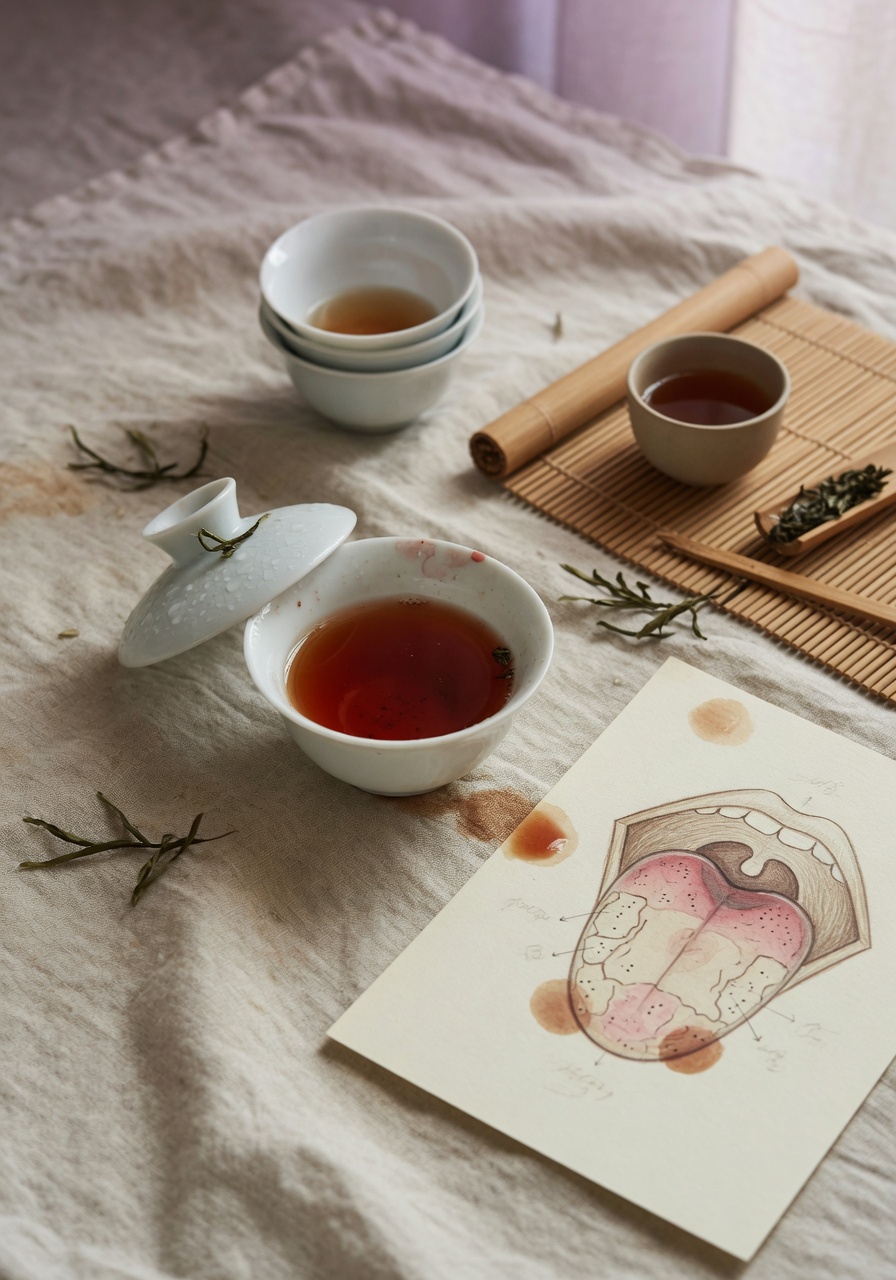
Huígān — the returning sweetness, scored
The sweetness that arrives after the tea is gone is the most discussed and least defined sensation in Chinese tasting rooms. Here is how to anchor it on a 10-axis rubric.
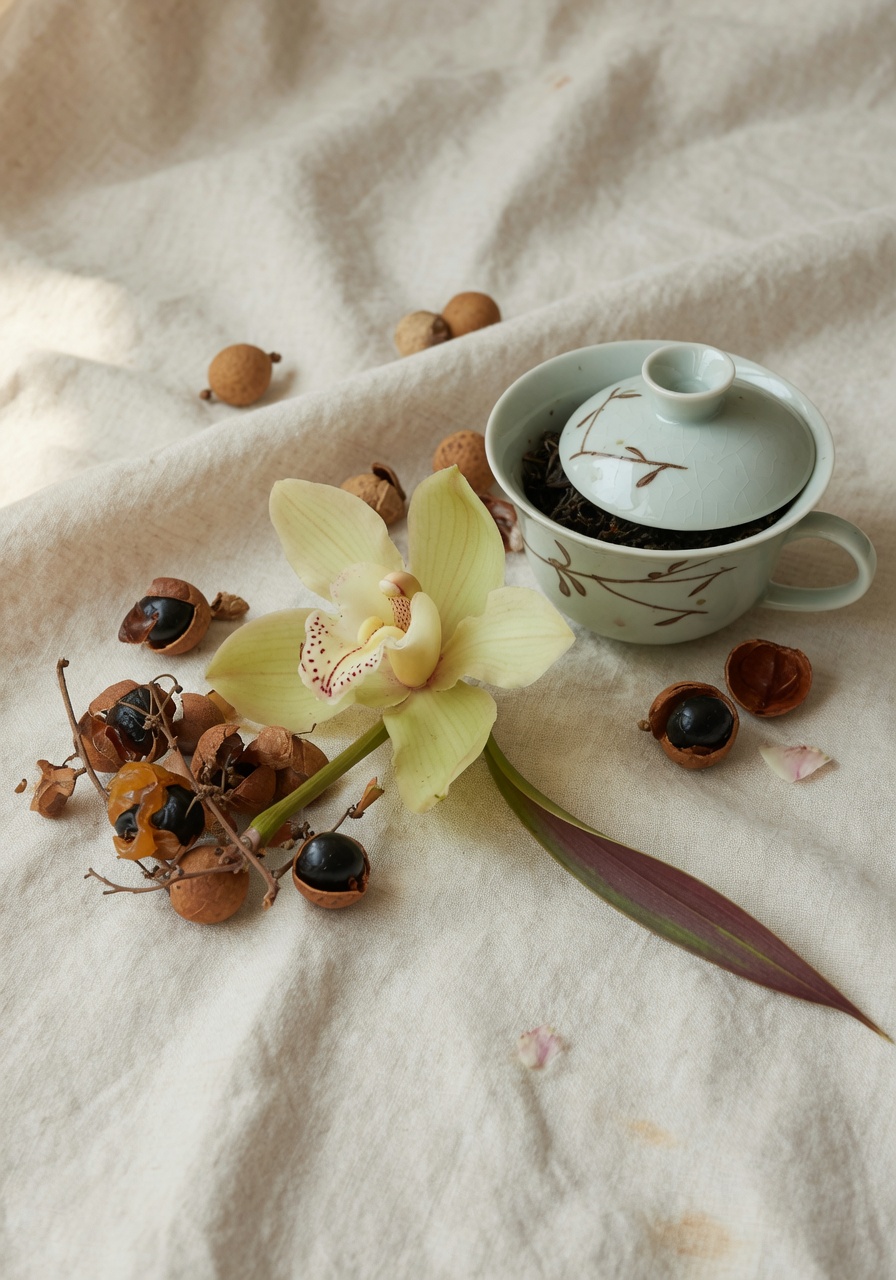
Orchid vs longan aroma — telling them apart
Two of the most over-used descriptors in Chinese tea evaluation sit only one nuance apart. This is a field guide to keeping orchid and longan distinct in your nose, your notes, and your scoring sheet.
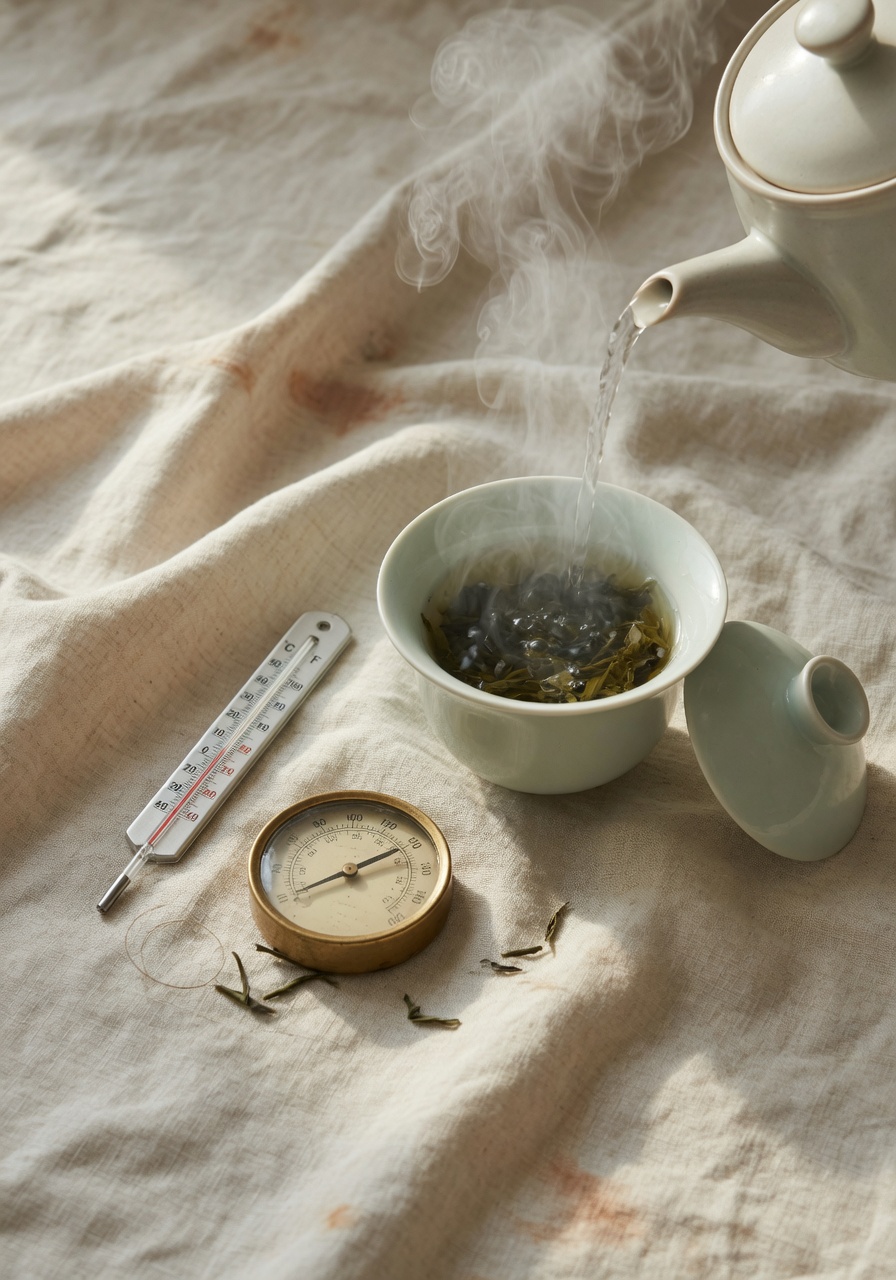
Temperature curves across the six categories of Chinese tea
Water temperature is not a single number — it is a curve that bends with leaf maturity, oxidation, and the steep you are on. A working map for green, yellow, white, oolong, red and dark tea.
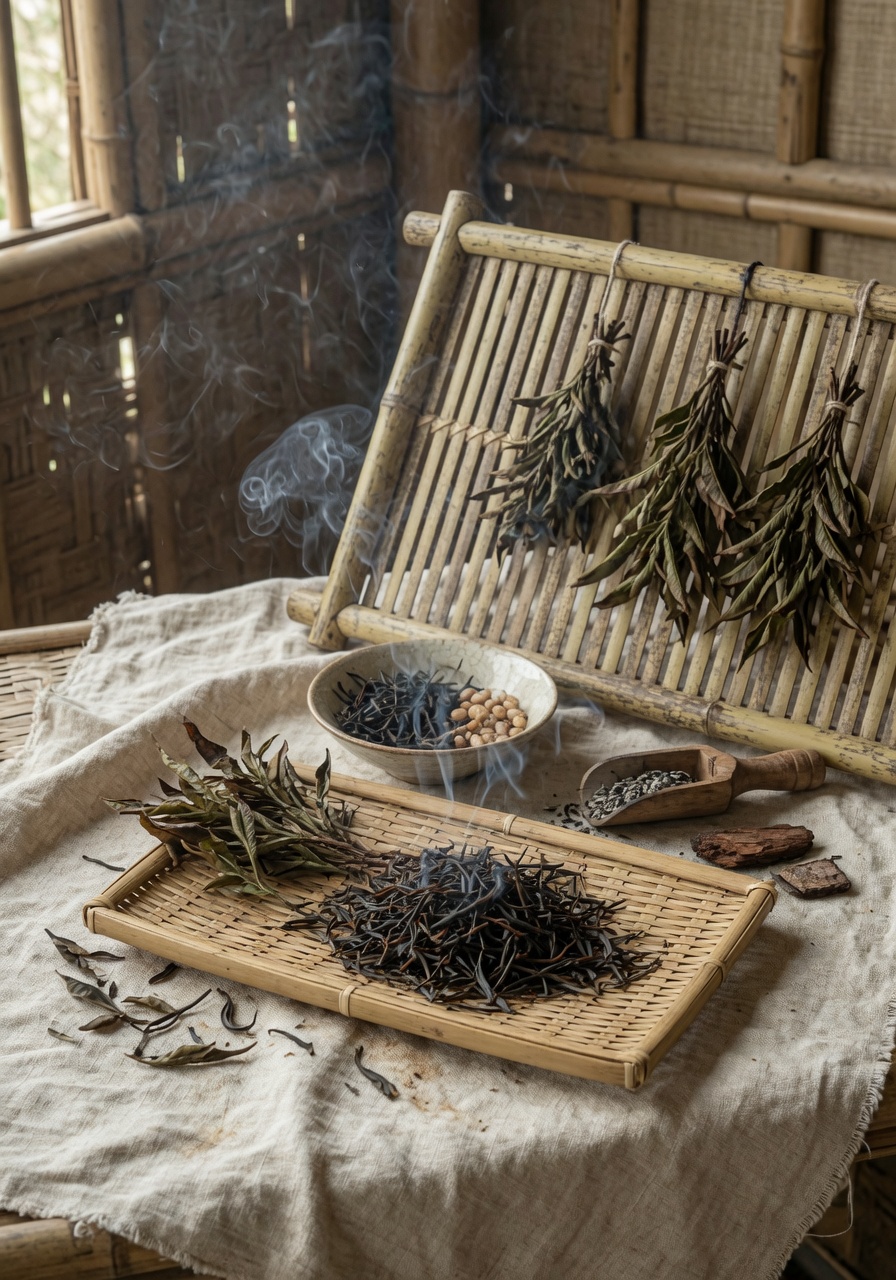
Smoky — defect or terroir character?
Wood smoke in the cup can mean a careless drying shed, a thunderstorm that forced the producer indoors, or a four-hundred-year tradition. The cupper's job is to tell which — and to score accordingly.