home · The named aromas that shape <em>Chinese tea</em> evaluation
Aroma vocabulary
Orchid vs longan aroma — telling them apart
Lán Xiāng yǔ Lóng Yǎn Xiāng · 兰香与龙眼香
Two of the most over-used descriptors in Chinese tea evaluation sit only one nuance apart. This is a field guide to keeping orchid and longan distinct in your nose, your notes, and your scoring sheet.
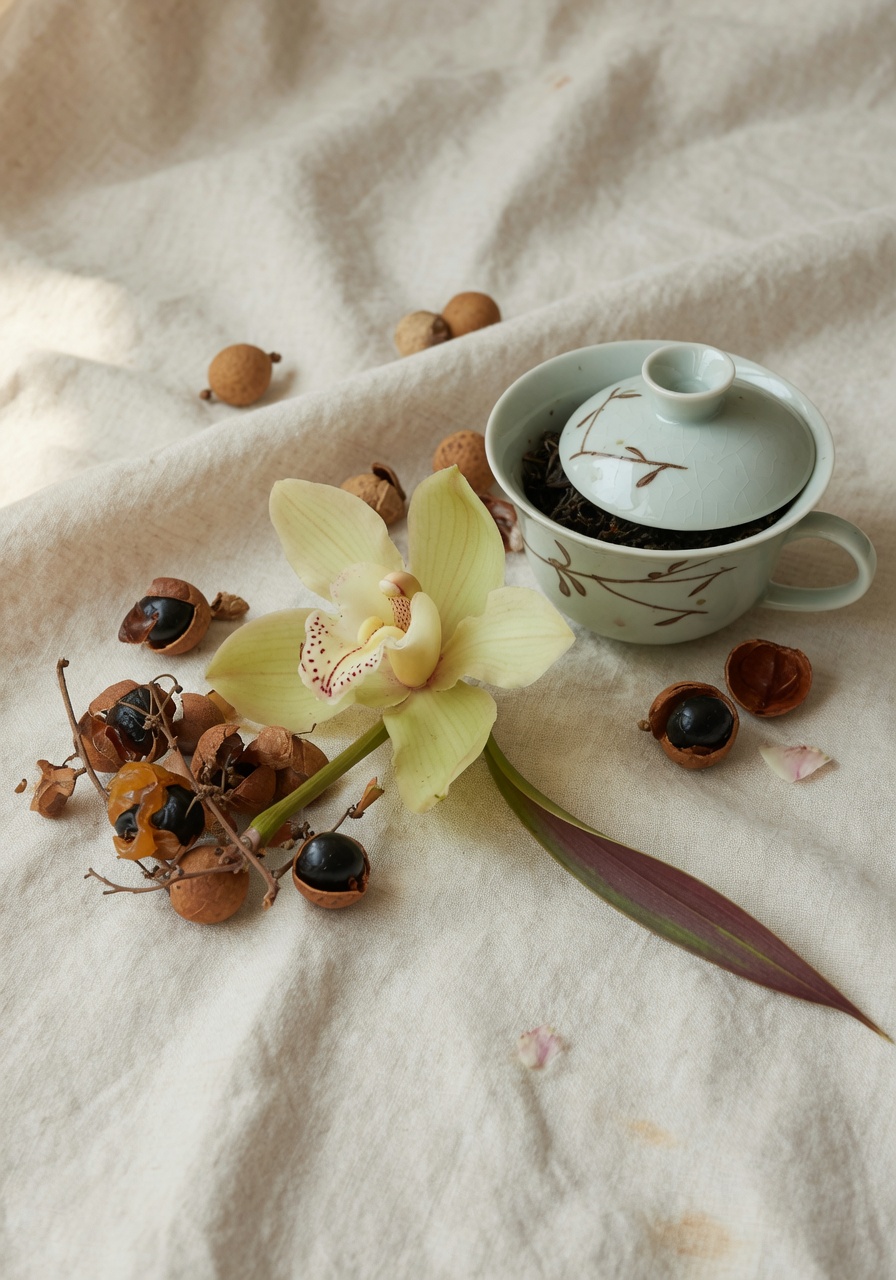
Of the named aromas a Chinese tea taster learns first — honey, smoke, mineral, wood, orchid, longan — the last two cause the most disagreement at the cupping table. Both are floral-adjacent. Both are sweet. Both appear in the lid-aroma (gài xiāng 盖香) of better Wǔyí oolongs and in the aged sweetness of certain white teas. And both have been used so loosely in marketing copy that the words have begun to lose their referent. When a buyer from Fúzhōu tells me a tea smells of lán xiāng and a buyer from Cháozhōu insists the same tea is lóng yǎn xiāng, neither is necessarily wrong — but one of them is using the word as a shorthand and the other as a precise sensory anchor.
This article is the disambiguation I wish someone had handed me in 2009, when I first sat the GB/T 23776 sensory exam in Guǎngzhōu and confused the two on the very first flight. We will pin each descriptor to a botanical reference, walk through the molecules behind them, and then run a side-by-side calibration using six readily available reference teas. By the end you should be able to score lán xiāng and lóng yǎn xiāng on the same wheel without flinching — and, more importantly, know when neither word applies and the correct answer is simply “sweet floral, unspecified”.
What the words actually point to
Chinese sensory vocabulary is anchored to real, physical reference objects, not to abstract aroma families. Lán xiāng — 兰香 — points to the scent of Cymbidium orchids, the slim-leafed terrestrial orchids cultivated in southern China since the Sòng dynasty, and most often to Cymbidium goeringii (春兰) and Cymbidium ensifolium (建兰). The reference is not the showy tropical Phalaenopsis of florist shops; it is a thin, cool, almost green-edged floral with a slight powdery undertone, the kind of scent that fills a small room from one stem and then disappears when you try to focus on it. Lóng yǎn xiāng — 龙眼香 — points to the dried fruit of Dimocarpus longan, the longan or “dragon eye”, a relative of lychee grown across Fújiàn, Guǎngdōng and Guǎngxī. The reference here is the dried fruit, not the fresh one: a warm, dark-honey sweetness with a slight smoky-caramel edge from the drying process, and a distinctly musky tail that fresh lychee does not have.
The two descriptors therefore differ on three axes at once. Orchid is cool, longan is warm. Orchid is green-floral, longan is brown-fruity. Orchid is volatile and fleeting, longan is heavy and persistent. If your note for a single tea includes both, you are almost certainly describing the arc of the cup over time rather than a single moment — and that arc is itself a useful observation, but it needs to be written down as two timestamps, not one descriptor.
The chemistry, briefly
The molecular picture matches the botanical one. Work by Wáng Yuèfēi and colleagues at the Tea Research Institute in Hángzhōu (2015) identified linalool, linalool oxides, methyl jasmonate and trace indole as the dominant volatiles driving orchid-type notes in Wǔyí rock oolongs. Linalool by itself is a generic floral; the orchid character emerges when linalool oxides II and III rise above roughly 8 % of the linalool fraction, which is typical in light-fire yán chá held at 90-110 °C charcoal for short sessions. Methyl jasmonate adds the cool, slightly green edge that drinkers identify as specifically orchid rather than rose or osmanthus.
Longan aroma sits in a different chemical neighbourhood. The drying process for longan fruit and the slow withering-plus-piling that produces longan-style notes in tea share a Maillard pathway: furanones (especially 4-hydroxy-2,5-dimethyl-3(2H)-furanone, the same compound responsible for cooked-strawberry notes), 2-acetylfuran, and small amounts of guaiacol contribute the warm, dark, slightly smoky sweetness. In aged white teas — Shòu Méi and Gòng Méi stored seven to fifteen years — the same furanone family rises measurably, which is why mature white tea is so often described as lóng yǎn tāng (longan soup). The chemistry tells us, fairly bluntly, that orchid is a fresh-leaf and gentle-heat phenomenon while longan is a time-and-Maillard phenomenon. You can taste this distinction directly; see our companion piece at tea.school on the temperature curves across the six categories of Chinese tea.
Where each note typically appears
Orchid is the signature lid-aroma of well-made Wǔyí oolong, particularly Shuǐ Xiān (水仙) from old bushes and the lighter-fire Ròu Guì (肉桂) styles. It appears as a top-note in Tiě Guān Yīn of the qīng xiāng (清香) style, and as the high-floral lift in single-bush Phoenix dāncōng — though in dāncōng the orchid is often subordinated to a more dominant fruit or honey note. In green tea, Tài Píng Hóu Kuí (太平猴魁) carries a quiet orchid in the lid aroma when brewed at 80 °C.
Longan turns up in three reliable places: well-aged white tea from Fúdǐng (seven years plus), traditional charcoal-roast Tiě Guān Yīn of the nóng xiāng (浓香) style, and certain Wǔyí oolongs given a medium-plus fire. It also appears as a secondary note in mature shēng pǔ’ěr after fifteen-plus years of humid storage, though there it competes with camphor and old-wood notes.
A side-by-side calibration flight
The fastest way to fix the two words in your memory is to taste them against each other on the same morning, with the same water, in two identical gàiwǎn. I run this flight every February with new staff at our Guǎngzhōu tasting room. You will need six teas: three for the orchid pole, three for the longan pole. Buy small — 25 g of each is enough.
For orchid, use a current-season light-fire Wǔyí Shuǐ Xiān (charcoal-roast, not electric), a qīng xiāng Tiě Guān Yīn from spring 2024 or later, and a single-bush Mì Lán Xiāng dāncōng — the dāncōng is included precisely because it sits on the boundary and trains your ear for the difference. For longan, use a 2017 or older Shòu Méi white from Fúdǐng, a nóng xiāng Tiě Guān Yīn with three or more rounds of charcoal, and a medium-fire Wǔyí Ròu Guì. Brew each at 5 g to 110 ml gàiwǎn, 100 °C water, with a 10-second first infusion and a 15-second second.
Smell the dry leaf, then the warmed empty cup, then the lid after the first pour, then the liquor itself, then the cooled cup. Write the aroma word that fits each of those five moments without looking at your neighbour’s sheet. On every flight I have run, new tasters mark orchid most reliably on the lid aroma and longan most reliably on the cooled cup — which already tells you something about volatility and where to look in your own practice.
The boundary case: Mì Lán Xiāng
Mì Lán Xiāng dāncōng (蜜兰香, “honey-orchid fragrance”) is the trap. The name contains lán but the dominant note in a well-made example is closer to longan or lychee honey than to cool orchid. The lán in Mì Lán Xiāng historically referred to the jiàn lán (建兰, Cymbidium ensifolium), which has a warmer, honeyed scent than the cooler chūn lán. So the cultivar name is not wrong, it is simply using the orchid word against the warm, honeyed reference rather than the cool one. When you score Mì Lán Xiāng on a wheel, mark it on the orchid spoke but note the modifier warm in your margin; otherwise your notes will contradict themselves six months later.
Where students most often confuse them
In our six-week sensory calibration programme the single most common confusion appears in week three, when students taste a 2019 Shòu Méi against a fresh qīng xiāng Tiě Guān Yīn. Both register as “sweet floral” on first pass. The diagnostic question I teach is: does the aroma feel cool or warm against the back of your throat after you swallow? Orchid leaves a cool, slightly minty trace. Longan leaves a warm, slightly drying trace, almost like the finish of a baked pastry. This is not poetry — it is a real thermoreceptive signal, mediated by different volatile groups, and it works reliably once you have tasted enough reference cups to anchor it.
Scoring on the sensory wheel
On the tea.degree 16+64 sensory wheel, lán xiāng sits in the inner ring under “floral” and resolves at the outer ring into three sub-spokes: cool orchid (chūn lán reference), warm orchid (jiàn lán reference), and orchid-mineral (the specific Wǔyí expression where orchid sits on top of the rocky yán yùn base). Lóng yǎn xiāng sits in the inner ring under “dried fruit” — not under floral — and resolves into fresh longan (rare, mostly in young white tea), dried longan (the canonical reference), and roasted longan (the heavier, smokier expression in nóng xiāng oolong).
The key scoring discipline is to never mark both poles on a single tea without a temporal note. If a tea shows orchid in the lid aroma and longan in the cooled cup — which is common in medium-fire Wǔyí — record that as two separate observations with their timestamps. The aggregate score for the tea is not “orchid plus longan equals complex”; it is “orchid at minute one, longan at minute four, transition score 8/10”. This is how the GB/T 23776-2018 sensory protocol handles it, and it is also how the cupping team at the Wǔyíshān Tea Institute records lid aromas in their archival sheets.
When neither word is the right answer
A discipline I impose on myself and my staff: if you cannot point to the specific reference object — the Cymbidium stem in the windowsill pot, the bag of dried longan from the Guǎngzhōu wholesale market — you do not get to use the word. The fallback vocabulary is wide enough to cover most cases without reaching for the named aromas. “Sweet floral, unspecified” is honest. “Honey-fruit, warm” is honest. “Floral but I cannot place it” is honest and tells the next reader of your notes far more than a forced lán xiāng.
The over-use problem is real. A 2022 audit by the China Tea Marketing Association of three hundred consumer-facing product pages on Tmall and JD found lán xiāng claimed on 71 % of oolong listings and lóng yǎn xiāng on 38 % of aged white tea listings, while blind sensory panels (n=12 trained tasters) confirmed the descriptor in only 23 % and 41 % of the same products respectively. The orchid word in particular has drifted into meaning “high-quality floral” rather than the specific cool-floral reference. As tasters we cannot fix the marketing, but we can refuse to let the drift into our own notes. If you want to see how this descriptor discipline carries over into other contested terms, our piece on whether smoke is a defect or a terroir character covers similar ground for the opposite end of the wheel.
A short reference library for your shelf
To anchor the words, keep physical references near your tasting station. For orchid: a small pot of Cymbidium goeringii if your climate allows, or a sealed jar of dried orchid petals from a Chinese herbal supplier (search 春兰花干). Open the jar, smell, close. For longan: a 250 g bag of dried longan fruit (桂圆干) from any Asian grocer — keep it sealed and refrigerated, and pull a single fruit when you need to recalibrate.
For tea references, I recommend rotating three teas every six months so the references stay current with the season. My current set, as of spring 2024, is a Zhèng Yán Shuǐ Xiān from Niú Lán Kēng for orchid, a 2016 Shòu Méi cake from Fúdǐng Yǒuyì for longan, and a medium-fire Ròu Guì from Mǎ Tóu Yán as the boundary case where both notes appear in sequence. The shop side of the constellation — shop.thetea.app — carries comparable reference lots when ours run out, and the tea.school calibration modules use the same set so that scores transfer between platforms.
Keep your reference notes dated. Aroma memory is shorter than people admit; a descriptor anchored in February drifts by August unless you re-smell the reference. Two minutes a week is enough. This is the same discipline as the six-week calibration programme, scaled down to maintenance.
References
- GB/T 23776-2018 — Methodology for sensory evaluation of tea — Standardization Administration of the People's Republic of China
- Aroma constituents of Wǔyí rock tea: linalool oxide ratios and floral character — Wáng Yuèfēi et al., Journal of Tea Science, Vol. 35 No. 4, 2015
- Volatile profile of aged white tea from Fúdǐng — Lín Zhì et al., Food Chemistry, Vol. 289, 2019
- Consumer claim audit of oolong and white tea product listings — China Tea Marketing Association internal report, 2022
- Cymbidium species in classical Chinese horticulture — Chén Xīnqǐ, Orchids of China, Science Press Beijing, 2009
- Cupping archive — Wǔyíshān Tea Research Institute — Wǔyíshān Tea Research Institute, March 2023
Read next
Related articles
A six-week sensory calibration programme
Six weeks, six reference teas, one notebook. A structured programme to align your tasting scale to the GB/T standard — and to the cuppers who set it.
Smoky — defect or terroir character?
Wood smoke in the cup can mean a careless drying shed, a thunderstorm that forced the producer indoors, or a four-hundred-year tradition. The cupper's job is to tell which — and to score accordingly.
Temperature curves across the six categories of Chinese tea
Water temperature is not a single number — it is a curve that bends with leaf maturity, oxidation, and the steep you are on. A working map for green, yellow, white, oolong, red and dark tea.
Huígān — the returning sweetness, scored
The sweetness that arrives after the tea is gone is the most discussed and least defined sensation in Chinese tasting rooms. Here is how to anchor it on a 10-axis rubric.