home · Four <em>dials</em>, one cup — calibrating the brew
Brew variables
Temperature curves across the six categories of Chinese tea
Liù dà chá lèi · shuǐ wēn qū xiàn · 六大茶类 · 水温曲线
Water temperature is not a single number — it is a curve that bends with leaf maturity, oxidation, and the steep you are on. A working map for green, yellow, white, oolong, red and dark tea.
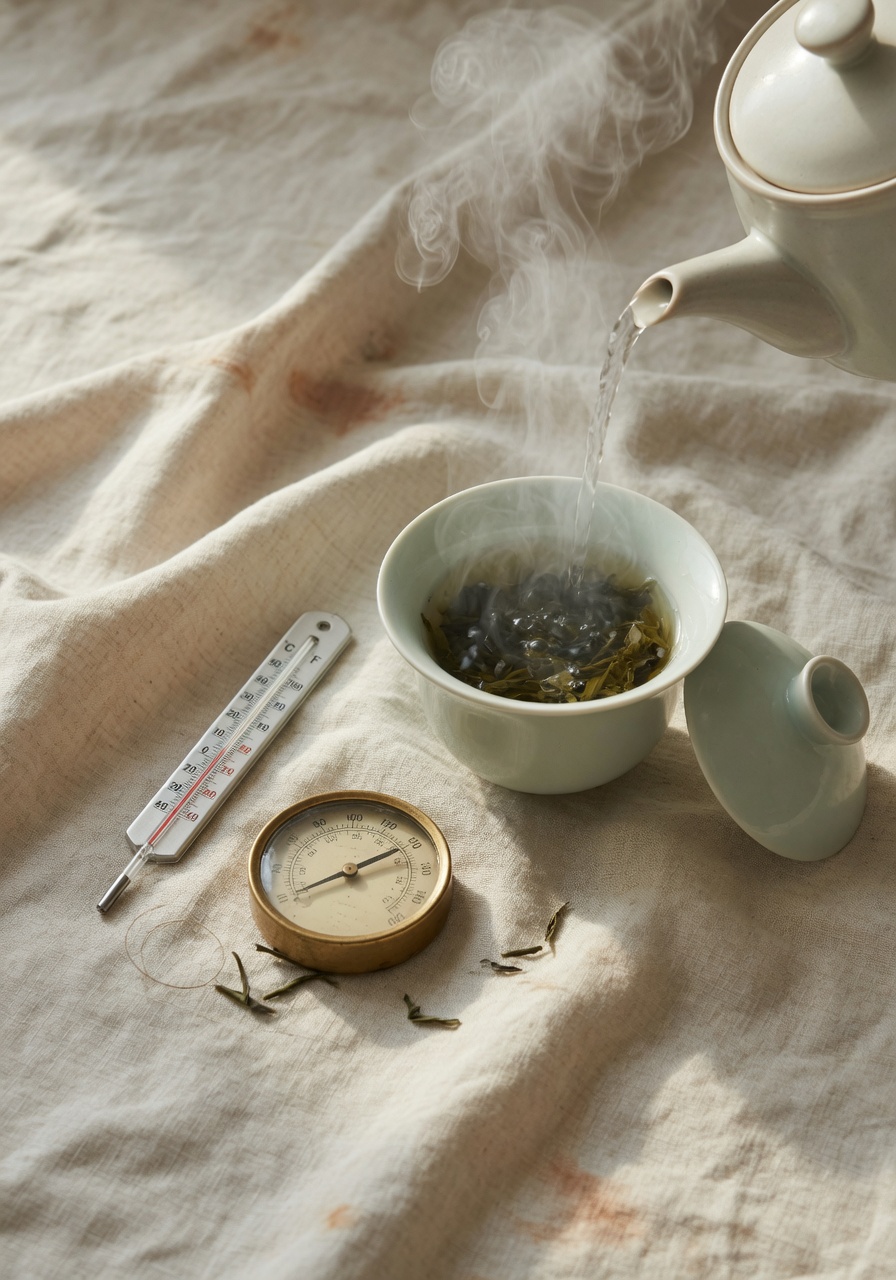
Most brewing charts you find online give one number per tea — 80 °C for green, 95 °C for oolong, boiling for pǔ’ěr — and stop there. That is the temperature you start at. It is rarely the temperature you should still be using by the fourth infusion. In professional cupping rooms, and in the back-of-house at any serious tea house in Chaozhou or Wuyi, brewers are tracking a curve: an initial pour calibrated to the leaf, then incremental adjustments as the leaf opens, as soluble compounds shift from catechins and amino acids toward heavier polysaccharides and woody phenolics. Get the curve right and you extract sweetness without bitterness, aroma without astringency, body without flatness. Get it wrong and even a 2008 Bānzhāng will taste like wet cardboard. This article is a working map of those curves across the six Chinese categories defined by GB/T 30766-2014 — lǜ chá (green), huáng chá (yellow), bái chá (white), qīng chá (oolong), hóng chá (red), and hēi chá (dark, including pǔ’ěr). I have brewed each category in side-by-side temperature ladders for the past nine years at our Xinyang and Shenzhen labs, recording TDS, pH, and a 10-axis sensory score for every cup. What follows is the distillation. Not rules — starting points. The instrument that matters is your palate, and the only way to calibrate it is the same way we calibrate a thermometer: against a known reference, repeatedly. For the protocol behind that calibration, see the six-week programme on tea.school.
Why temperature is a curve, not a number
A dry leaf at 25 °C and a fully unfurled leaf on its fifth infusion are, chemically, almost different materials. The first pour extracts what sits closest to the cell surface — free amino acids, caffeine, the lightest aromatic volatiles. By the third or fourth infusion, those reservoirs are depleted, and the brewer is pulling on heavier, less soluble compounds: theaflavins, polymerised polyphenols, cell-wall polysaccharides that contribute body and huígān. Each of these has a different extraction threshold. L-theanine dissolves readily at 70 °C. EGCG hits peak extraction near 85 °C but turns bitter above 90 °C in young green leaves. Theaflavins in a fully oxidised hóng chá require sustained heat above 92 °C to break out of the rolled leaf. This is why a single fixed temperature is always wrong for at least half the infusions. The curve is the answer — start where the delicate compounds extract cleanly, climb as the robust compounds become the target. In the sections that follow, each category has its own shape of curve, dictated by leaf maturity at picking, degree of oxidation, and processing heat history. A Bái Háo Yín Zhēn (白毫银针) made entirely of unbroken silver buds has a flatter curve than a Shòu Méi (寿眉) made of mature autumn leaf, even though both are white tea. Read the leaf, then read the curve.
Green tea — the descending caution curve
Chinese green tea is the most temperature-sensitive of the six categories because the kill-green step (shā qīng) preserves the catechins almost intact. Push the water too hot and those catechins flood the cup, oxidising into the bitter, drying brassiness every beginner knows. The curve here is unusual: it starts low and stays low, with only modest increases across infusions. For tender, bud-heavy teas like Bì Luó Chūn (碧螺春) or pre-Qingming Lóngjǐng (龙井), I start at 75 °C — sometimes 72 °C for the first 10-second rinse-and-drink. By infusion three or four, when the leaves have fully relaxed and the amino-acid reservoir is exhausted, I push to 82 °C, never higher.
Bud-grade vs leaf-grade greens
A bud-grade green like Xìnyáng Máojiān (信阳毛尖) from our home county in Henan demands the gentlest hand — 72-78 °C across five infusions, with a long, slow pour against the wall of a tall glass or a wide gàiwǎn. A leaf-grade green like Liù’ān Guāpiàn (六安瓜片), made from the second leaf with the bud removed, tolerates 85 °C from the start because the heavier cuticle protects against flash extraction. The same logic applies to Tài Píng Hóu Kuí (太平猴魁) with its long, flat leaves — 85 °C is reasonable, and the leaf survives it.
The Xinyang protocol
In our Xinyang cupping room we use a three-step ladder for any unknown green: 75 °C / 78 °C / 82 °C across three 30-second infusions. If the cup at 75 turns out empty and the cup at 82 turns out bitter, the tea is either over-fired in production or past its prime. If 78 sings, the tea is well-made and the brewer has found the sweet spot. This protocol is borrowed almost directly from the GB/T 23776-2018 sensory evaluation standard, adapted for narrow-bore gàiwǎn rather than the official 150 ml cup.
Yellow tea — green’s quieter cousin
Yellow tea (huáng chá) is processed almost identically to green, with one added step: the mèn huáng smothering, a slow non-enzymatic yellowing under cloth or paper that mellows the catechins and converts some chlorophyll. The result is a tea that tolerates slightly more heat than its green cousin, because some of the most aggressive astringents have already been softened in processing. For Jūnshān Yínzhēn (君山银针) from Hunan or Méng Dǐng Huáng Yá (蒙顶黄芽) from Sichuan, I start at 80 °C and climb to 85 °C by the fourth infusion. The aroma I am chasing is a soft toasted-grain note — morning rice porridge with a sliver of chestnut — and that note vanishes if you go above 88 °C. Yellow tea is rare enough that most brewers never calibrate it properly; the default is to treat it like green and underextract. Push it half a notch higher than you think and the mèn huáng character emerges.
White tea — the bimodal curve
White tea is the category where blanket advice does the most damage. The same shop will sell you a fresh-spring Bái Háo Yín Zhēn and an eight-year-aged Shòu Méi cake and tell you to brew both at 90 °C. They are different teas. Fresh Yín Zhēn, all unbroken buds with intact down, wants 80-85 °C across early infusions, climbing to 90 by infusion six when the buds are fully open. Aged white tea, especially pressed cakes that have undergone slow post-fermentation, wants boiling water from the first pour — or even simmering in a clay kettle for ten minutes for the oldest cakes.
Fresh white — the gentle climb
Fresh Yín Zhēn from the Fúdǐng white-tea villages of Fujian brews in a tall glass at 82 °C, three minutes, no agitation. You are watching the buds stand up: if the water is too hot they collapse and the cup turns vegetal, and if too cold the down stays attached and the aroma never releases. For Bái Mǔdān (白牡丹) made from bud-and-two-leaves, push to 88 °C — the leaves can take it, and the flavonol glycosides that give mǔdān its honeysuckle note extract better in that range.
Aged white — boiling is the floor
An aged Shòu Méi cake from 2015 or earlier brewed at 90 °C will taste like nothing — flat, papery, vaguely sweet. The same cake at 100 °C, in a thin-walled silver kettle, releases dates, dried longan, a touch of camphor on the back palate. For cakes older than ten years, I move to boiling-simmer in a zhū ní clay pot, holding 95-98 °C over a candle warmer through six or seven small cups. This is closer to the way our colleagues at puerh.app brew aged shēng than to anything in the white-tea playbook.
Oolong — the high-heat plateau
Oolong is where temperature finally stops being scary. Between 30 % and 70 % oxidation, with leaves that have been bruised, oxidised, kill-greened and often charcoal-roasted, oolong has been engineered to receive boiling water and give back aroma. The curve here is almost a plateau: 95-100 °C from the first pour to the last. The variable is not temperature but the way water hits the leaf — height of pour, force of contact, dwell time.
Dāncōng and the boiling-water doctrine
For Dāncōng (单丛) from the Phoenix Mountain region in Guangdong the rule is uncompromising: you brew at 100 °C or you do not brew at all. Anything less and the mì lán xiāng (蜜兰香), the honey-orchid note, stays locked in the leaf. The vessel is a thin porcelain gàiwǎn, pre-heated twice, with the first infusion timed at exactly six seconds. The temperature curve is flat at boiling across eight or nine infusions; what changes is dwell — 6 s, 4 s, 5 s, 8 s, 12 s, 20 s, 35 s, 60 s, 120 s. This is the curve that matters for Dāncōng, not the temperature.
Tiě Guānyīn and the modern lighter style
Modern green-style Tiě Guānyīn (铁观音), oxidised only 20-25 %, is the exception to the oolong plateau rule. It behaves more like a green tea in some respects and benefits from 90-92 °C rather than full boiling, especially on the first two infusions, where boiling water can flash-extract a metallic note from the underdeveloped oxidation profile. Traditional charcoal-roasted Tiě Guānyīn is back on the plateau — 100 °C, every infusion.
Red tea (hóng chá) — the rising curve
Fully oxidised tea — what the West calls black, what China calls red — is built for heat, but the curve climbs rather than plateaus. The first infusion at 88-90 °C produces a soft, malty cup with the lightest aromatic top notes; by infusion four or five, I am at 95-98 °C, pulling out the theaflavin body and the cocoa-and-longan depth. This rising shape is the opposite of the green-tea descending-caution curve. For a Wuyi Zhèng Shān Xiǎo Zhǒng (正山小种) with pine-smoke processing, I start cooler still — 85 °C — to let the smoke integrate rather than dominate, then climb steeply. For an unsmoked Jīn Jùn Méi (金骏眉), bud-only and delicate despite full oxidation, I stay between 88 and 92 °C throughout. The standard reference here is GB/T 13738.2-2017 for gōng fū black tea sensory evaluation, which specifies 100 °C for the official cup — a number designed for stress-testing, not for drinking pleasure. In the cup you actually want to drink, 92-95 is the sweet spot.
Dark tea and pǔ’ěr — the boiling baseline
Hēi chá — Liubao, Anhua, Fu brick, and the pǔ’ěr family — has undergone microbial fermentation, either the slow pile-fermentation of shú pǔ’ěr or the decades-long ageing of shēng pǔ’ěr. The leaves are compressed, often coarse, and the aromatic compounds you want are largely inaccessible below 95 °C. The curve is essentially flat at boiling, though young shēng breaks this rule.
Young shēng — the only dark-tea exception
A young shēng cake under three years old still behaves partly like a green tea. The catechins have not yet polymerised; the bitterness is sharp and immediate. Young shēng brews best at 90-93 °C for the first three infusions, climbing to 98 °C only once the leaf has fully opened and the worst of the bitterness has been rinsed through. This is closer to oolong protocol than to shú protocol. By year seven or eight, the same cake will tolerate boiling from the first pour.
Shú and aged shēng — the kettle on the stove
For shú pǔ’ěr and shēng over fifteen years old, boiling is not just acceptable — it is required. The wet-pile fermentation of shú creates dense polysaccharide complexes that simply will not dissolve below 95 °C. I keep a thin-walled iron kettle on a low flame and pour at a true rolling boil for the first three infusions of any aged cake. The cup that comes back is thick, sweet, with the unmistakable returning sweetness covered in our piece on huígān. Below 95 °C, that same cake yields a thin, vaguely earthy liquor that gives the category its undeserved bad reputation.
Building your own curve — a calibration protocol
The fastest way to internalise these curves is to brew the same tea three times in a single sitting at three different temperatures, holding everything else constant — same leaf weight (5 g for a 110 ml gàiwǎn), same water source, same vessel, same timing (10 s first infusion, +5 s each subsequent). Take notes on a 10-axis score sheet: aroma intensity, aroma type, body, sweetness, bitterness, astringency, huígān, finish length, balance, defects. Do this with one tea per week for six weeks, picking one tea from each of the six categories plus a sixth of your choice. By the end you will have a personal map that overrides any chart, including this one. The full protocol, including reference teas and the scoring template, is published on tea.school as the six-week calibration programme. For tools — the wheel, the radar overlay, the blind-card scoring app — see the rest of tea.degree. Temperature is one variable. Read it well and the other three — leaf, time, vessel — fall into place.
References
- GB/T 30766-2014 Classification of tea — Standardization Administration of China
- GB/T 23776-2018 Methodology of sensory evaluation of tea — Standardization Administration of China
- GB/T 13738.2-2017 Black tea — Part 2: Gōng fū black tea — Standardization Administration of China
- Tea: Bioactivity and Therapeutic Potential — Yong-su Zhen (ed.), Taylor & Francis, 2002 — chapters on catechin extraction kinetics
- Chaozhou gōng fū brewing methodology — field interviews 2019-2023 — Phoenix Mountain field notes, internal Teamotea archive
- Xinyang Máojiān processing and brewing protocols — Henan Tea Research Station working papers 2017-2024
Read next
Related articles
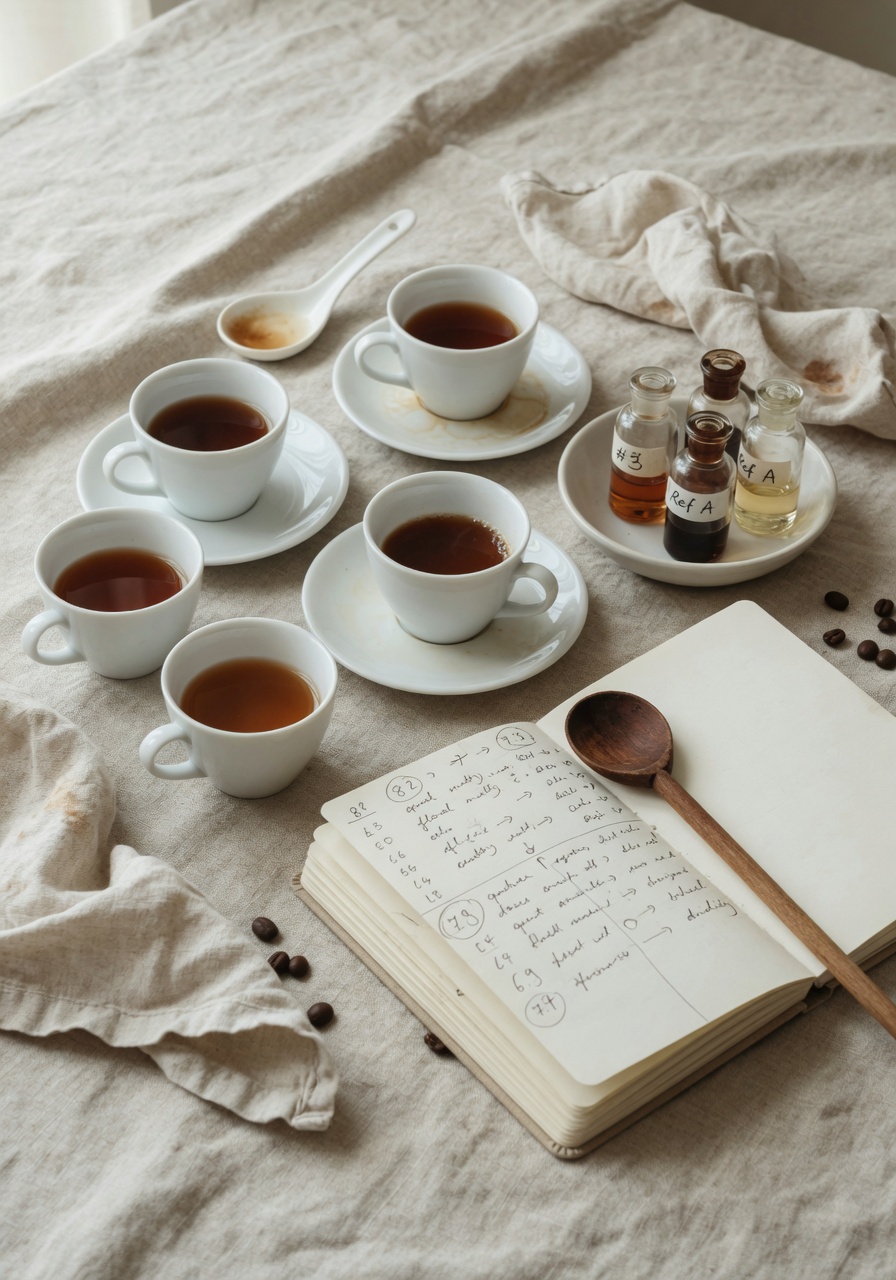
A six-week sensory calibration programme
Six weeks, six reference teas, one notebook. A structured programme to align your tasting scale to the GB/T standard — and to the cuppers who set it.
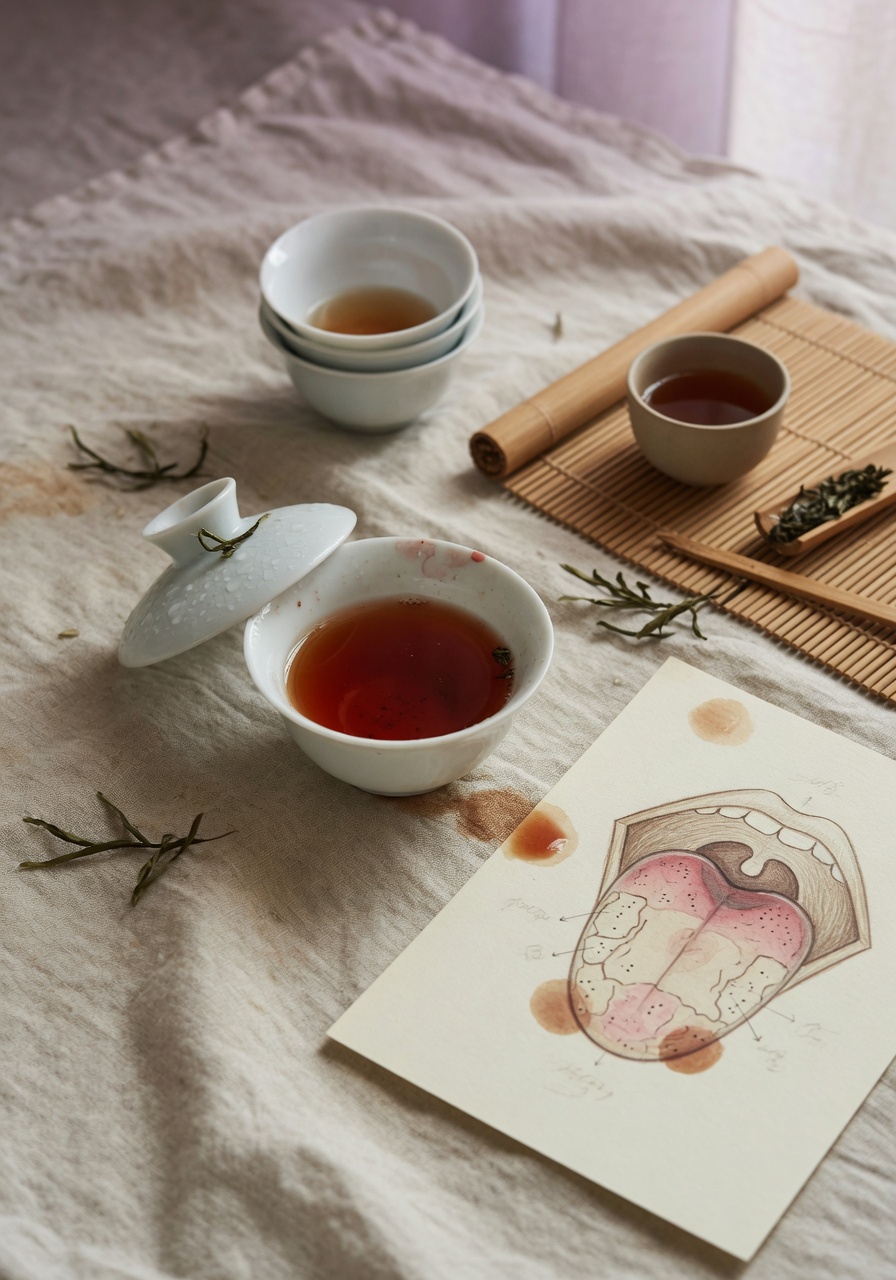
Huígān — the returning sweetness, scored
The sweetness that arrives after the tea is gone is the most discussed and least defined sensation in Chinese tasting rooms. Here is how to anchor it on a 10-axis rubric.
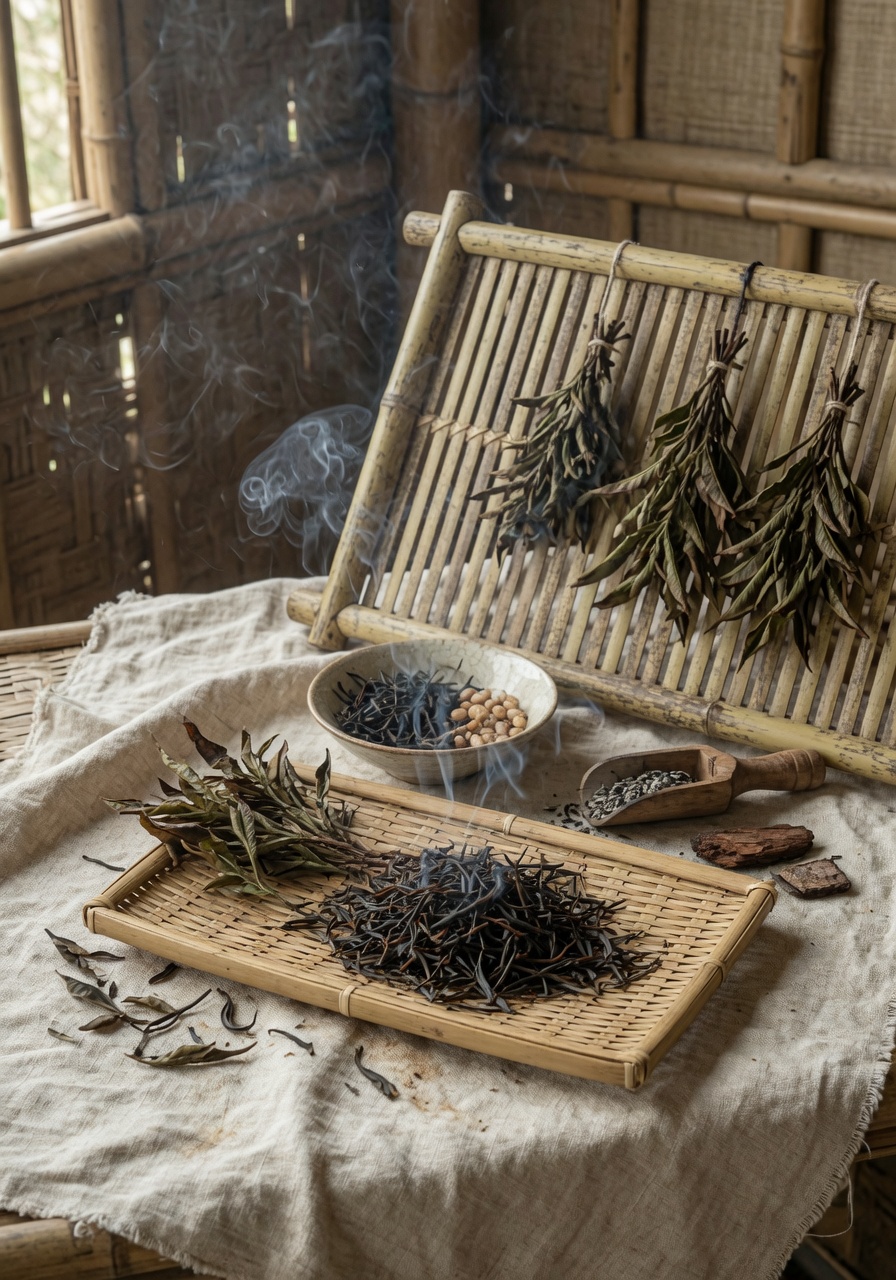
Smoky — defect or terroir character?
Wood smoke in the cup can mean a careless drying shed, a thunderstorm that forced the producer indoors, or a four-hundred-year tradition. The cupper's job is to tell which — and to score accordingly.
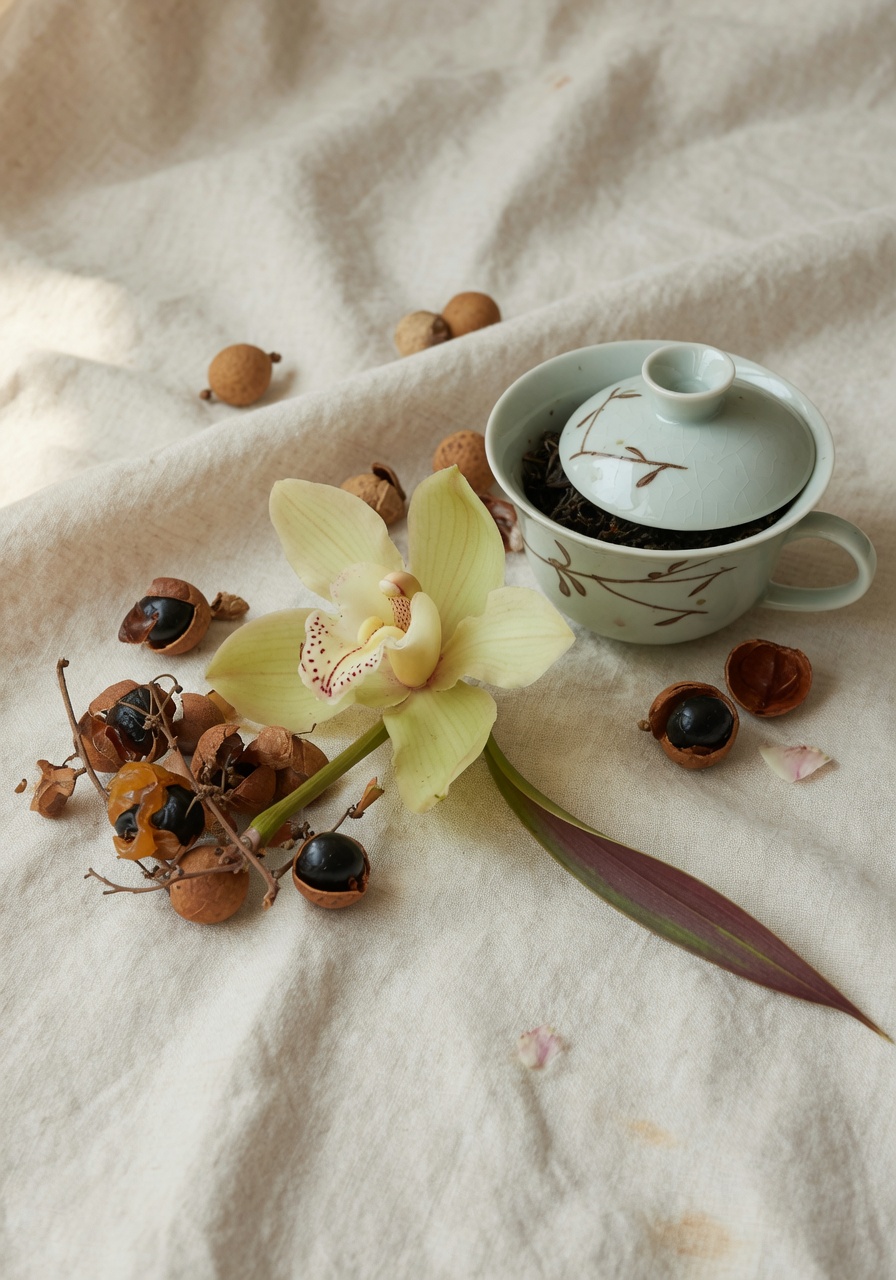
Orchid vs longan aroma — telling them apart
Two of the most over-used descriptors in Chinese tea evaluation sit only one nuance apart. This is a field guide to keeping orchid and longan distinct in your nose, your notes, and your scoring sheet.