home · Reading the <em>off-notes</em> — a sommelier's defect lexicon
Common defects
Smoky — defect or terroir character?
yān xūn wèi · 烟熏味
Wood smoke in the cup can mean a careless drying shed, a thunderstorm that forced the producer indoors, or a four-hundred-year tradition. The cupper's job is to tell which — and to score accordingly.
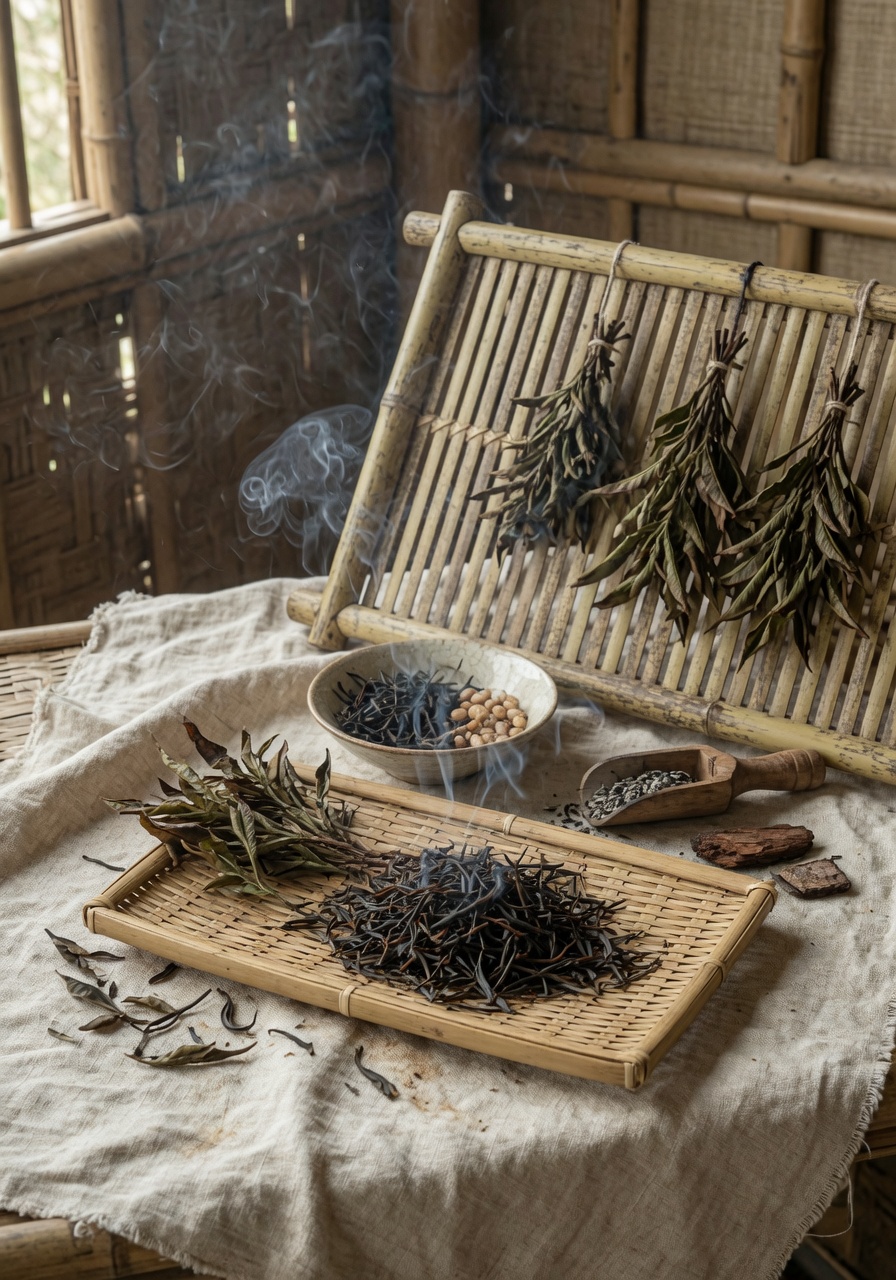
Smoke is the most argued-about note on the Chinese tea table. A judge in a Fujian competition hall in May 2023 disqualified an entire flight of Zhèng Shān Xiǎo Zhǒng (正山小种) because three of seven cups showed pine smoke — yet the producer, a fourth-generation Tóngmù villager, had used pine in the qīnglóu (青楼) drying loft exactly as the standard for the protected origin requires. Two hundred kilometres east, in Anxi, a different judge that same week downgraded a Tiě Guān Yīn (铁观音) by four points for a smoke note worth less than a third of what the Tongmu lot carried — and that decision was correct. The same descriptor, the same intensity on the nose, two opposite verdicts. This article is about how a tea expert separates smoke-as-terroir from smoke-as-fault. We will work through the chemistry (guaiacol, syringol, 4-methylguaiacol), the processing intent (designed pine smoke versus accidental contamination), the regional protected-origin rules, and the way the 10-axis scoring rubric on tea.degree handles the distinction in practice. The frame matters because smoky is the one defect descriptor that, mis-applied, gets a perfectly orthodox tea marked down — and, missed, lets a genuinely faulty lot pass.
What smoke actually is, chemically
Smoke in tea is a small family of phenolic compounds — primarily guaiacol (2-methoxyphenol), 4-methylguaiacol, syringol, and 4-vinylguaiacol — produced when lignin in wood breaks down between 200 °C and 400 °C. They are extraordinarily potent: guaiacol has an odour threshold in water around 3 µg/L, which means a few micrograms per litre of infusion is enough for a trained nose to flag the note. The compounds are also stable; they survive months of storage, transport through plastic, and the second and third infusions of a Gongfu session almost unchanged. This is why a smoke note, once introduced, cannot be “aired out” of finished tea. The 2019 study by Wang and colleagues at the Tea Research Institute of CAAS in Hangzhou measured guaiacol levels of 180–340 µg/kg in authentic Zhèng Shān Xiǎo Zhǒng from Tongmu, against 8–22 µg/kg in unsmoked Wuyi black teas from the same season. The signal-to-baseline ratio is roughly twenty to one. A judge who tastes through enough samples builds an internal threshold near the lower end of that range — and that calibration is what the six-week programme on tea.school tries to drill in.
Pine versus mixed hardwood
Not all wood smoke smells the same. Pine (松木, sōngmù) — specifically Pinus massoniana, the resinous Masson pine native to Fujian — carries more terpene-derived notes alongside the phenols: a sweet, slightly camphorous edge that drinkers describe as longan, dried apricot, or campfire candy. Cypress, oak, and bamboo give cooler, drier, more medicinal smoke profiles dominated by syringol. When a tea smells of cold ash, burnt rubber, or carbonised paper, the source is almost never deliberate pine — it is overheated drying machinery, a charcoal basket that flared, or environmental contamination from a neighbouring kitchen. Learning to discriminate pine resin from generic char is the first practical skill a smoke cupping demands.
When smoke is the tea — designed pine-smoke traditions
Three Chinese teas carry smoke as part of their protected identity. The first and most famous is traditional Zhèng Shān Xiǎo Zhǒng from the Tongmu protected origin zone in Wuyishan, Fujian — the original black tea, recognisably smoked since at least the early Qing. The qīnglóu, a three-storey wooden drying tower, holds leaf above smouldering pine for 8–12 hours of withering and again during final drying; guaiacol levels build to the 200–300 µg/kg range described above. The second is Xiǎo Zhǒng Hóng Chá (小种红茶) made outside Tongmu using the same method — legally a different category since the 2009 GI registration but sensorially similar. The third, less discussed outside China, is certain rough-leaf Liù Bǎo Chá (六堡茶) from Guangxi, where pine smoke from charcoal-basket drying was historically used to repel insects during the long river journey to Southeast Asian tin miners. For these teas, an absence of smoke is a defect — a sign that the producer skipped the guò hóng huǒ (过红火) finishing step to save labour. On the tea.degree rubric, you score the smoke note for cleanliness, integration, and persistence into the huígān, not for presence or absence.
The Tongmu standard, on paper
GB/T 13738.1-2017, the Chinese standard for gōngfū hóng chá (工夫红茶) and xiǎo zhǒng hóng chá, lists “pine smoke aroma, pure and lasting” (松烟香纯正持久) as a positive sensory descriptor for the Zhèng Shān Xiǎo Zhǒng category, scored within the aroma section worth 25 of 100 total points. The standard explicitly distinguishes this from “焦烟” (jiāo yān, scorched smoke) and “杂烟” (zá yān, off-smoke), both of which appear in the defect column. A cupper trained only on the Western descriptor “smoky” misses this three-way split entirely, which is why translation work — the kind we maintain in the tea.degree vocabulary library — matters.
Lapsang for export, lapsang for home
Most lapsang sold abroad is not Tongmu — it is heavily smoked outside-zone tea made for the European palate that came to expect the note in the 19th century. Authentic Tongmu Zhèng Shān Xiǎo Zhǒng sold inside China is now often the unsmoked wú yān (无烟) version, since domestic drinkers since around 2005 have preferred the longan-honey profile without the campfire. The same producer may make both styles in the same week. When you write smoke into a tasting note, identify the lot: producer, village, year, smoked or unsmoked. Without that context, the descriptor is unreadable.
When smoke is a defect — the four common causes
Outside the three traditional smoked categories, a smoke note is almost always a process or storage fault. In two decades of cupping work across Guangdong and Fujian I have logged the cause in roughly four hundred defective lots; the distribution falls into four bins. First, overheated shāqīng (杀青) — the kill-green pan or rolling drum running above 280 °C, scorching leaf surfaces before enzymes are properly denatured. The result is a flat, ashy smoke with a hard bitterness that does not return as huígān. Second, charcoal-basket flare-up during bèihuǒ (焙火) roasting — common in low-grade Wuyi rock tea and Dancong when an inexperienced operator lets the charcoal core breathe oxygen. The note here is sharper, more acrid, often paired with a burnt-sugar undertone. Third, contaminated drying space — tea dried in a room shared with cooking, heating stoves, or a tobacco-smoking worker. The smoke here is incoherent: cigarette tar, cooking oil, or kerosene depending on source. Fourth, fire damage in storage — a warehouse fire kilometres away can taint an entire season’s báichá (白茶) cake through plastic wrapping, because phenolic compounds migrate freely. Each cause has a sensory signature, and learning to back-trace from cup to cause is the practical skill that separates a description from a diagnosis.
The white tea problem
White tea is the category most often ruined by smoke, because Bái Háo Yín Zhēn (白毫银针) and Bái Mǔdān (白牡丹) rely on long, low-temperature withering — 36 to 72 hours in open-air lofts where any nearby combustion source can taint the leaf. A 2018 incident in Fuding, documented in the Fujian Tea Industry Association annual report, saw twelve tonnes of premium yín zhēn downgraded after a neighbour’s barbecue restaurant operated for three weeks fifty metres upwind of an unsealed drying shed. The smoke note on the finished tea was faint — perhaps 15 µg/kg guaiacol — but unmistakable against the cucumber-melon baseline of good yín zhēn. For white tea, the threshold of “defect” sits much lower than for black tea, because there is no roast or smoke profile to absorb it.
Scoring smoke on the 10-axis rubric
On the tea.degree scoring rubric, smoke does not have its own axis. It is scored across three: aroma cleanliness, aroma complexity, and finish integration. For an unsmoked category — a green Lóngjǐng (龙井), a yellow Jūnshān Yínzhēn (君山银针), an Anxi Tiě Guān Yīn — any perceptible smoke reduces aroma cleanliness by 1–3 points on the 10-scale, depending on intensity. For a traditional smoked category, you instead score whether the smoke is pure (clean pine, no scorch, no foreign char) and integrated (sitting underneath the fruit and malt, not sticking out like a chimney). A Tongmu lot with thin, harsh smoke loses points for poor integration even though smoke is expected. The blind tasting mode on tea.degree exists partly to defend judges from this trap: when the label is hidden, you cannot lazily score “smoke = defect” or “smoke = OK” by category. You have to actually decide whether the cup hangs together. A useful exercise is to cup an authentic Tongmu against an outside-zone lapsang and a defective Wuyi rock tea blind, side by side; the three smokes are distinct within ten seconds if you are calibrated.
Vocabulary discipline
The vocabulary library on tea.degree separates “pine smoke” (松烟, sōng yān), “scorched” (焦, jiāo), “ashy” (灰, huī), “acrid” (刺鼻, cìbí), and “tainted” (串味, chuàn wèi). Writing “smoky” as a single undifferentiated tag in a tasting note is the equivalent of writing “fruity” — true but useless. Every cupping form we publish requires the source-coded term: which kind of smoke, at what intensity (faint / present / dominant), and at what phase (dry leaf / wet leaf / liquor / empty cup).
A practical decision tree
When you encounter smoke in the cup, work through five questions in order. One: what category of tea is this, and does the protected-origin standard list smoke as a positive descriptor? If yes — proceed to evaluate quality of smoke. If no — proceed to fault diagnosis. Two: is the smoke pine-resinous (sweet, longan-tinged) or char-like (ashy, acrid, dry)? Pine in a smoked category is on-style; char in any category is fault. Three: does the smoke integrate with the body of the tea, or sit on top as a separate layer? Integration is a function of skilled drying and adequate resting time after processing — usually 60–90 days for Tongmu black tea. Four: does the smoke carry into the huígān, or does it cut the returning sweetness off? A well-made smoked tea returns sweet through the smoke; a poorly made one leaves a dry, ashy finish with no return. Five: is the smoke consistent across infusions, or does it spike and fade? Designed smoke fades gracefully across five to seven infusions; contamination smoke often peaks at infusion two or three then drops abruptly as the surface phenols rinse off. These five checks take perhaps ninety seconds at the table and resolve almost every smoke question I have encountered. For the underlying theory of how huígān interacts with phenolic notes, see the companion article on returning sweetness.
Closing — the judge’s responsibility
The reason smoke matters as a teaching case is that it forces the cupper to hold two ideas at once: that a sensory descriptor is neutral, and that its evaluation is category-dependent. Tea judging in China — and in the export markets that depend on Chinese standards — has been damaged repeatedly by reviewers who treat smoke as inherently negative, or, more recently, as inherently exotic and therefore positive. Both errors fail the producer. A Tongmu family who has tended the qīnglóu for three generations deserves to have their pine smoke read correctly; a Fuding white-tea producer whose drying shed was contaminated deserves an honest defect call so the cause is fixed next season. The 10-axis rubric, the vocabulary library, and the blind cupping protocols on tea.degree exist to enforce this discipline. Used together, they are the difference between a tasting note and a diagnosis — and that is the difference between a hobbyist palate and a professional one.
References
- GB/T 13738.1-2017 — Black tea Part 1: Congou black tea — Standardization Administration of China
- Aroma characterization of Lapsang Souchong black tea by GC-MS and sensory evaluation — Wang J. et al., Food Chemistry, Tea Research Institute CAAS Hangzhou, 2019
- Fujian Tea Industry Association Annual Report 2018 — Fuding white tea defect log — Fujian Tea Industry Association
- GB/T 22291-2017 — White tea standard — Standardization Administration of China
- Phenolic smoke compounds in foods — odour thresholds and stability — Maga J.A., CRC Critical Reviews in Food Science and Nutrition
Read next
Related articles
Huígān — the returning sweetness, scored
The sweetness that arrives after the tea is gone is the most discussed and least defined sensation in Chinese tasting rooms. Here is how to anchor it on a 10-axis rubric.

A six-week sensory calibration programme
Six weeks, six reference teas, one notebook. A structured programme to align your tasting scale to the GB/T standard — and to the cuppers who set it.

Temperature curves across the six categories of Chinese tea
Water temperature is not a single number — it is a curve that bends with leaf maturity, oxidation, and the steep you are on. A working map for green, yellow, white, oolong, red and dark tea.
Orchid vs longan aroma — telling them apart
Two of the most over-used descriptors in Chinese tea evaluation sit only one nuance apart. This is a field guide to keeping orchid and longan distinct in your nose, your notes, and your scoring sheet.