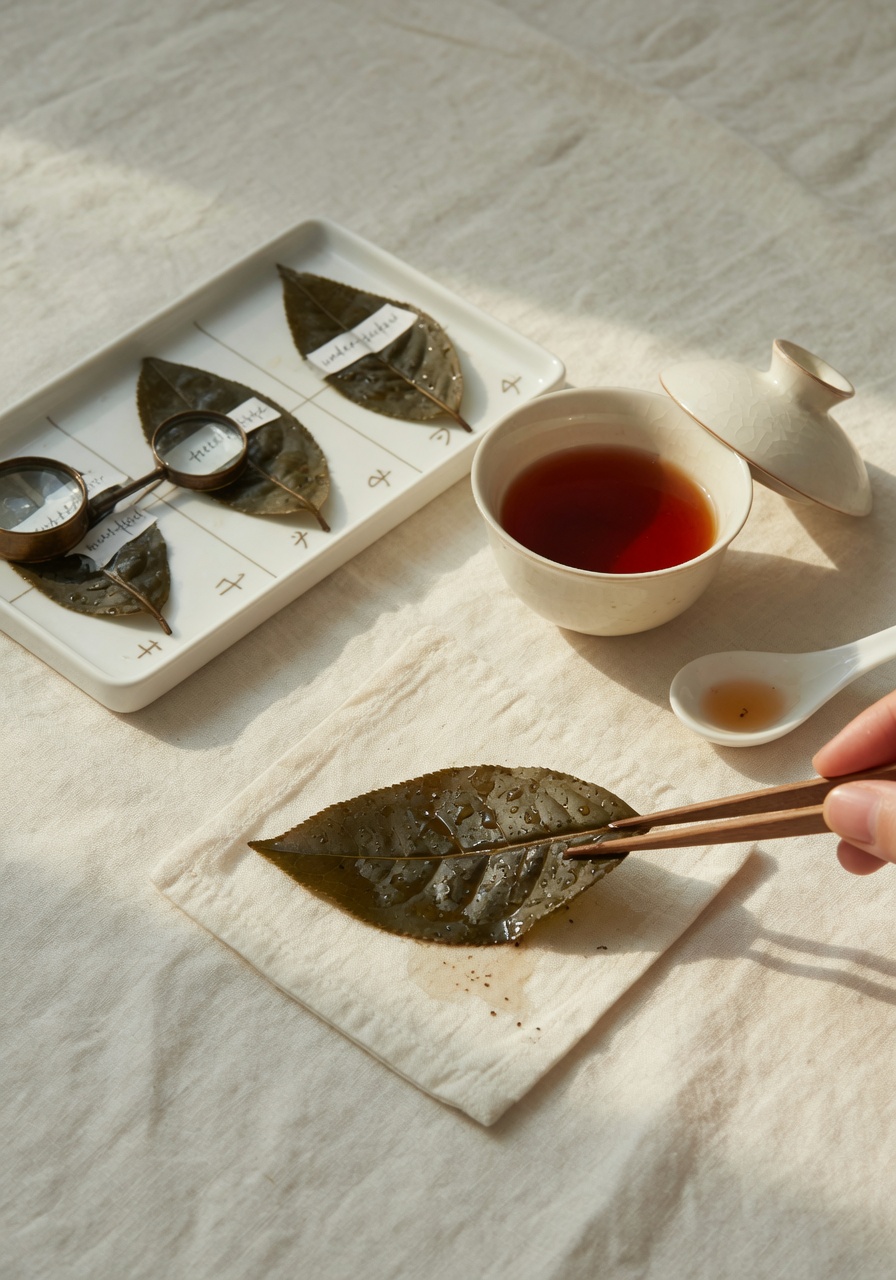
What a fault is, and what it isn’t
Defect language in Chinese tea grading predates the modern sensory wheel by several centuries. The Qing-era gōngfū (工夫) graders at Wuyi already used terms like jiāo (焦, scorched), suān (酸, sour) and mèi (霉, musty) to dock lots before they reached the merchant houses on Xiamen wharves. When the national standards office codified GB/T 23776–2018 — the current sensory evaluation protocol for tea — those same three roots survived almost untouched, joined by qīng (青, grassy/raw) and guò huǒ (过火, over-fired). A defect, in this lineage, is not simply an unpleasant note. It is a note whose cause can be traced back to a specific failure of withering, fixing, rolling, oxidation, drying or storage.
This is the distinction the topic insists on. Smoky is the canonical example, and the reason we opened the section with Smoky — defect or terroir character? A campfire note in a Zhèng Shān Xiǎo Zhǒng (正山小种) from Tongmu village in northern Fujian is the entire identity of the tea — pine-smoke drying in the qīng lóu (青楼) loft has been documented at the Tongmuguan checkpoint since at least the 1640s. The same note in a Yunnan dian hong is a fault: a leaky drying oven, a chimney drawing the wrong way, a batch rescued from rain. Same molecule (guaiacol, 4-methylguaiacol), opposite verdict. The grader’s job is not to like or dislike it, but to ask whether the producer intended it and whether the rest of the leaf supports the claim.
The other faults follow the same logic. Sour usually means a stalled kill-green or a wet-piled leaf that began fermenting before it should have — common in rainy-season máochá from Lincang, less common from drier Menghai. Musty (cāng wèi, 仓味) almost always points to storage: cardboard, humidity above 75 percent, or a warehouse that shared air with spices. Flat means the volatile top notes have outgassed, often because the tea was milled or repacked too aggressively. Bitter-without-return — kǔ ér bù huà (苦而不化) — is the cruellest defect to diagnose because it can come from anywhere: over-plucked summer leaf, nitrogen-heavy fertiliser, a fixing pan held twenty seconds too long. A trained panel separates it from honest astringency by counting seconds: real huí gān (回甘) arrives within twelve to twenty seconds of the swallow; a defect lingers as a flat metallic bitterness and never sweetens.
Why does any of this matter outside the cupping room? Because the price difference between a graded and a downgraded lot at the Fuding white-tea auctions, or at the Xishuangbanna spring market, routinely runs three to one. A buyer who cannot name a fault cannot negotiate it, and a producer who cannot diagnose one cannot fix it next season. For sommeliers writing menus — see the service notes on tea.degree and the pairing logic catalogued at thetea.app — defect literacy is also what separates a confident menu description from a defensive one. You can sell smoke, oxidation, even a touch of cāng wèi in an aged shou — but only if you know what you are selling, and only if the rest of the cup earns it.