Why your palate drifts — and how to bring it back
Every taster drifts. After a season of cupping the same shop inventory, thresholds shift: astringency that once registered as 7 starts reading as 5, and the bright top-note of a fresh Bì Luó Chūn (碧螺春) blurs into the background. Calibration is the corrective. It is the practice of re-anchoring your internal scale to external references — both physical samples and codified vocabulary — at scheduled intervals.
The idea is not new. The Specialty Coffee Association published its first Q-grader curriculum in 2004, and the Court of Master Sommeliers has used blind flights since 1977. Chinese tea was slower to formalise, partly because the GB/T standards (notably GB/T 23776-2018 for sensory evaluation of tea) were written for laboratory technicians, not field tasters. The protocol described in A six-week sensory calibration programme translates those laboratory methods into something a working sommelier or serious hobbyist can run from a home table.
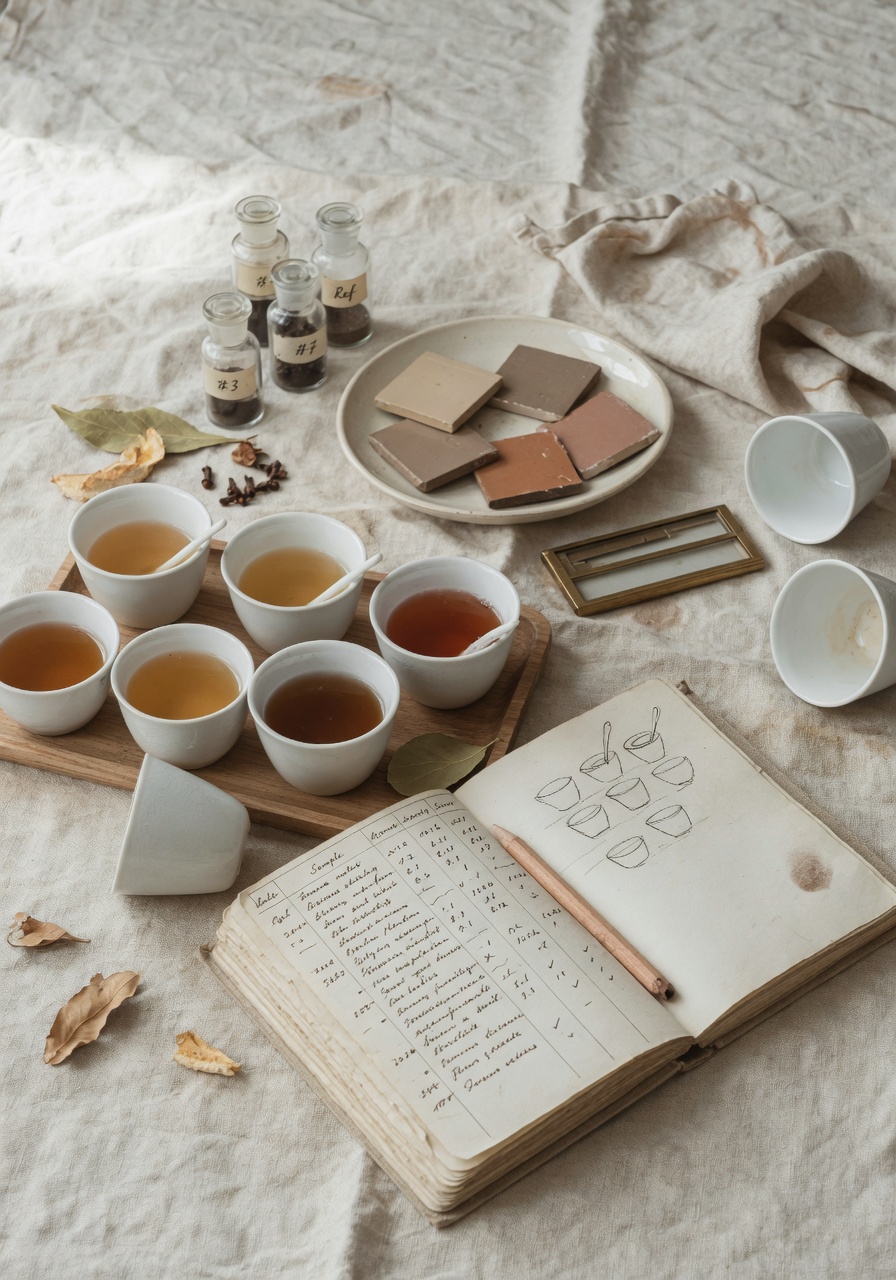
The structure is straightforward. Week one establishes baseline thresholds — the four basic tastes at three concentrations each, plus a astringency ladder using tannic acid solutions. Weeks two and three move to single-origin reference teas: a Shī Fēng Lóng Jǐng (狮峰龙井) from a verified plot in Weng Jia Shan, Hangzhou, paired against a lower-grade Zhejiang green to train the gap between grades 1 and 3. Weeks four and five introduce processing-style references — a lightly oxidised Anxi Tiě Guān Yīn (铁观音) against a traditional charcoal-roasted version from the same maocha, so the taster learns to isolate roast from cultivar. Week six is the audit: a blind flight of all twelve references, scored against your week-one notes, with drift quantified in points per axis.
The discipline matters more than the samples. The calibration sessions for the Teamotea sommelier track rest on three non-negotiables — same time of day, same water (60 mg/L total dissolved solids), same porcelain. Without these constants, you are measuring the room, not the tea. A fourth rule governs the white-tea reference set from Fuding: never calibrate after eating chili, and never within forty-eight hours of a cold. The nose recovers slowly.
The protocol’s deeper purpose is vocabulary alignment. When ten tasters score the same Fènghuáng Dān Cōng (凤凰单丛) and one writes “orchid” while another writes “gardenia”, the disagreement is rarely sensory — it is lexical. The reference library on this site, which pairs each descriptor with an aroma standard and a verified tea example, exists to close that gap. Run the six-week programme alongside it, and by the audit week your notes should match other calibrated tasters within one point on a ten-axis scale.
Professional context matters too. Buyers at shop.thetea.app recalibrate before each spring harvest sourcing trip, and the tea.school curriculum makes the six-week protocol a prerequisite for level-three certification. For most readers the goal is humbler — to know, with quiet confidence, that the score you wrote yesterday means the same thing today.