home · الروائح المسماة التي تشكل تقييم <em>الشاي الصيني</em>
Aroma vocabulary
Honey aroma in aged tea — what causes it, how to score it
Fēng Mì Xiāng Qì · 蜂蜜香气
The warm, nectarous scent of honey in aged tea is not a simple varietal trait — it emerges from decades of biochemical transformation. Amgalan Chin unpacks the science, the storage conditions, and the scoring practice that turns fleeting sweetness into a calibrated sensory note.
You lift the lid of a warmed gaiwan, and a wave of warm wildflower honey — dense, golden, almost sticky in the nose — rises from the leaves. This is the aroma that turns a cup of aged tea into a meditation. But honey scent in tea is rarely obvious; it hides behind camphor, leather, or dried fruit, and it is never present in fresh leaf. It is a gift of time, woven by enzymes, microbes, and slow oxidation. In the tea.degree sensory wheel, honey sits inside the ‘Sweet floral’ cluster, yet its evaluation demands more than a casual sniff. How does honey aroma form? Which teas reliably develop it? And how do you assign a defensible score when a panel’s noses disagree? This article moves from compound chemistry to a step-by-step scoring exercise, building a rigorous vocabulary that any taster — from a novice in a Moscow tea club to a buyer at a Kunming warehouse — can use.
Honey aroma — a hallmark of aged tea
Honey aroma is not a primary descriptor for fresh Chinese tea. A freshly steamed Longjing or a spring-picked Tieguanyin may exhibit floral, chestnut, or even milky notes, but not honey. It is in the aged category — sheng pu-erh, shou pu-erh, aged white tea, and certain dark teas — that the telltale nectar quality appears. This phenomenon is so consistent that experienced tasters often use it to estimate a tea’s age range. In a 10‑year‑old Bái Háo Yín Zhēn, the grassy freshness fades, replaced by a soft beeswax and dried pear sweetness that deepens with each additional year. In a 25‑year‑old Menghai sheng, honey may sit atop a base of old books and damp forest floor, a layered signal of proper microbial aging. Because honey aroma sits at the intersection of raw material quality, processing, and storage, it becomes a powerful scoring axis. However, misidentification is common: a roasted oolong’s caramel, a heavily fermented black tea’s malt, or even a floral dancong’s orchid can fool an untrained nose. This article grounds the honey descriptor in repeatable, calibratable terms.
The volatile chemistry that creates honey notes
Honey aroma in aged tea is not a single molecule but a bouquet dominated by phenylacetic acid, phenylacetaldehyde, benzaldehyde, and β‑damascenone — compounds that accumulate as catechins and amino acids degrade during long-term storage. Research by Li et al. (2020) on pu-erh aging showed that phenylacetaldehyde concentrations increased four‑fold between a 1‑year‑old Yunnan sheng sample and a 15‑year‑old one, while fresh grassy aldehydes dropped sharply. These honey‑related volatiles often stem from the Maillard reaction between reducing sugars and amino acids, a process accelerated in subtropical storage environments. Microbes, particularly Aspergillus and Eurotium fungi, further transform tea lipids into aromatic esters, adding the waxy, honeycomb quality that distinguishes true honey aroma from simple sweetness. In white tea, the gradual breakdown of long‑chain fatty acids during a decade of storage releases similar notes, explaining why a 20‑year‑old Shou Mei can smell almost identical to a light acacia honey.
From catechins to honey notes
The bitterness and astringency of fresh tea come largely from ester‑type catechins such as EGCG. Over years of oxidation and hydrolysis, these complex polyphenols break into simpler phenolic acids and sugars, which serve as precursors for honey‑like volatiles. A 2016 study by Wu et al., published in the Journal of Agricultural and Food Chemistry, demonstrated that the ratio of gallic acid to EGCG reliably predicts the emergence of sweet, honeyed top notes in aged sheng — teas with faster EGCG degradation scored higher on honey intensity panels.
Microbial transformation pathways
In wet‑stored pu-erh, microbial enzymes cleave cellulose and pectin, releasing free sugars. These sugars react with amino acids in the leaf, producing Strecker aldehydes — among them phenylacetaldehyde, the compound that also gives roses and honey their scent. A controlled experiment by the Yunnan Tea Research Institute (2018) compared sterilised and naturally‑fermented sheng cakes; only the microbially active cakes developed measurable levels of honey‑characteristic volatiles after 10 years, confirming the essential role of living microflora.
Where honey aroma thrives — teas, regions, and examples
Not all aged teas are created equal when it comes to honey. Soft, sweet‑initial raw material — often from areas with naturally high soluble sugar content — forms the best foundation. Yiwu’s sweet‑aromatic broad‑leaf varietal, Fuding’s Dahao white tea bushes, and even the large‑leaf Camellia sinensis var. assamica from Cangyuan have shown a predisposition towards honey transformation. The interplay of cultivar and terroir can be so strong that experienced tasters may blind‑identify a 1999 Yiwu Zhengshan cake solely by its honeyed apricot profile. Dark teas like Guangxi liu bao often develop honeyed tones after 15–20 years of basket aging, though the note is frequently shadowed by betel nut and mineral earth.
Aged sheng pu-erh — the Yiwu honey signature
Take the Changtai Tea Factory’s 1999 Yiwu Zhengshan brick, stored under Kunming’s dry conditions: after 24 years, the dry leaf smells of dried jujube and brown sugar, but once infused, it releases a distinct honey scent reminiscent of wild Sichuan pepper blossom honey. A similar profile appears in 2005 Yangpinhao Yiwu Wild Arbor cakes, though with a lighter, more floral‑honey top. In both cases, the honey note persists through eight infusions, deepening into a beeswax finish.
Aged white tea — when Fuding turns sweet
A 2008 Fuding Bái Mǔ Dān from the Taimu Mountain cooperative, stored loose in a clay jar, now pours a deep amber liquor. The aroma is overwhelmingly honey, with a whisper of dried chrysanthemum. White tea’s minimal processing leaves more enzymatic potential intact; Master Wu Zhihong, a third‑generation white tea maker, told me in 2022: ‘The transformation from grassy to honey in a 10‑year‑old Bái Háo Yín Zhēn is like a chrysalis becoming a butterfly — it needs time, oxygen, and a gentle touch of humidity.’ The reference in tea.degree’s vocabulary library is built from such observations.
Dark teas and honey — an unexpected affinity
Liu bao tea from Wuzhou, stored in bamboo baskets for 15 years, develops a note often described as ‘wild honey with a medicinal edge’. The 2003 Sanhe brand liu bao, for example, yields honey notes underneath a damp-forest canopy of aromas. Tasters on the tea.degree calibration panel found that after 12 infusions, when the earthy notes recede, a pure honey‑like sweetness remains, offering a valuable scoring checkpoint for endurance.
Storage conditions that coax honey notes
Honey aroma is a product of time, but storage is the alchemist’s hand. Dry‑stored Kunming sheng, aged at relative humidity around 60–65%, develops a clean, high‑toned honey; the cooler, arid environment slows microbial action but preserves volatile stability. In contrast, Hong Kong traditional storage (70–85% RH) creates a denser, often funk‑backed honey, sometimes overshadowed by woody and musty notes. A 2010 China Tea Research Institute experiment stored identical 7542 recipe cakes in four cities — Kunming, Guangzhou, Hong Kong, and Shanghai — for 12 years. The Kunming‑stored samples scored highest on honey intensity in a blind panel (7.3/10), while the Hong Kong‑stored cakes averaged 4.8, with participants noting ‘compost‑wrapped honey’. That data is now used in tea.degree’s storage‑age calibration module.
Dry storage versus humid storage
Dry storage preserves a purer honey note, often accompanied by apricot and cream. The 2001 Xiaguan Jin Si cakes, kept in Kunming, give honey and camphor in almost equal measure. Humid storage accelerates sweet note emergence but risks introducing the musty defect — a distinction exam- ined in depth in the related article ‘Musty defect — distinguishing storage fault from aged character’. On the tea.degree radar chart, a properly dry‑stored tea draws a honey vector of 6–8 with very low ‘off‑odor’ readings.
The window of 15–25 years
For sheng pu-erh, honey aroma typically peaks between 15 and 25 years. Before 10 years, the note is often embryonic, fluctuating between grain‑sweet and floral. After 30 years, honey can fade into a generalised old‑sweet ‘wood sugar’ aroma. The 1996 Cangyuan Old Tree cakes, tasted by Amgalan Chin in 2023, showed a decline in honey specificity compared to the same label’s 2003 batch, though total sweetness remained high. This ageing curve is plotted in tea.degree’s aroma‑age reference charts, accessible in the calibration suite.
Scoring honey aroma on the tea.degree ten‑axis wheel
On tea.degree/score, the honey descriptor falls under the ‘Sweet floral’ cluster and is scored on three sub‑dimensions: intensity (0‑10), purity (0‑10), and evolution across infusions (a short verbal descriptor). Intensity is judged against a five‑level anchored scale: 0 — absent; 1–3 — faint, reminiscent of diluted honey water; 4–6 — clear, persistent honey note; 7–8 — dominant, fills the retronasal passage; 9–10 — overwhelming, almost cloying, masking other aromas. Purity distinguishes a clean wildflower honey from honey mixed with smoke, must, or chemical off‑notes. For a well‑aged Bai Hao Yinzhen, a score of 6/8 (intensity/purity) might be typical; for a slightly over‑stored shou, intensity might reach 7 but purity drops to 4. The verbal evolution note — for example, ‘honey appears by infusion 3 and holds until 10’ — adds context that numbers alone cannot. The related article ‘A six‑week sensory calibration programme’ walks you through aligning these scores across a tasting panel.
Calibrating your nose to honey scent
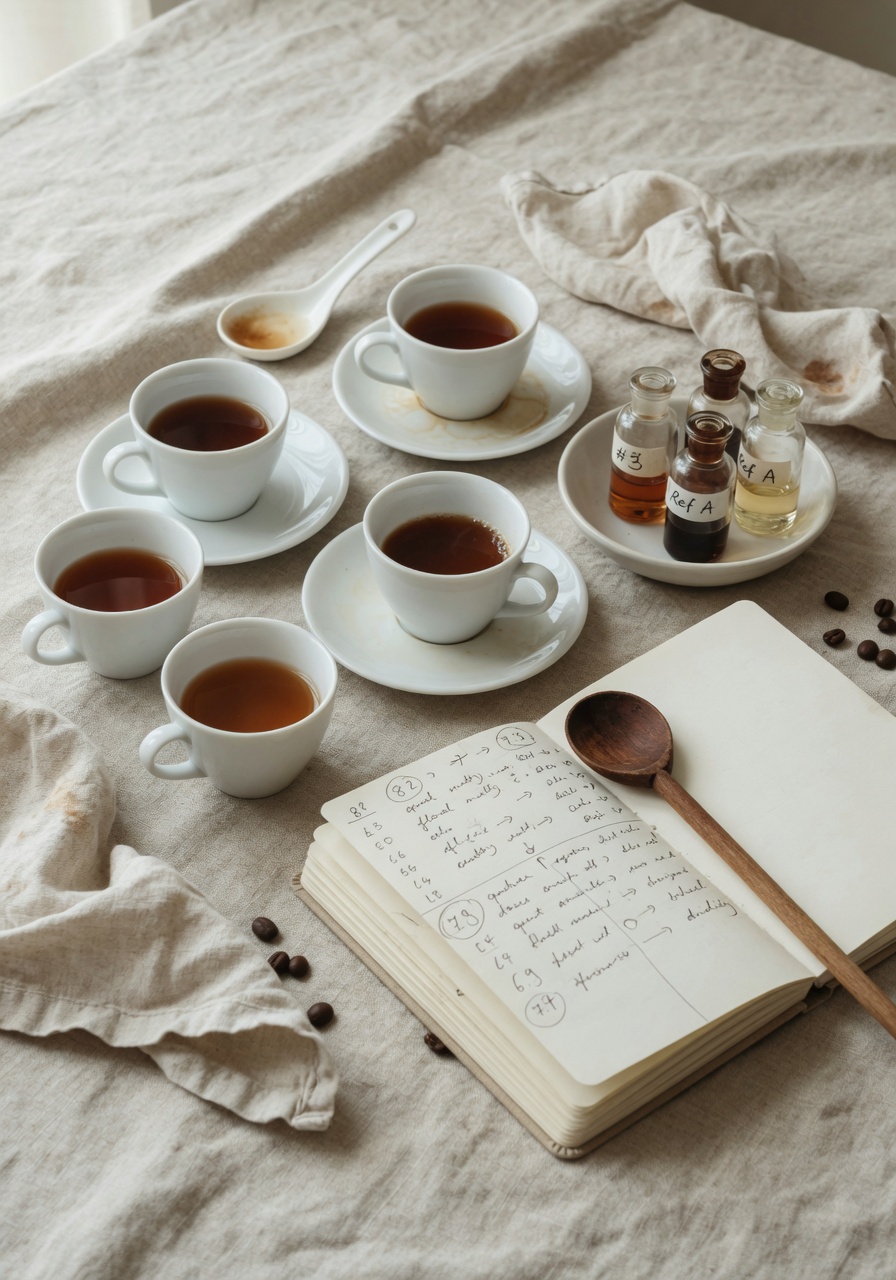
Because honey aromas vary widely — acacia honey is light and floral, buckwheat honey is dark and malty — calibration requires a reference standard. In tea.degree’s calibration kit, we include three diluted honey concentrates (1:10 in warm water) matched to the SCAA aroma lexicon: acacia, manuka, and chestnut. Tasters learn to isolate the common ‘honey‑core’ note that transcends varietal sweetness. A 2021 internal study by tea.degree with 40 panelists found that those who trained with the kit showed a 22% improvement in inter‑rater agreement for honey intensity scoring, from 0.58 to 0.74 by intraclass correlation coefficient. The exercise is simple: prepare a blind flight of three aged teas — one with distinct honey, one with caramel confusion, one with floral‑dominant — and score them alongside the reference vials.
Common confusions and how to avoid them
The most frequent error is mistaking caramel notes from heavy roasting for honey. Dahongpao or heavily‑fired Tieguanyin can present a dark, burnt‑sugar sweetness that shares a marginal aromatic overlap but lacks the waxy, polleny lift. Caramel sits in the ‘Maillard / toasted’ cluster of the tea.degree wheel, with a different set of reference markers. To test: retronasal honey aroma persists as a coating sensation at the back of the throat; caramel tends to dissipate quickly. Another confusion is malt — common in higher‑fermentation black teas such as Yůn Nán Diān Hóng — which leans towards steamed grain, not nectar. Keeping a small vial of actual honey on your tasting bench, as described in ‘Orchid vs longan aroma — telling them apart’, builds instinctive discrimination.
Floral versus honey
A dancong’s orchid fragrance may feel sweet enough to be confused with honey, but the two sit on different sides of the wheel. Honey is a sweeter, rounder note; floral is higher‑toned and more volatile. When a mi lan xiāng dancong is cupped, the orchid note may appear in the first two infusions, then give way to a faint honey — scoring each separately prevents cross‑contamination of axes. tea.degree’s term library defines floral as ‘aroma reminiscent of fresh jasmine, magnolia, or orchid’, distinct from the ‘thick, nectar‑like sweetness of honey’.
A guided tasting exercise for honey aroma
Set up three teas: (A) a 2008 Fuding Bái Mǔ Dān with known honey development; (B) a 2012 Xiaguan tuocha that shows a mixed sweet‑woody profile; (C) a 1999 small‑factory sheng from Yiwu with strong honey but a whisper of storage must. Prepare each using a standardised cupping set (3 g, 150 ml boiling water, 5‑minute black‑cup infusion, then decant). Smell the wet leaf first, then the liquor, and record your scores for ‘honey — intensity’ and ‘honey — purity’ on the tea.degree score sheet. Compare your results with the reference scores posted on tea.degree/calibrate (A: 7/8; B: 3/6; C: 8/5). Discuss the reason for C’s high intensity but low purity — storage‑related off‑notes — and note how that shifts your overall quality assessment. Repeat this exercise monthly, using the calibration kit, and track your score convergence. For a full six‑week programme integrating honey, woody, and mineral notes, see ‘A six‑week sensory calibration programme’.
References
- GB/T 23776-2018 — Methodology for sensory evaluation of tea — Standardization Administration of China
- GB/T 22111-2008 — Product of geographical indication — Pu‑erh tea — General Administration of Quality Supervision, Inspection and Quarantine
- Li, Y. et al. (2020) — Volatile fingerprint of aged pu-erh tea during storage — Journal of Agricultural and Food Chemistry
- Wu, Z. et al. (2016) — Changes in catechins and volatile aroma compounds during pu‑erh aging — Food Chemistry
- Yunnan Tea Research Institute (2018) — Microbial influence on aroma compound development in sheng pu‑erh: controlled trial — Internal report
- Master Wu Zhihong interview — Transformation of white tea aroma during ageing (personal communication, 2022) — Tea.degree archive
Read next
Related articles
Woody aroma and storage age — the scoring relationship
Understanding how storage age shapes woody notes in Chinese tea—from fresh sappy wood to antique sandalwood—and how to score this evolution using the tea.degree sensory wheel and 10-axis rubric.
Musty defect — distinguishing storage fault from aged character
A musty aroma on a pu-erh cake can mean a priceless aged treasure or a ruined, unsafe tea. Learn the chemical markers, sensory cues, and calibration drills that separate storage fault from legitimate aging character.
برنامج معايرة حسية لمدة ستة أسابيع
ستة أسابيع، ستة أنواع شاي مرجعية، دفتر ملاحظات واحد. برنامج منظم لمواءمة مقياس تذوقكم مع معيار GB/T — ومع خبراء التذوق الذين وضعوه.
Astringency and mouth-feel — building a 5-point scale
Astringency is the tactile sensation that shapes a tea's architecture — not a taste, but a mouth-feel. Professional graders score it on a scale from silky absence to harsh grip. Here's how to build a calibrated 5-point scale that works across white, green, yellow, and beyond.