home · The leaf after the liquor — how to <em>read</em> the spent leaf
Wet-leaf evaluation — Yè Dǐ 叶底
Leaf structure intactness — grading consistency
Yè dǐ jié gòu wán zhěng xìng — píng fēn yī zhì xìng · 叶底结构完整性 — 评分一致性
An intact leaf in the bottom of the gaiwan carries the story of plucking, withering, rolling, and firing. Grading intactness isn't about perfection — it's about reading how the leaf has navigated its journey, and converting that narrative into a consistent, repeatable score.
A spent leaf unfurls beneath hot water, often the final witness called before a grade is assigned. Yet leaf intactness is among the most inconsistently scored metrics in professional cupping. The challenge isn’t only to see whether the leaf is whole or broken; it’s to weigh that observation against the tea’s intended style — a traditional yancha with fragmented edges may still achieve top marks, while a Bái Háo Yín Zhēn (白毫银针) with torn tips signals mishandling that shaves points off every previous category. At tea.degree we approach intactness as a diagnostic lens, one that works best when calibrated against processing know‑how and a shared vocabulary.
The narrative in the wet leaf
When we lift a gaiwan lid and examine the yè dǐ (叶底), we are reading a processing history. An even, supple leaf with intact margins in a premium green tea like Tài Píng Hóu Kuí (太平猴魁) tells of gentle shāqīng (杀青) in a hot wok and careful hand‑pressing that preserved its two‑leaves‑and‑a‑bud architecture. Conversely, a black tea leaf that splinters into coarse fragments under the fingers may have been over‑rolled or dried too aggressively. As Chen Hui Yi, Senior Tea Expert at teamotea, notes: ‘The leaf never lies — it records every moment of pressure, heat, and moisture it met. Our job is to learn that language.’
Defining intactness — a grading framework
Most sensory standards, including GB/T 23776‑2018, treat intactness as a qualitative descriptor, not a numeric score. For practical cupping rooms, we adapt a four‑point scale that resonates across categories: 4 — structurally complete, margins clean, veins unbroken; 3 — minor tip breaks or edge wear, overall identity intact; 2 — leaves fragmented but still identifiable to plucking standard; 1 — mash or powder, original form unrecognisable.
The four-point scale in practice
This scale works backward from the tea’s origin. A score of 4 in a high‑grade Lóngjǐng (龙井) demands elongated, spear‑shaped leaves with serrated margins still visible. In a Bái Mǔdān (白牡丹), a 4 means the one‑bud‑two‑leaf structure is fully legible. Yet the same 4 in a heavily twisted Wuyi oolong may be almost impossible; the leaf is intentionally fractured along the twist lines. Understanding intention is key.
When intentional breakage is not a defect
Some styles build character from fragmentation. Gongfu black teas from Ān xī, rolled into tight pearls, accept a degree of leaf separation during steeping. The cupper must judge whether fragmentation is stylistic (acceptable) or a sign of machine over‑work (defect). Fang Ting, oolong specialist, explains: ‘In Tiěguānyīn (铁观音), we look for the ability of the leaf to recover its shape, not for absolute wholeness. Brittle, sharp-edged fragments are a warning, but a clean split along a twist line is not.’
Processing fingerprints on leaf structure
Every manufacturing step — withering, fixation, rolling, drying — leaves its mark on the wet leaf. White teas that have been sun‑wilted too long develop notched edges that later tear in infusion; under‑withered green teas resist rolling and subsequently show compression wounds. Over‑fired leaves become brittle and yield to a fine dust that clouds the cup and drops the intactness score sharply.
Machine vs hand — a tale of bruising
The shift from hand‑rolling to mechanical rollers has introduced a specific pattern of edge‑bruising in black teas and some oolongs. Under magnification, machine‑handled leaves often show parallel compression lines, whereas hand‑rolled leaves display more random stress marks. These patterns help assign a point of origin for a low intactness score — the evaluator can decide whether the fault lies in raw material or in factory technique.
How aging reshapes the leaf
In aged teas, leaf integrity becomes a moving target. A twenty‑year‑old raw pu‑erh (生普洱) stored in a slightly humid environment will release its cellulose bonds, making the leaf softer and more prone to fragmentation upon steeping. For such teas, intactness scoring must be normalised against storage age and condition. Most competitive standards, including those used by the China Tea Certification Committee, require separate reference chips for aged categories. teamotea’s calibration programme, mirrored on tea.school, trains tasters to identify whether leaf disintegration is age‑appropriate or evidence of poor‑quality raw material.
Calibration protocol and blind scoring
Consistency breaks down when tasters rely on memory alone. A robust calibration protocol links every intactness score to physical reference samples. At tea.degree, we advocate a monthly blind cupping round where three teas — a fragile green, a medium‑rolled oolong, and a tightly compressed dark tea — are scored by the same team, and inter‑rater variance is tracked over time.
Using tea.degree’s blind mode
The blind tasting mode at tea.degree strips all provenance, allowing tasters to focus solely on leaf characteristics. Scoring intactness without knowing whether the tea is a delicate Bìluóchūn (碧螺春) or a robust shóu pu‑erh (熟普洱) removes expectation bias and forces a pure structural read. After three sessions, most tasters see their deviation drop below 0.5 points on a four‑point scale.
From consistent scoring to deeper insight
Leaf intactness is never an isolated metric. A low score that correlates with grassy off‑notes points to under‑withering. A low score paired with burnt‑sugar flavours suggests over‑firing. Linking intactness to aroma and mouth‑feel — as explored in tea.degree’s scoring rubric at /score — transforms the wet‑leaf examination from a checklist item into a diagnostic engine. The next step, as Chen Hui Yi advises, is to archive high‑resolution photographs of scored leaves alongside the sensory data, building a visual library that future panels can use to lock in their scales.
References
- GB/T 23776-2018 — Methodology of sensory evaluation of tea — Standardization Administration of China
- GB/T 22291-2017 — White tea — Standardization Administration of China
- Chen L, Wang X. Impact of withering time on leaf integrity in pan‑fired green tea. Journal of Tea Science, 2020, 40(3): 345‑352. — Tea Research Institute, Chinese Academy of Agricultural Sciences
- Personal interview with Fang Ting, Senior Tea Expert (Oolong, Puerh), teamotea, May 2024. — teamotea internal archive
- China Tea Certification Committee — Aged tea sensory evaluation protocol, rev. 2022. — China Tea Marketing Association
Read next
Related articles
Astringency and mouth-feel — building a 5-point scale
Astringency is the tactile sensation that shapes a tea's architecture — not a taste, but a mouth-feel. Professional graders score it on a scale from silky absence to harsh grip. Here's how to build a calibrated 5-point scale that works across white, green, yellow, and beyond.
Body and mouth-coating — calibrating the heavyweight teas
Why some teas feel like velvet, others like water. A technical calibration of body and mouth-coating in heavyweight teas, from pu-erh to dark teas.

برنامج معايرة حسية لمدة ستة أسابيع
ستة أسابيع، ستة أنواع شاي مرجعية، دفتر ملاحظات واحد. برنامج منظم لمواءمة مقياس تذوقكم مع معيار GB/T — ومع خبراء التذوق الذين وضعوه.
منحنيات درجة الحرارة عبر الفئات الست للشاي الصيني
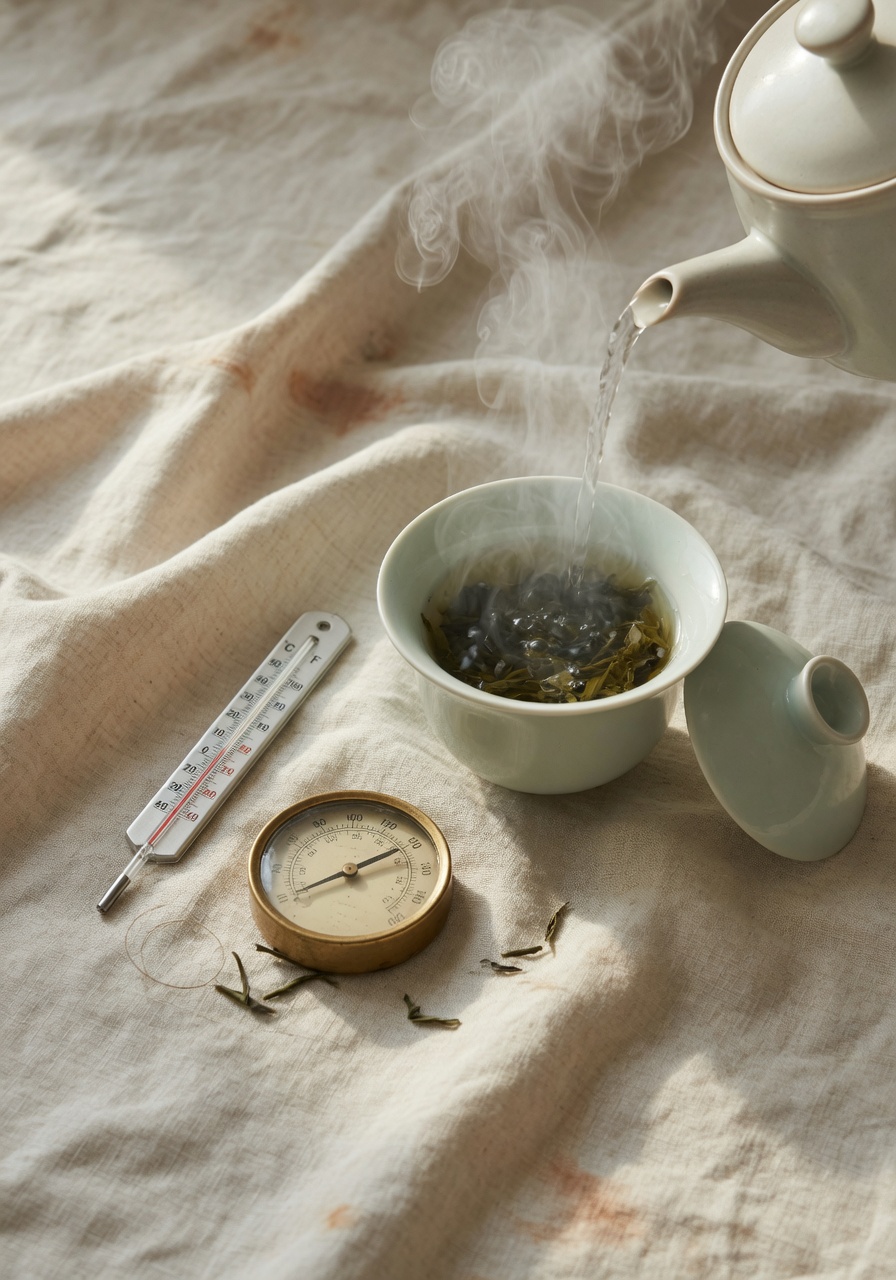
درجة حرارة الماء ليست رقمًا واحدًا — إنها منحنى ينحني مع نضج الأوراق، والأكسدة، ومرحلة النقع التي أنت فيها. خريطة عملية للشاي الأخضر، والأصفر، والأبيض، والأولونغ، والأحمر، والداكن.