home · Four <em>dials</em>, one cup — calibrating the brew
Brew variables
Leaf weight and extraction — calibration tables
How a precise ratio of leaf to water — sometimes as little as a one-gram shift — can open or close an entire tea’s aromatic architecture. A calibration framework for professional tasters and serious home brewers.
Every tea session begins with a number — grams of leaf, millilitres of water, degrees Celsius, seconds of steep. Yet the number most brewers treat as a casual estimate is the one that governs all the others: leaf weight. A variance of half a gram can shift a Bái Háo Yín Zhēn from honeydew and hay to metallic emptiness, or turn a tightly rolled Wǔ Yí yán chá from mineral clarity to overbearing char. This article unpacks the calibration relationship between leaf weight and extraction, offers reference tables for the six categories of Chinese tea, and provides a method for building your own personal brew compass — an essential tool for anyone serious enough to score tea on a 10‑axis sensory wheel like the one at tea.degree.
The universal starting point — ratio as a language
Before calibration can begin, one needs a baseline. The Chinese national sensory evaluation standard GB/T 23776‑2018 defines a general infusion: 3 g of tea to 150 ml of boiling water, steeped for 5 minutes. This single‑point reference is designed for commercial grading, not for pleasure. Yet it reveals the fundamental rule — ratio precedes all other variables. A professional taster’s personal baseline often deviates: for white teas, 4 g per 100 ml in a gaiwan (a ratio of 1:25) is common, while for delicate green teas such as early‑spring Lóng Jǐng, the dose may drop to 2.5 g per 100 ml to prevent the water from scalding the buds. These ratios are not preferences — they are the first layer of calibration, the translation of leaf weight into a predictable extraction curve.
Gongfu vs analytical steep
Gongfu brewing — short steeps, high leaf load — uses ratios from 1:15 to 1:20, designed to reveal the tea’s evolution across six to twelve infusions. In contrast, the analytical steep used in the calibration programme at tea.school adopts a fixed 1:50 ratio (2 g per 100 ml) with a single 3‑minute steep, eliminating time as a variable so weight and temperature alone can be tested. Understanding both modes allows the taster to choose the appropriate calibration frame for the tea at hand.
Precision matters — scales, volume, and the illusion of ‘spoon’
A standard Western teaspoon of Bái Háo Yín Zhēn weighs approximately 1.2 g, while the same spoon filled with tightly twisted Dān Cōng yè weighs 2.8 g — a 130% difference. Volume measurement is the enemy of calibration. Green tea profiles developed for the Hunan Agricultural University sensory panel rely on a repeatable protocol: use a 0.01 g resolution scale, zeroed before each measurement. The leaf must be taken from the centre of the sample bag to avoid fines that have settled at the bottom. At tea.degree, the recommended minimum for calibration work is a 200 g / 0.01 g pocket scale, recalibrated weekly against a 100 g calibration weight.
Leaf weight and extraction curves — the invisible architecture
Extraction is not a single event but a curve — polyphenols, amino acids, and aromatic compounds dissolve at different rates. Increase leaf weight while keeping time and temperature constant, and the cup skews toward the slower‑extracting heavier polyphenols (catechins, theaflavins) before the delicate amino acids can fully bloom. A 2022 comparative study with three Fújiàn bái chá demonstrated this: at 3 g per 100 ml, the extraction curve peaked at 90 seconds with prominent melon notes; at 5 g per 100 ml, the same tea gave a 60‑second bitter spike that masked the fruit entirely. The calibration tables at the end of this article map these curves for each category.
The amino acid window
In white and yellow teas, the sweet‑umami character is carried primarily by theanine and glutamic acid, which extract fully within the first 60 seconds at 80 °C. If leaf weight is too high, theanine is overwhelmed by catechins before it can register on the palate. A calibrated weight opens a ‘window’ — typically between 40 and 70 seconds — where the amino acid profile dominates. In that moment, when you close your eyes after the first sip, you should feel the tea moving along the sides of the tongue, not striking the centre — that is theamino acid window.
Calibration tables — a working example: Bái Háo Yín Zhēn
The following table is a calibration reference for Fúdǐng Bái Háo Yín Zhēn, 2022 harvest, stored in a cool dark environment for 18 months. The vessel is a 100 ml porcelain gaiwan; water is TDS 45 mg/L, 80 °C.
Table 1 — Bái Háo Yín Zhēn extraction matrix
Weight | Steep 1 (s) | Steep 2 (s) | Steep 3 (s) | Expected Aroma | Expected Body | Notes 2.5 g | 45 | 40 | 55 | hay, honeydew, faint marzipan | light, silky | too dilute for texture scoring 3.0 g | 40 | 35 | 50 | melon rind, steamed corn silk | medium‑light, soft coating | baseline for floral detection 3.5 g | 35 | 30 | 45 | cooked sugarcane, faint white pepper | medium, velvet grip | ideal for mouthfeel calibration 4.0 g | 30 | 25 | 35 | baked pear, slight metallic note | medium‑full, drying edge | risk of bitterness after 20 s 4.5 g | 25 | 20 | 30 | over‑steamed vegetables, dust | heavy, astringent finish | off‑target; use only for astringency drills
Vessel geometry — why your teapot disagrees with your gaiwan
Leaf‑to‑water ratio is not a two‑dimensional number. The shape of the brewing vessel — surface area, wall thickness, lid fit — introduces a third variable: heat retention and leaf expansion. A tall glass used for green tea (Bì Luó Chūn, for instance) cools faster than a thin porcelain gaiwan, slowing extraction; to compensate, leaf weight should be increased by 10–15 %. Conversely, a thick Yíxīng zǐ shā pot holds heat so well that a 3 g dose of shēng pǔ’ěr can extract like 4 g in porcelain. When you switch vessels, always re‑calibrate with a 0.5 g step‑down from your standard weight. Let the first infusion tell you whether to go up or down. Testing across five vessel types is part of the calibration module on tea.school.
Water mineral content — the hidden weight multiplier
Water with high calcium and magnesium content (hard water, TDS >150 mg/L) binds to tea polyphenols, reducing astringency but also muting high‑frequency aromatics. When using such water, tasters often increase leaf weight to restore aroma volume — a compensation that can backfire by introducing bitterness in later steeps. The preferred calibration water for tea.degree work is TDS 30–60 mg/L, achieved either through bottled spring water (Icelandic Glacial or Volvic) or a reverse‑osmosis filter re‑mineralised with a pinch of bicarbonate. If you must use local tap water, document the TDS and adjust your table accordingly — a 10 mg/L rise in hardness is roughly equivalent to a 0.2 g increase in leaf weight for green and white teas, per internal testing by the tea.degree panel in 2024.
Diagnostic troubleshooting — reading the cup through leaf weight
When a tea session goes wrong, the problem often masquerades as a defect in the leaf when it is actually a weight issue. Use this quick diagnostic table, developed with input from the tea.degree calibration programme:
Symptom → Likely cause → Adjustment
Thin, watery body with no aftertaste → Under‑leafed → Increase by 0.5 g per 100 ml Sharp, front‑of‑tongue bitterness that lingers → Over‑leafed → Decrease by 1 g; lower temp by 5 °C Aroma present but disappears within seconds → Weight correct; water too hot → Drop temp by 5–10 °C Flat, cardboard‑like flavour → Stale water or leaf too fine → Check TDS; measure leaf weight (fines may be over‑represented) Astringency builds across steeps → Polyphenol overload from high leaf weight + long steep → Reduce weight 0.5 g, keep steep time fixed For exercises on scoring bitterness, see “Bitter without return vs bitter with return — scoring practice” on tea.degree; for body calibration, refer to “Body and mouth‑coating — calibrating the heavyweight teas”.
Building your own calibration table — a four‑step protocol
The tables provided in this article serve as a foundation, but every taster’s palate, water supply, and teaware collection is unique. To build a personal calibration table, follow this protocol, which mirrors the six‑week programme outlined at tea.school:
- Choose one reference tea of known provenance and stable storage — ideally the same as your scoring benchmark.
- Prepare a matrix of five leaf weights (2.0, 2.5, 3.0, 3.5, 4.0 g) for a fixed water volume (100 ml) and temperature.
- Steep each weight three times at identical intervals; record aroma, texture, taste, and aftertaste on a 10‑point scale.
- Plot the results as a radar overlay (using the tea.degree radar tool) to visualise where weight shifts open or close the tea’s profile. Repeat the process for each new tea category you work with, and revisit annually as the tea ages — weight requirements can drop by 5–10 % after two years of storage as the leaf softens and extracts faster.
References
- GB/T 23776‑2018 Methodology of sensory evaluation of tea — Standardization Administration of China
- GB/T 8302‑2013 Tea — Sampling — Standardization Administration of China
- Extraction kinetics of polyphenols and amino acids in green tea (Journal of Food Science, 2021) — Li, J., et al.
- Water hardness and tea infusion quality (Food Chemistry, 2019) — Zhu, Y., et al.
Read next
Related articles
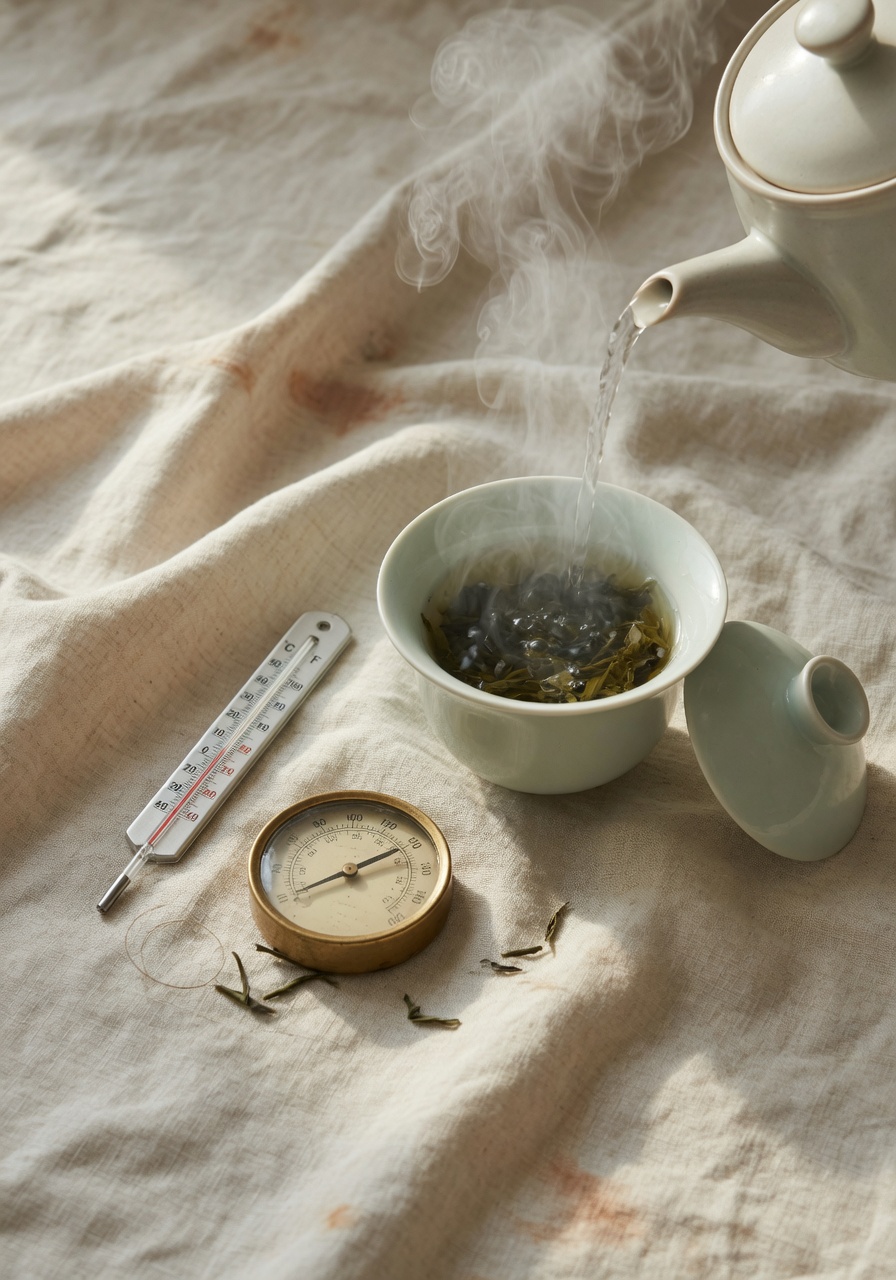
Temperature curves across the six categories of Chinese tea
Water temperature is not a single number — it is a curve that bends with leaf maturity, oxidation, and the steep you are on. A working map for green, yellow, white, oolong, red and dark tea.
Astringency and mouth-feel — building a 5-point scale
Astringency is the tactile sensation that shapes a tea's architecture — not a taste, but a mouth-feel. Professional graders score it on a scale from silky absence to harsh grip. Here's how to build a calibrated 5-point scale that works across white, green, yellow, and beyond.
Bitter without return vs bitter with return — scoring practice
In tea evaluation, bitterness is not a defect — it’s a signal. Learn to distinguish the flat, lingering bitterness that mars a session from the vibrant, transforming bitterness that presages a wave of returning sweetness (*huígān*), and master the scoring criteria used by professional graders at tea.degree.
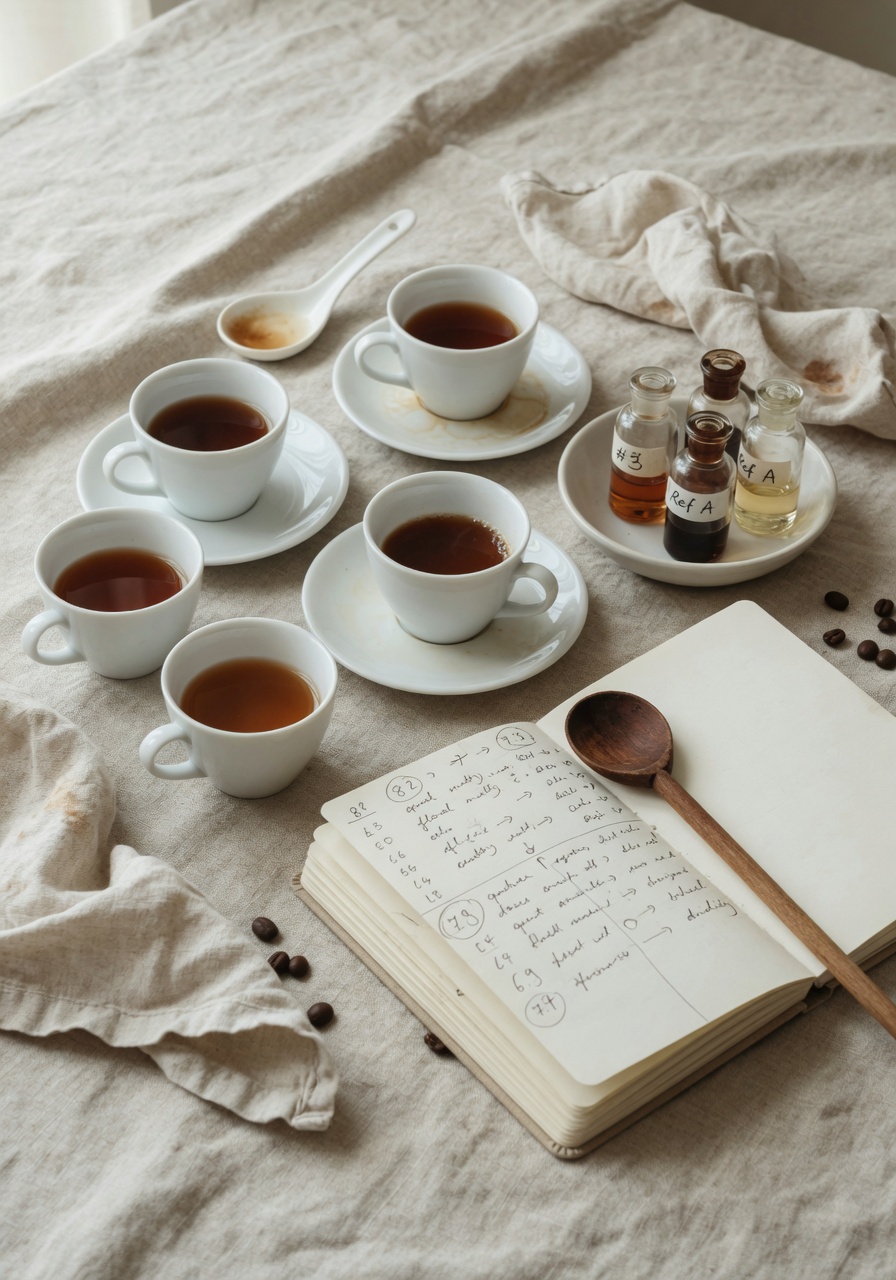
A six-week sensory calibration programme
Six weeks, six reference teas, one notebook. A structured programme to align your tasting scale to the GB/T standard — and to the cuppers who set it.