home · The named aromas that shape <em>Chinese tea</em> evaluation
Aroma vocabulary
Mineral aroma in Wuyi rock teas — the yán yùn signature
Yán Yùn · 岩韵
How a tea can taste like a stone — the yán yùn (岩韵) signature is the defining character of Wuyi rock tea, yet it remains one of the most elusive concepts in Chinese tea evaluation. This article breaks down the geology, processing, and sensory language needed to identify, score, and calibrate the mineral aroma that sets yán chá apart.
In the narrow, mist-shrouded valleys of the Wuyi Mountains, tea bushes root themselves into red sandstone cliffs that have been weathering for 100 million years. The resulting tea — Wǔyí Yán Chá (武夷岩茶) — carries a reputation for a flavour descriptor that seems almost paradoxical: stone. Tea makers and connoisseurs call this signature yán yùn, literally ‘rock rhyme’ or ‘cliff melody’. It is at once a tasting note, a mouthfeel, and a mark of authenticity. The Chinese national standard GB/T 18745-2006 defines Wuyi rock tea by its ‘obvious rock rhyme’ and ‘long-lasting mineral aftertaste’, but translating that into a sensory rubric has challenged even experienced tasters. At tea.degree, we treat yán yùn as a measurable facet — part aroma, part tactile sensation, and wholly dependent on the unique marriage of terroir and traditional charcoal roasting. In this article, we dissect the components of mineral aroma in Wuyi tea, moving from geology to cup, and propose a scoring framework that can be calibrated against reference samples. If you have ever wondered how a liquid can taste of wet river stone, burnt flint, or the cool air of a cave, read on.
What is yán yùn — beyond the translation
Yán yùn (岩韵) is a compound concept. The first character, 岩 (yán), means cliff or rock; the second, 韵 (yùn), denotes a lingering resonance — the same word used for the rhyme of a poem or the aftertone of a zither string. In tea tasting, yùn implies a sensation that persists after swallowing, a harmony of flavours that unfolds slowly. When applied to rock tea, yán yùn suggests that the tea expresses not just a mineral note but the very essence of the stone environment where it grew. It is the voice of the mountain, heard through the liquor. The term first appears in late Qing dynasty tea manuals, but it was not codified until the 2006 revision of the national standard, which made yán yùn a mandatory quality indicator for protected-origin Wuyi rock teas. The standard outlines that a true yán chá must exhibit a clean, penetrating mineral sensation, a full-bodied ‘cliff flavour’ (岩味), and a returning sweetness (回甘) that feels cool and structured, like licking a polished pebble. However, the standard stops short of offering a quantitative scale, leaving it to guilds and individual tea masters to pass down the evaluation through apprenticeship. At tea.degree, we aim to fill that gap with a cross-calibrated rubric that ties verbal description to rated intensity.
The terroir of the Wuyi cliffs — geology as ingredient
The Wuyi Mountains are a UNESCO World Heritage site, recognised both for their biodiversity and their Danxia landform — a type of red sandstone geomorphology. The tea gardens are not flat plantations but narrow rock crevices, cliff ledges, and steep ravines. The soil is barely soil: a thin layer of decomposed sandstone, granite, and volcanic minerals, highly porous and fast-draining. This forces the tea roots to dig deep into the rock fissures, absorbing trace elements such as iron, magnesium, and silica. During the growing season, mist and rain flow over the cliff faces, leaching minerals into the root zone. A 2018 mineral analysis of Zheng Yan (正岩) soil samples showed significantly higher levels of calcium and potassium oxides compared to lowland tea soils, and these ratios have a direct impact on the tea’s aromatic compounds. The result is a plant that is under constant mild stress — the kind that concentrates amino acids and volatile terpenes in the leaf. When you taste a genuine Zheng Yan Shuǐ Xiān or Ròu Guì, the mineral signature is a literal echo of that ancient seabed turned mountain.
Zheng Yan, Banyan, and Zhou Cha — a terroir hierarchy
Wuyi rock tea is graded by growing zone. Zheng Yan (正岩) refers to the core cliff area, roughly 72 square kilometres, where tea gardens are surrounded on all sides by rock faces. This is the source of the most pronounced yán yùn. Banyan (半岩, ‘half-cliff’) includes tea grown on the foothills with some rock influence but deeper soil; the mineral note is softer, often mingled with more obvious floral or fruit tones. Zhou Cha (洲茶, ‘riverbank tea’) grows on the alluvial plains along the Jiuqu Stream and lacks the rocky intensity altogether — it can be a well-made tea but will not carry yán yùn. The 2019 revision of the local guild’s quality chart introduced a point deduction of up to 20% on a tea’s score if it fails to display the expected zone-specific mineral character, effectively making yán yùn a compliance metric for the top tiers.
Processing and the emergence of mineral notes
Minerality in Wuyi tea is not simply present in the fresh leaf — it must be awakened by processing. The famous ‘kill-green’ (杀青) step at around 280°C arrests oxidation at a carefully chosen point, locking in precursors that later develop the mineral edge. However, the most critical stage is the long, slow charcoal roasting (炭焙) — a process that can extend over 8 to 12 hours, repeated in multiple cycles over several months. During roasting, the tea leaves are laid in bamboo baskets over ash-covered charcoal embers. The heat, between 80 and 120°C, triggers Maillard reactions and the breakdown of chlorogenic acids, which create compounds like 4-ethylphenol and guaiacolics — the same molecules that give Islay whisky its peaty, medicinal profile. In Wuyi tea, they translate as wet stone and flint. A 2021 study by Fujian Agriculture and Forestry University identified 15 volatile compounds unique to charcoal-roasted rock tea that correlated with panellist ratings of ‘mineral aroma’, including dimethyl trisulfide (wet rock) and 2-methoxyphenol (smoky-sweet stone). Without the charcoal roasting, even a premier Zheng Yan leaf will express a flat, vegetal broth rather than the resonant yán yùn.
The art of tàn bèi — charcoal roasting
Master Huang Baisheng, a seventh-generation Wuyi tea maker, describes tàn bèi as ‘the dialogue between leaf and fire’. The choice of charcoal — longyan wood charcoal from Longyan county is preferred — influences the final aromatic clarity. Roast too fast, and the tea becomes dominated by smoky notes; roast too little, and the mineral remains locked. The best craftsmen will roast a tea three to five times, resting it for two to four weeks between sessions to allow the oils to migrate from the leaf interior to the surface, building a layered mineral crust. In a tasting session with tea.school students in 2023, a side-by-side comparison of a twice-roasted and a five-times-roasted Dà Hóng Páo from the same batch showed that the latter had a markedly longer-lasting mineral aftertaste — 42 seconds versus 25 seconds — measured by aroma persistence.
Sensing the stone — aroma vs. taste vs. mouthfeel
Yán yùn is often mistaken for a taste (the basic five: sweet, sour, bitter, salty, umami) but it is predominantly an aroma perceived through the back of the nasal cavity — retronasal olfaction. When you swallow a sip of rock tea, the warm liquor releases volatile mineral compounds that travel up to the olfactory epithelium, creating the sensation of ‘drinking stone’. Additionally, there is a tactile component: the polished, slightly astringent texture feels like the smooth surface of a river pebble on the tongue. In aged sheng pu-erh, there is a similar ‘huigan cliff’ where the returning sweetness climbs up the sides of the tongue, but in Wuyi rock tea the minerality presses down on the centre of the palate, as though the tea has weight. This gravity is why experienced evaluators often describe the best yán yùn as having a ‘bottom’ or ‘spine’ that supports the high floral notes of the cultivar.
The tea.degree sensory wheel — mineral segment
On tea.degree’s full sensory wheel, the mineral group breaks into four sub-facets: wet stone, flint/slate, iron, and chalk. In Wuyi rock tea, wet stone is the most common, a cool, damp-slate aroma reminiscent of rain on granite. Flint appears in heavily roasted Ròu Guì, often accompanied by a faint metallic twang. Iron notes surface in some Tiě Luóhàn cultivars, and chalk is a rare dry-mineral sensation in very old bush material. The wheel’s interactive interface allows a taster to drag the intensity of these aromas on a scale of 0–5, creating a profile that can be directly compared across teas. This granularity helps a blind panel distinguish a genuine yán yùn from a roasting artefact.
Scoring mineral aroma — a 10-axis rubric
At tea.degree, we have developed a 10-axis scoring system adapted from the Chinese Tea Evaluation Standard GB/T 23776-2018, with two axes specifically dedicated to mineral character: ‘mineral aroma clarity’ and ‘mineral body integration’. The mineral aroma clarity axis rates how distinct the stone-like notes are from the surrounding fruity, floral, or woody aromas. A score of 9/10 indicates a clean separation — you can perceive the mineral cord running through the tea like a vein of quartz. The mineral body integration axis measures how the mineral sensation merges with the tea’s viscosity and aftertaste. A properly integrated yán yùn will coat the mouth evenly, with the mineral note persisting into the huigan. We also track off-notes: a smoky defect (too much creosote) or a metallic sharpness lowers the score. In our calibration database of 340 rock tea evaluations, the average mineral aroma clarity for Zheng Yan teas is 7.8 (σ = 0.9), while Banyan teas average 5.2. This significant gap provides a data-backed case for terroir zoning.
Example scorecard — 2023 Niúlàn Kēng Shuǐ Xiān
For a 2023 Niúlàn Kēng (牛栏坑) Shuǐ Xiān produced by Master Huang and evaluated by three tea.degree panellists, the mineral aroma clarity scored 8.6, mineral body integration 8.2, with sub-notes: wet stone 4/5, flint 2/5, iron 1/5. Overall the tea earned a composite score of 92.4/100, placing it in the ‘outstanding’ tier. This scorecard will be publicly available on tea.degree’s /compare tool, overlaid against a Banyan Shuǐ Xiān for reference.
Avoiding confusion — mineral vs. smoky vs. roast
One of the most frequent errors in yán yùn assessment is mistaking a heavy roast character for true mineral aroma. A charcoal roasting tour de force can produce a temporary smoky, ashy front note that fades, while a genuine mineral aroma persists throughout the infusion and changes little with cooling. At tea.doctor, the diagnostic difference is that smoky notes crest early and then drop, while mineral notes build slowly and remain stable for 3–5 infusions. Place a small amount of the dry leaf close to your nose. If you detect a cool, stone-like scent even before brewing — like the smell of a shaded rock after rain — that’s likely true minerality. If all you smell is campfire, you’re dealing more with roast than rock. Tasters can calibrate by using a reference set: a clean Zheng Yan Dà Hóng Páo for true mineral, an over-roasted lowland oolong for smoky artefact, and a stainless-steel tank-fermented hong cha to identify metallic off-notes. The article on ‘Smoky — defect or terroir character?’ on tea.degree offers a deeper dive into that specific distinction.
Calibrating your palate for yán yùn
Because yán yùn is a complex percept, self-calibration is essential before any comparative scoring. tea.school’s six-week sensory programme (see article ‘A six-week sensory calibration programme’) includes a dedicated week on mineral aroma, using paired samples that isolate wet stone and flint notes. For those working independently, we recommend assembling a calibration kit: a 2022 Zheng Yan Ròu Guì (middle roast), a 2021 Banyan Shuǐ Xiān, and a control tea — perhaps a non-rock Fujian oolong such as Tieguanyin with no mineral character. Taste them side by side at the same temperature (85°C) and note where the stone-like sensation appears on the palate. Use pure, lightly mineralised water (TDS 30–50 ppm) to avoid masking. The tongue needs a neutral reset between sips — plain warm water, no crackers. After three sessions, most tasters can reliably discriminate mineral notes from floral and woody backdrops, ready to apply the 10-axis rubric on tea.degree’s /score page.
References
- GB/T 18745-2006 — Product of geographical indication — Wuyi rock tea — Standardization Administration of China
- Volatile Compounds Contributing to the ‘Mineral’ Aroma of Wuyi Rock Tea — Li, J. et al., Journal of Tea Science, 2021
- Mineral composition of soils in Wuyi rock tea growing zones — Wang, X. et al., Geoderma, 2018
- China Tea Evaluation Standard GB/T 23776-2018 — Standardization Administration of China
Read next
Related articles
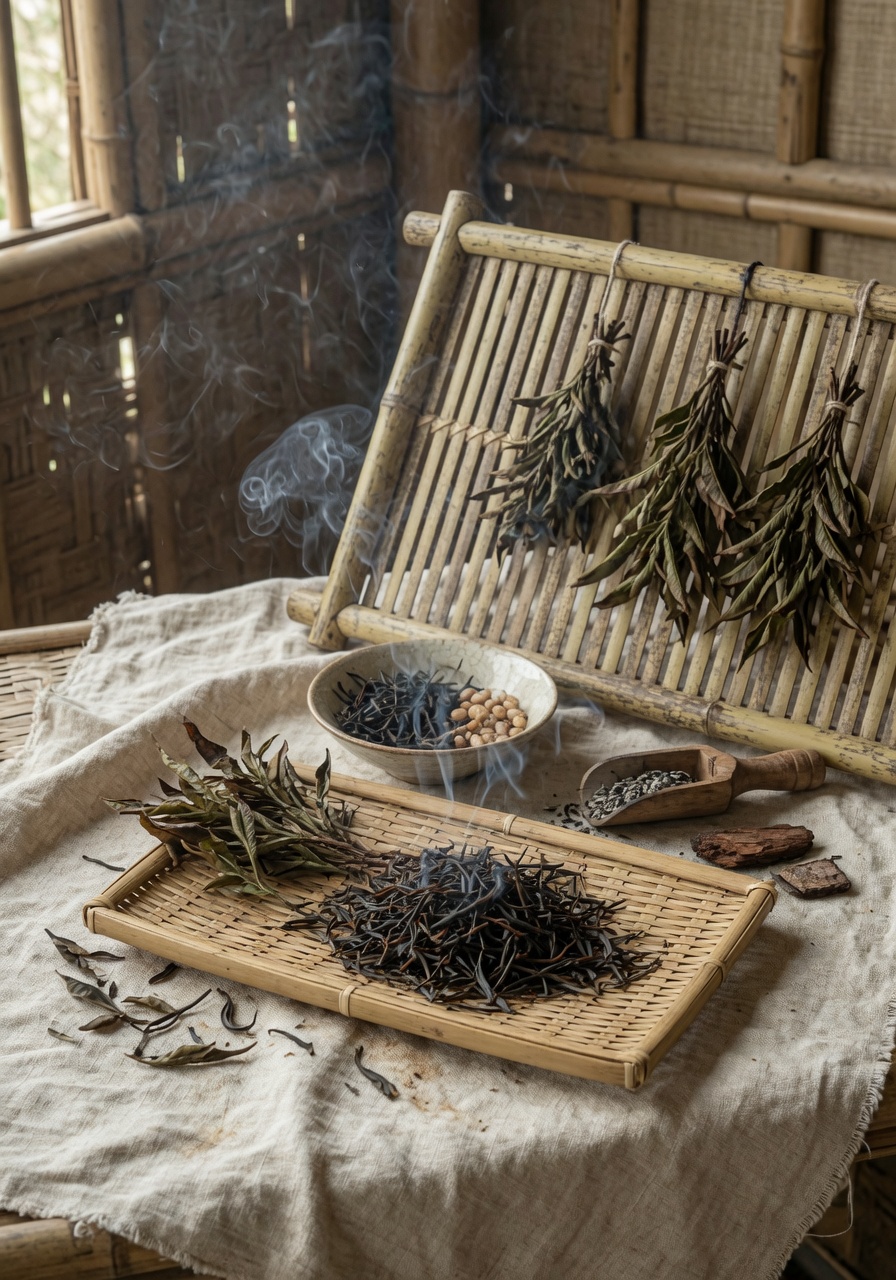
Smoky — defect or terroir character?
Wood smoke in the cup can mean a careless drying shed, a thunderstorm that forced the producer indoors, or a four-hundred-year tradition. The cupper's job is to tell which — and to score accordingly.
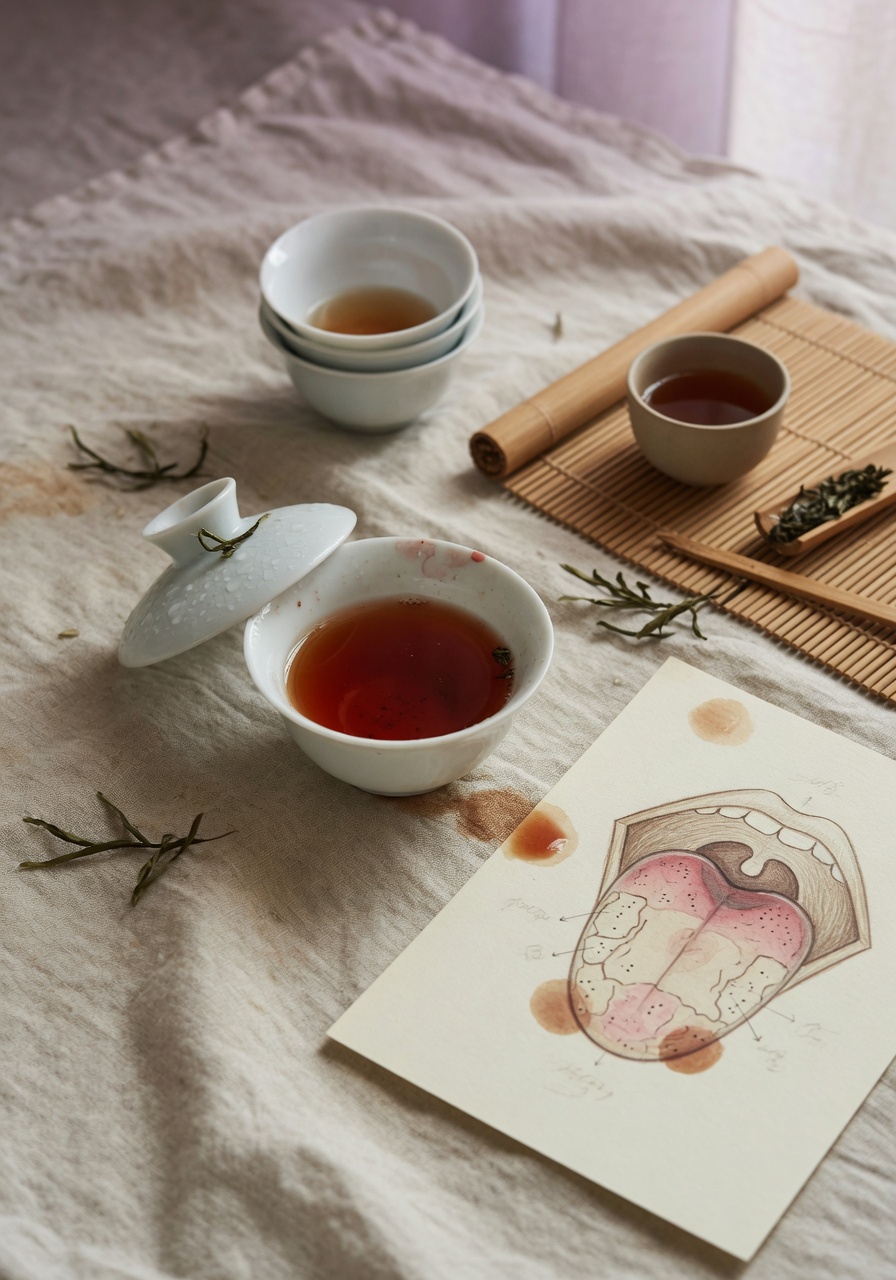
Huígān — the returning sweetness, scored
The sweetness that arrives after the tea is gone is the most discussed and least defined sensation in Chinese tasting rooms. Here is how to anchor it on a 10-axis rubric.

A six-week sensory calibration programme
Six weeks, six reference teas, one notebook. A structured programme to align your tasting scale to the GB/T standard — and to the cuppers who set it.
Astringency and mouth-feel — building a 5-point scale
Astringency is the tactile sensation that shapes a tea's architecture — not a taste, but a mouth-feel. Professional graders score it on a scale from silky absence to harsh grip. Here's how to build a calibrated 5-point scale that works across white, green, yellow, and beyond.