home · How a cup is <em>scored</em> — the mathematics of tea evaluation
Scoring rubrics
The official tea.academy rubric explained, criterion-by-criterion
A criterion-by-criterion tour of the 100-point sensory evaluation system that anchors tea.academy examinations and professional trade buying — from dry leaf geometry to the last echo of sweetness on the breath.
How do you put a number on a tea? The question has vexed buyers, producers, and educators for centuries. A tea that one taster calls ‘floral and lively’ might register as ‘thin and grassy’ to another, even when both sit at the same cupping table. The tea.academy scoring rubric exists to narrow that gap — not by eliminating subjectivity, which is the soul of sensory work, but by giving it enough structure to be repeatable, teachable, and defensible. Developed over a decade of collaborative work between academy faculty and trade buyers in China, the rubric borrows from the Chinese national standard GB/T 23776-2018 while adding a finer resolution for aftertaste, mouthfeel, and flavour complexity — the dimensions that turn a workable tea into a remarkable one. This article walks through each criterion, explaining what it measures, how points are distributed, and what a scorer actually looks for when the liquor hits the tongue. Whether you are calibrating your palate on tea.degree or preparing for a formal certification through tea.school, understanding the rubric is the first step toward seeing tea the way the market sees it.
The architecture of a scored tea session
The tea.academy rubric uses a 100-point scale divided across six dimensions, each with a fixed weighting: dry leaf appearance (15 points), aroma (25 points), liquor colour (10 points), taste and mouthfeel (30 points), infused leaf (10 points), and aftertaste with overall harmony (10 points). The weight assignment reflects a philosophical choice: flavour and tactile experience — the core of drinking — matter most, while appearance and spent leaves, though diagnostic, carry less numerical heft. Every criterion is scored independently against a calibrated reference set maintained by the academy, which includes four to six benchmark teas per category (white, green, yellow, oolong, black, dark). The total score then maps to a quality tier: 90–100 is exceptional, 80–89 is premium, 70–79 is commercial grade, 60–69 is acceptable but flawed, and below 60 indicates a tea that should not reach market. In a formal examination, the candidate must score a flight of three teas within a ±3-point tolerance of the panel average to pass the practical segment. This tolerance — narrow but not impossibly so — is a deliberate design: it rewards calibration while acknowledging that even expert palates diverge on the finest nuances.
Dry leaf — geometry, tip content, and colour integrity
Fifteen points may seem slight, but the dry leaf is the first evidence of picking standard, processing care, and storage history. A scorer examines a representative 5-gram sample spread on a white porcelain tray under daylight-spectrum light. Three sub-components are evaluated: shape consistency (are the leaves or buds uniformly sized, tightly rolled, or correctly twisted for the style?), tip-to-leaf ratio (higher tip content almost always signals a finer pluck and greater sweetness potential), and colour integrity (no scorched patches, no grey oxidation from stale tea, no unnaturally bright green that hints at fixation problems). In Bái Háo Yín Zhēn, a single oxidised tip costs you a point — not because it ruins the taste, but because it tells you that withering was uneven. The dry leaf is a resume; you read it before the interview. For green teas, the scorer also looks for the lustrous gloss known as cuì (脆) — a visual marker of well-preserved catechins. In rolled oolongs, pellet tightness and consistent particle size influence the score, since uneven rolling leads to uneven extraction. The dry leaf score is rarely a tie-breaker at the top, but it separates carefully handled teas from batch-blended fillers with a single glance.
What the dry leaf tells you about storage
Storage faults announce themselves first in the dry leaf. A white tea that has picked up ambient humidity shows a slight darkening at the edges — a browning that experienced scorers call ‘cold rust.’ A dark tea (hei cha) stored too dry loses the sheen of fungal-active ageing and takes on a dusty matte surface. These visual cues, cross-checked with aroma, form the first line of quality control before water ever touches the leaf.
Aroma — the three-phase assessment
Aroma holds 25 points, the second-largest chunk, because it predicts taste with remarkable accuracy and reveals faults that the palate might forgive on a first sip but that persist through the session. The rubric mandates a three-phase assessment: dry-leaf aroma (5 points), aroma of the infused liquor captured immediately after the pour (15 points), and aroma of the spent leaf after the final steep (5 points). For the infused liquor, the taster lifts the aroma cup — the tall, narrow vessel used in the Chinese gaiwan set — and inhales three times: once with the cup near the chin, once at the nose, and once deep inside the cup, tilting slightly, following the GB/T 23776-2018 ‘three-sniff’ protocol. The first sniff catches top notes (the most volatile aromatics), the second reveals the body of the aroma, and the third, with the cup cooling, exposes any off-notes hidden by initial volatility. Scorers score for intensity, complexity, and cleanliness. A jasmine-scented green tea, for instance, must show distinct floral layering without a stale vegetal undertone; a Wuyi rock tea must carry the mineral, roasty depth of its pedigree without carbon-forward char from over-firing. The academy’s reference library includes aroma kits for each category — sealed jars of benchmark samples that assessors sniff before every examination to anchor their memory.
The hot, warm, and cold cup sequence
The temperature of the aroma cup matters enormously. At ~85–95 °C, high volatiles dominate — think orchid, asparagus, toasty grain. As the cup cools to around 50–60 °C, heavier, sweeter notes emerge: honey, stewed fruit, toasted nuts. Below 40 °C, the cold cup often betrays storage faults — cardboard, damp basement, or a hollow emptiness that signals a tea past its prime. The official rubric instructs scorers to note their impressions at each temperature stage, using a standardised set of 64 aroma descriptors available in the tea.degree vocabulary library.
Liquor colour — hue, clarity, and the life in the cup
The 10 points allocated to liquor colour may seem a formality, but the shade and clarity of a tea’s infusion speak directly to oxidation level, roast intensity, age, and cleanliness. The scorer holds the tasting cup over a white grading tile, tilting it 45 degrees to assess the depth of colour and the presence — or absence — of suspended particles. A fresh Lóngjǐng should glow with a bright, slightly yellow-tinged jade green that is transparent, not turbid. A Wuyi shuǐxiān, by contrast, earns points for a deep amber with a clear orange rim, signalling proper roast penetration and adequate ageing. Cloudy liquor in any category but dark tea is an immediate deduction, usually pointing to microbial activity, poor filtration, or excessively broken leaf. For aged white teas, a progression from pale champagne to deep apricot is expected, and the scorer adjusts the expectation accordingly. The academy’s reference card for liquor colour provides 12 standard colour swatches — from ‘pale straw’ to ‘dark chestnut’ — calibrated to a spectrophotometer so that examiners across continents can align their language. This is one place where the rubric values objectivity: colour can be verified with instruments, yet it remains a surprisingly powerful proxy for quality when the taster is well-calibrated.
Taste and mouthfeel — the 30-point core
Thirty points for taste and mouthfeel acknowledge that tea is first a beverage, and flavour is the reason we return to the cup. The rubric splits this dimension into taste (flavour quality, balance, intensity, and accuracy to type) and mouthfeel (body, astringency structure, smoothness, and coating). To evaluate, the taster slurps a 10-ml liquor sample sharply across the tongue, aerating it to release aromatics retronasally, then rolls the liquid across the entire oral cavity before spitting — or swallowing, though spitting is standard in prolonged sessions to prevent palate fatigue. Flavour descriptors follow the academy’s 64-leaf sensory wheel, with special attention to the bitter-sweet axis. Bitterness is not automatically penalised; rather, it is assessed for type: a clean, quick-flash bitterness that converts to sweetness within seconds is a hallmark of fine shēng pǔ’ěr, while a stagnant, vegetal bitterness that coats the throat earns deductions. Sweetness, too, is calibrated — the honey-water sweetness of an oxidised dancong versus the cooling-sugar sweetness of a shade-grown Ānjí Bái Chá. Mouthfeel gets equally granular attention. Astringency is scored on a 5-point intensity scale (linked to the tea.degree astringency calibration article), but also by quality: tight, puckering astringency that leaves the mouth dry is a flaw; fine-grained, ‘chalky’ astringency that stimulates saliva is often desirable in young sheng. Body, meanwhile, is assessed from 1 (water-thin) to 5 (syrup-thick), with the ideal varying by tea type.
The bitter-sweet axis and huígān timing
Huígān — the returning sweetness — is the bridge between taste and aftertaste. The rubric requires the scorer to note the onset time (in seconds) from the moment the liquor is swallowed until a wave of sweetness rises from the throat. Under 5 seconds is considered rapid; 5–15 seconds is standard; over 20 seconds suggests a tea lacking structure. The official protocol uses a stopwatch for this measurement during calibration exams, a detail that surprises many newcomers but reflects the academy’s commitment to precision. For more on this phenomenon, see the companion article ‘Huígān — the returning sweetness, scored’ on tea.degree.
Body — from water-light to syrup-thick
Body is often the most misunderstood criterion. It is not about strength of flavour but about the physical weight of the liquor on the palate — a function of soluble solids, polysaccharides, and pectin content. Green teas typically score light-to-medium; well-fermented black teas achieve a medium-full body; and aged pǔ’ěr or heavily roasted Wuyi yán chá can push into full, almost oily territory. Scorers are trained with a glycerol-and-water concentration series to internalise the scale, ensuring that body is judged independently of personal preference.
Infused leaf — the afterimage of craftsmanship
With 10 points, the infused leaf is the final diagnostic page of a tea’s biography. After the last steep, the leaves are tipped onto the gaiwan lid or a white saucer and examined for colour evenness, degree of oxidation or fermentation, leaf integrity, and flexibility. Uniformity is the watchword: a perfectly processed sencha-style green tea shows leaves that are all a consistent bright green, with no yellow or brown spots that would indicate uneven kill-green heat. For partially oxidised oolongs, the scorer looks for the classic ‘red edge, green centre’ — lǜ yè hóng biān (绿叶红边) — in leaves that have been tossed correctly; the absence of this feature in a traditional Táoguàn-style dancong suggests shortcut oxidation. You can fake a lot in the cup, but you cannot fake the spent leaf. Teas that taste acceptable can still have wet leaves that reveal a patchwork of different cultivars — blended to hide a processing mistake. Leaf integrity also matters: a high percentage of whole leaves earns full marks, while excessive breakage suggests rough handling or re-roasting of older material. The spent leaf is additionally smelled for any residual off-aromas — that final cold sniff often catches storage taint that the liquor hid.
Aftertaste and harmony — the final 10 points
Aftertaste and harmony represent the most subjective score in the rubric, yet also the one that separates good from transcendent. ‘Aftertaste’ encompasses the length and quality of the lingering sensation — sweetness, cooling (the huí gān and huí tián duo), mineral resonance (the yán yùn of rock teas), and any throat-coating or relaxing effect. ‘Harmony’ asks whether all the preceding elements cohere into a unified experience, or whether the tea feels disjointed — a brilliant dry leaf that leads to a thin liquor, or a powerful aroma that collapses into hollow taste. The scorer is trained to wait a full 60 seconds after the last sip before awarding this score, using that quiet interval to let the tea’s total imprint settle. For candidates taking the blind tasting exam on tea.degree, this is where the rubric demands the deepest trust in calibration, as there are no external references — only the memory of hundreds of teas and the internalised threshold for what constitutes length, sweetness, and balance. The academy provides a 20-point supplementary scale for trade buyers who need to make rapid purchasing decisions, where aftertaste and harmony are collapsed into a single ‘finish’ score alongside a simplified dry leaf and taste assessment, but the full 10-point aftertaste criterion remains the gold standard for teaching and certification.
Using the rubric for trade buying
In a buying scenario — say, at the Fúdǐng white tea market — the full 100-point rubric is often compressed into a 20-point quick-score sheet: dry leaf (3), aroma (5), liquor colour (2), taste/texture (6), and finish (4). The tea.academy training teaches students to translate fluently between the two systems, so that a buyer can mentally reconstruct the detailed picture in seconds. The 20-point variant was designed for speed, but its DNA is identical.
Calibration and the human element
No rubric survives contact with an uncalibrated palate. The academy therefore mandates a 12-hour calibration protocol before any examination or official buying event, part of which is available as a self-guided six-week programme on tea.degree. Calibrators taste through a set of five reference teas — one per major category — each morning for three days, logging their scores into the tea.degree scoring interface, which overlays their radar charts against the master panel’s reference curves. If a scorer’s deviation exceeds the ±3-point tolerance, the system flags the criteria — usually aroma or mouthfeel — where drift has occurred, and recommends targeted exercises, such as the orchid vs. longan aroma pairs or the astringency 5-point scale drills. The rubric is a map, but calibration is the compass: you can study the map for years, but if your compass is bent, every tea you taste will be off-course. The tea.degree sensory wheel — a 16-segment, 64-leaf interactive tool — was built directly from this rubric to give students a tactile way to internalise the evaluation vocabulary. For those who want to test their calibration, the site’s blind mode strips away leaf images and origin labels, forcing a pure sensory engagement that mirrors the examination setting. It is this combination of a codified rubric, a structured calibration routine, and digital practice tools that makes the tea.academy system genuinely reproducible in a way that traditional master-apprentice relationships, for all their depth, often cannot scale.
References
- GB/T 23776-2018 Methodology of sensory evaluation of tea — Standardization Administration of China
- ISO 3103:1980 Tea — Preparation of liquor for use in sensory tests — International Organization for Standardization
- A review of tea sensory scoring methods and their application in quality grading — Wang, L. et al., Journal of Tea Science, 2020
- Cross-regional calibration benchmarks for pǔ'ěr and dark tea evaluation — tea.degree reference library
Read next
Related articles
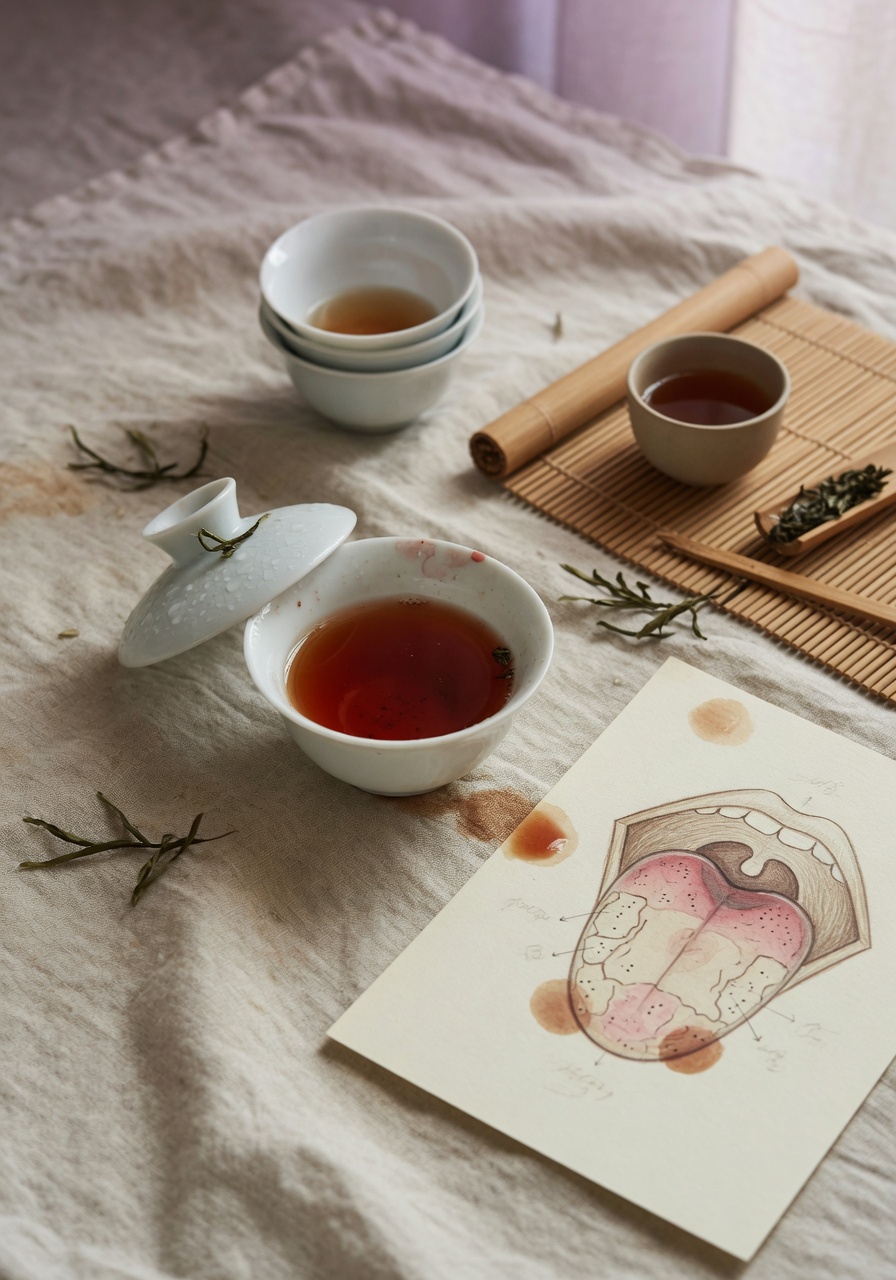
Huígān — the returning sweetness, scored
The sweetness that arrives after the tea is gone is the most discussed and least defined sensation in Chinese tasting rooms. Here is how to anchor it on a 10-axis rubric.
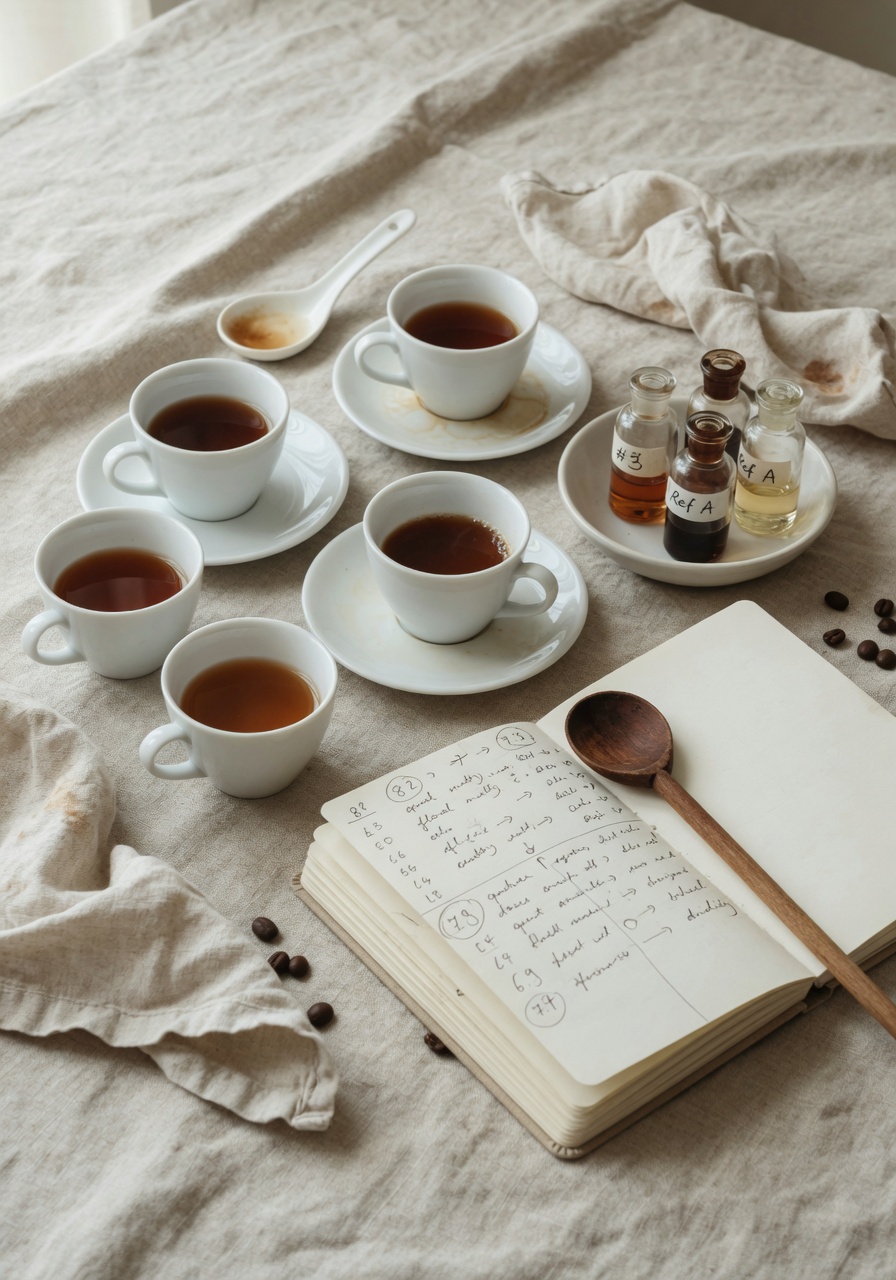
A six-week sensory calibration programme
Six weeks, six reference teas, one notebook. A structured programme to align your tasting scale to the GB/T standard — and to the cuppers who set it.
Astringency and mouth-feel — building a 5-point scale
Astringency is the tactile sensation that shapes a tea's architecture — not a taste, but a mouth-feel. Professional graders score it on a scale from silky absence to harsh grip. Here's how to build a calibrated 5-point scale that works across white, green, yellow, and beyond.
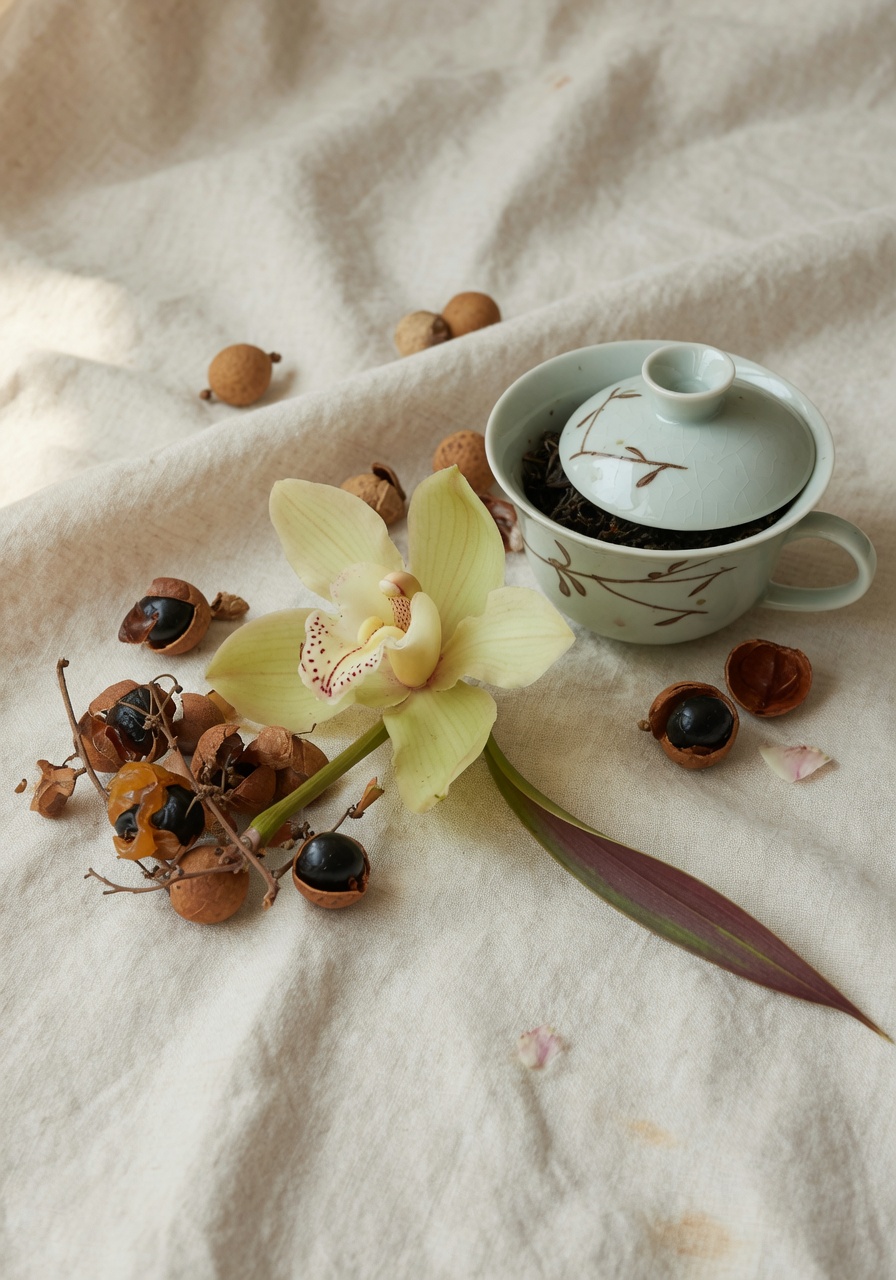
Orchid vs longan aroma — telling them apart
Two of the most over-used descriptors in Chinese tea evaluation sit only one nuance apart. This is a field guide to keeping orchid and longan distinct in your nose, your notes, and your scoring sheet.