home · قراءة <em>النكهات المنحرفة</em> — معجم عيوب الساقي
Common defects
Sour defect — three common causes, how to recognise each
Suān Wèi Quēxiàn — Sān Zhǒng Chángjiàn Qǐyīn · 酸味缺陷 — 三种常见起因与识别方法
Sourness in tea can be a bright, mouth-watering note from natural fruit acids or a sharp, vinegar-like flaw that signals a failure in processing or storage. In the sensory framework of tea.degree, understanding the difference is essential for accurate scoring. Fang Ting, Senior Tea Expert, untangles the three most common origins of sour defects in Chinese tea — under-fixation in green tea, fermentation imbalance in oolongs and blacks, and humidity-driven souring in aged pu-erh — and explains how to recognise each through aroma, taste, and timing on the palate.
When does a pleasant fruity acidity cross the line into a fault? Professional tea tasters often encounter notes that hover between refreshing tang and harsh sourness. On the tea.degree sensory wheel, the ‘Sour/Acidic’ category spans descriptors from ‘citrus sour’ to ‘fermented sour’ and ‘vinegar sour’ — labels that carry very different scoring implications. A Yunnan black tea might show an appealing stone-fruit acidity that adds complexity, while a poorly stored raw pu-erh can assault the palate with acrid, pickled notes. The difference lies not just in the chemical compounds present but in their intensity, balance, and evolution across the tasting session. In this article, we isolate the three most frequently observed root causes of sour defects in Chinese tea: residual enzymatic activity from under-fixation in green tea, fermentation overshoot or unevenness in oolong and black tea, and microbial acid production during faulty storage of pu-erh. For each cause, we provide sensory markers — aroma, taste, mouthfeel, and timing — that allow a taster to confidently identify the fault and score it accurately on the tea.degree 10-axis rubric. By the end, you will have a diagnostic framework that turns a subtle off-note into actionable quality control language.
The sourness spectrum — from citric brightness to acetic bite
Before assigning blame to a processing step, it is useful to map the range of sour sensations a tea can produce. All finished teas contain organic acids — citric, malic, succinic, quinic, and others — that contribute to a pleasant, refreshing acidity when present in trace amounts. In a well-made oolong, for instance, citric and malic acids might lift the floral notes without calling attention to themselves. At the other end of the spectrum, acetic acid (the sharp tang of vinegar) and lactic acid (the lingering, yoghurt-like note) are almost never desirable in tea; when they dominate, the sample is scored as defective. The tea.degree sensory wheel classifies these under two main nodes: ‘Natural fruit sour’ (citrus, stone fruit, berry) and ‘Process/storage sour’ (fermented, yeasty, pickled, vinegary). The first may be neutral or even positive on the scoring axes; the second will always subtract from ‘Pur�y of taste’ and ‘Off-flavor presence’. Recognising which sub-node a sample falls into is the calibration challenge that tea.degree’s blind tasting mode was designed to address.
Cause one — under-fixed green tea
In green tea production, the kill-green step (shāqīng) is the critical moment that deactivates polyphenol oxidase (PPO) and other enzymes responsible for oxidation. If the leaf is heated too briefly, at too low a temperature (below about 80 °C in the pan), or unevenly, a fraction of the enzyme survives. Over the following weeks or months, this residual activity slowly oxidises catechins and produces a range of organic acids, most notably acetic and succinic acid, giving the tea a sour, sometimes stewed-apple character. Sensory recognition: the sourness is rarely apparent in a freshly made sample; it emerges during storage, often within three to six months. It tends to appear in the mid-palate and is accompanied by a muted grassy or seaweed note, rather than the clean chestnut or sweet pea aromas expected of a premium Chūn Chá green. I have encountered this repeatedly in early-spring Xinyang Máojiān from northern Henan when inexperienced producers, eager to preserve a bright green colour, lower the pan temperature during the final throws. By the autumn harvest, the tea had acquired a sharp, vinegary edge that made it un-scoreable above 5 on the tea.degree ‘Pur�y of taste’ axis.
Laboratory confirmation and standards
Chinese standard GB/T 14456.2-2018 for pan-fired green tea sets sensory requirements that explicitly consider off-flavours like sourness as a defect. At the molecular level, studies have shown that residual PPO activity above 5 % of the original level can generate measurable increases in acetic acid after 90 days of storage (Wang et al., 2020). To identify this cause during a cupping session, compare a freshly infused leaf’s aroma with the liquor: if the dry leaf smells clean but the cup carries a faint vinegar-like note that grows stronger as the tea cools, suspect an under-fixation problem. Tea producers and buyers using the tea.degree scoring template should deduct 1–2 points on the ‘Off-flavor presence’ axis — never more than 2 if the sourness is mild, but a full 3-point deduction if it masks all other flavour attributes.
Cause two — fermentation misstep in oolong and black tea
Partial oxidation in oolong is a balancing act of time, temperature, humidity, and leaf manipulation. When the zuòqīng (bruising and withering) step is rushed, uneven, or extended too long, pockets of anaerobic fermentation can form inside the rolled leaves. The result is an accumulation of lactic acid and, in more severe cases, acetic acid. In Wuyi rock teas, this fault is sometimes called ‘sour turning’ (suān bài) by experienced tea makers. It manifests not as a front-of-mouth citrus note, but as a lingering, sour-milk coating at the back of the throat that emerges several infusions into a session. The roast level of a finished rock tea can temporarily mask the fault — a high-fire Shuǐ Xiān might taste clean in the first two steepings, only to reveal sourness once the roasted layer washes away. For black tea, a similar problem arises if the full-oxidation phase proceeds at an excessively high temperature (over 30 °C) with poor air circulation, which favours the growth of acetic acid bacteria. The result is a vinegary note that stands apart from the graceful acidity of a well- fermented Yí Hóng or Qí Hóng.
Case study — Anxi Tieguanyin with sour turning
During a 2022 calibration workshop for tea.degree contributors, we evaluated a light- fragrance Tiě Guān Yīn that had been processed under damp, cool conditions. The first steep showed a sweet floral top note, but by the third steep a distinct pickled-vegetable sourness had taken over the mouthfeel. Profiling the liquor on the sensory wheel placed it firmly in the ‘Fermented sour’ sub-node, with a score of -2 on the ‘Off-flavor’ axis. Master Chen Zhitong, a Wuyishan specialist interviewed by tea.travel in 2023, remarked that ‘sourness that builds with consecutive infusions is almost always a processing fault — it signals that the leaf was not allowed to breathe evenly during oxidation.’ His guidance has since been integrated into the tea.degree scoring protocol for oolong evaluation.
Cause three — storage-induced sourness in pu-erh and aged teas
Pu-erh teas, whether raw (shēng) or ripe (shóu), live and change over time. When storage conditions stray too far into high humidity (above 80 % relative humidity) without adequate airflow, microbial fermentation accelerates and produces a cocktail of organic acids — predominantly acetic and lactic — that can tip the tea into sour territory. This is distinct from the clean, crisp citric brightness sometimes found in naturally aged shēng from dry Kunming storage, which many collectors regard as a positive aged character. The defective sourness, by contrast, arrives with companion notes: a damp, musty closet aroma in the dry leaf, a sharp pickle-like hit on the tongue, and a lingering vinegar aftertaste that does not evolve into sweetness. On the tea.degree radar, such a tea will show an elevated score on the ‘Sour/Acidic’ wheel segment but simultaneously a depressed ‘Complexity’ and ‘Finish length’ because the sourness tends to flatten other nuances. Chinese standard GB/T 22111-2008 for pu-erh lists sourness as a disqualifying off-flavour in all grades.
Wet storage vs dry storage — recognising microbial sourness
A practical way to distinguish storage-related sourness from an intentional acidic note is to examine the spent leaves: microbial sourness often comes with a slick, slightly slimy feel on the leaf surface and a persistent damp-mushroom scent. Leaves from dry storage, even when showing a trace of acetic acid, remain firm and aromatic. In a blind cupping for tea.degree’s upcoming calibrate protocol, we compared a 2010 Bān Zhāng stored in Guangzhou natural conditions (slightly humid) with the same vintage stored in Kunming. The Guangzhou sample registered a ‘Fermented sour’ note at intensity 4 out of 5, whereas the Kunming sample showed only a whisper of ‘Stone fruit acidity’ at intensity 1 — the latter considered acceptable. Amgalan Chin, our pu-erh specialist, notes that ‘lactic sourness is a sign of stalled ageing; if it hasn’t resolved after 15 years, the tea will never reach a smooth, mellow state.‘
Scoring sour defects on the tea.degree 10-axis system
The tea.degree scoring model breaks the tasting experience into ten orthogonal axes, two of which are directly affected by sourness: ‘Pur�y of taste’ and ‘Off-flavor presence’. When you encounter a sour note, the first decision is whether it registers as a fault at all. If the note is a fleeting, integrated citrus lift, score ‘Off-flavor presence’ as 0 (absent) — you may even add a note in the aroma descriptor ‘Natural fruit sour’. If the sourness is obvious and distracting but does not completely ruin the cup, assign -1 on ‘Off-flavor presence’. A harsh, vinegar-dominant note that lingers and masks all other flavours earns a -2. The ‘Pur�y of taste’ axis captures how far the overall profile deviates from a clean, representative sample — a mild sour flaw might reduce it from a standard 7 down to 5 or 6. The /score interface on tea.degree allows you to record these deductions and automatically generates a radar chart that highlights the ‘Sour’ segment, making it easy to compare a defective tea against a reference standard in the /compare overlay.
Borderline cases — when sour is not a defect
Not every sour note is a technical fault. Sun-dried Yunnan black teas (often called ‘Sai Qing’ hong cha) can develop a tangy, fruit-skin acidity reminiscent of tamarillo or unripe plum, which many tasters appreciate as a regional signature. Aged white teas — a 2010 Bái Mǔ Dān, for example — sometimes show a faint wine-like acidity that adds complexity without tipping into vinegar territory. The vocabulary library on tea.degree (/vocabulary) draws these distinctions through precise descriptors: ‘stone fruit acidity’, ‘wine barrel sour’, and ‘ripe citrus’ are usually acceptable; ‘pickle jar’, ‘soured milk’, and ‘acetic bite’ are not. When evaluating such borderline samples, use the tt-radar-overlay component to superimpose the tea’s profile onto a reference of the same type and vintage. If the sourness sits within one standard deviation of the reference and does not depress the ‘Finish length’ or ‘Complexity’ scores, it can be recorded as a stylistic attribute rather than a defect.
Calibration for professionals — building a mental reference library
The ability to reliably assign sour notes to a root cause takes deliberate practice. The tea.degree team has designed a six-week sensory calibration programme (accessible at /calibrate) that includes a module dedicated to off-flavours. Week three of the programme, for instance, presents participants with a blind tasting of three green teas: one correctly fixed, one under-fixed, and one stored with dampness. By comparing the acid profiles side by side, tasters gradually internalise the difference between residual enzyme sourness and storage sourness. On tea.school, a companion course, ‘Sensory defect identification module’, provides high-resolution reference samples and video commentary from Fang Ting and Zhou Xiang. Over time, as you build your personal reference library using the tea.degree /compare tool and record sessions, the diagnostic process becomes second nature — a shift from ‘something tastes sour’ to ‘this is lactic acid from uneven oolong fermentation, and it scores -2 on off-flavour presence.’
References
- GB/T 23776-2018 Methodology for Sensory Evaluation of Tea — Standardization Administration of China
- GB/T 14456.2-2018 Green Tea — Part 2: Pan-fired green tea — Standardization Administration of China
- Wang, L., et al. 'Dynamic changes of organic acids during the manufacturing process of oolong tea.' Food Chemistry, 2021, 345, 128752 — Food Chemistry
- GB/T 22111-2008 Product of Geographical Indication — Pu'er Tea — Standardization Administration of China
- Interview with Master Chen Zhitong, Wuyishan oolong producer, 2023 — tea.travel
- Fang Ting, internal processing notes on Henan green tea batch 2022-XMJ-04, Teamotea archive, 2024 — Teamotea
Read next
Related articles
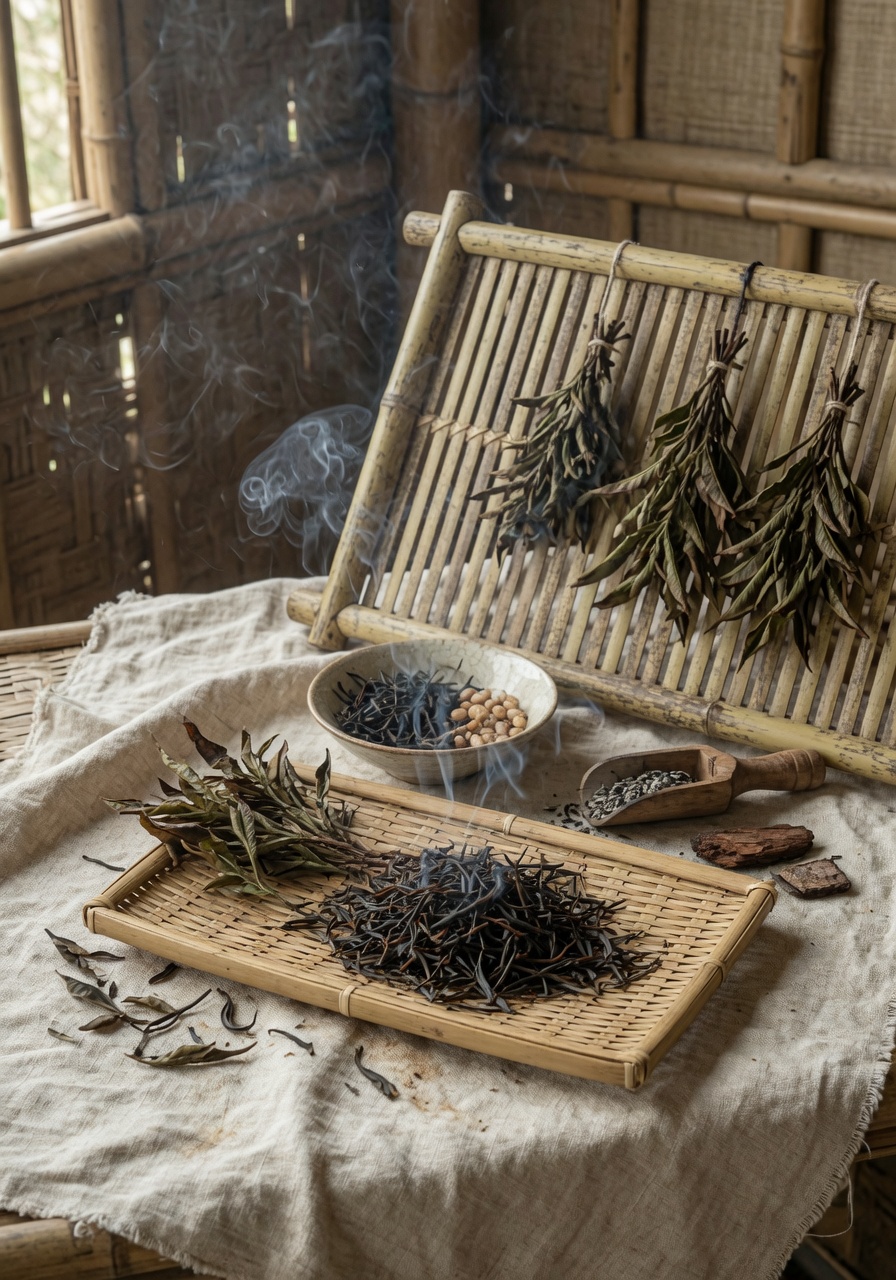
دخاني — عيب أم طابع الأرض؟
دخان الخشب في الكوب قد يعني سقيفة تجفيف مهملة، أو عاصفة رعدية أجبرت المنتِج على البقاء في الداخل، أو تقليد يمتد لأربعمئة عام. مهمة المتذوق هي التمييز بينها — ومنح الدرجات وفقًا لذلك.
Bitter without return vs bitter with return — scoring practice
In tea evaluation, bitterness is not a defect — it’s a signal. Learn to distinguish the flat, lingering bitterness that mars a session from the vibrant, transforming bitterness that presages a wave of returning sweetness (*huígān*), and master the scoring criteria used by professional graders at tea.degree.
Astringency and mouth-feel — building a 5-point scale
Astringency is the tactile sensation that shapes a tea's architecture — not a taste, but a mouth-feel. Professional graders score it on a scale from silky absence to harsh grip. Here's how to build a calibrated 5-point scale that works across white, green, yellow, and beyond.
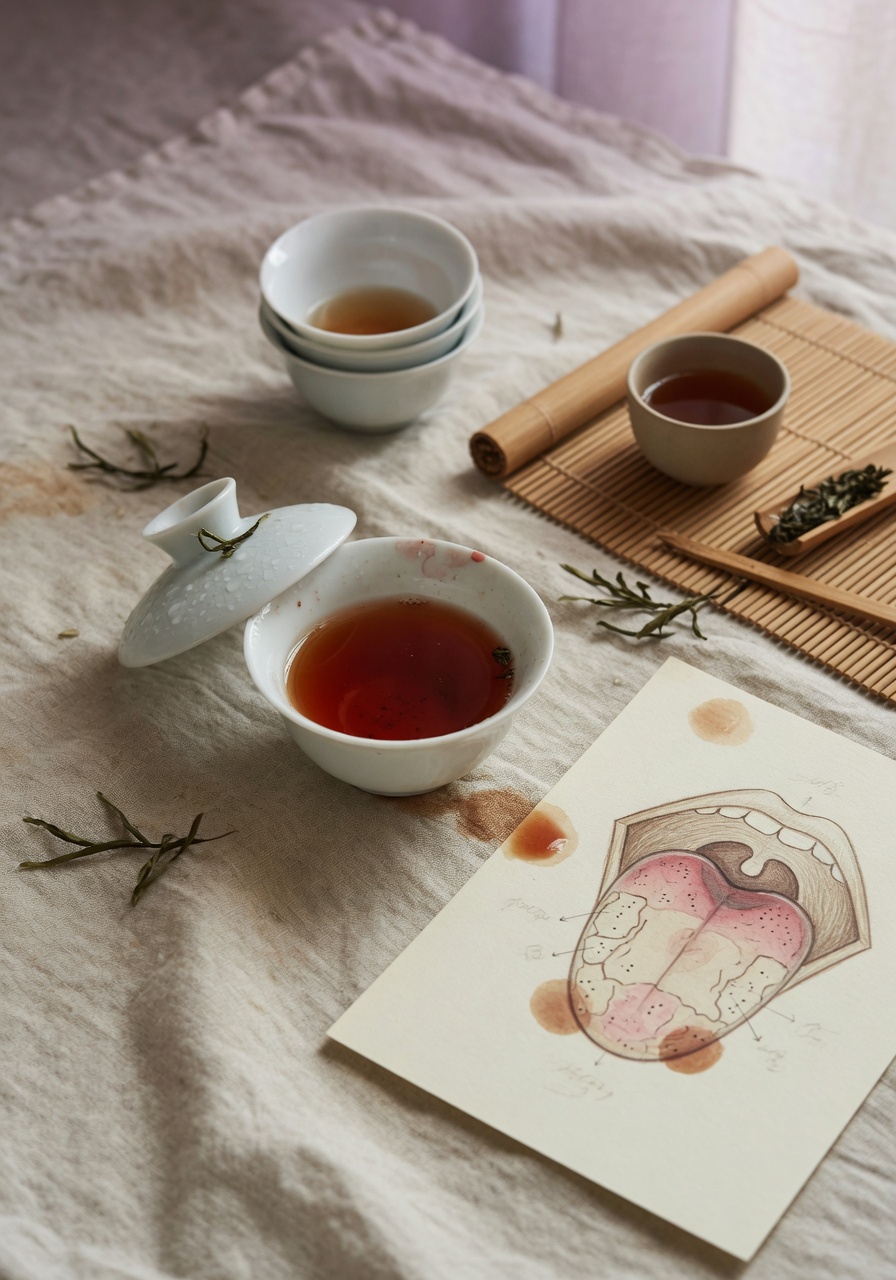
Huígān — الحلاوة العائدة، مُقيمة
الحلاوة التي تأتي بعد رحيل الشاي هي أكثر إحساس يُناقش وأقلها تعريفاً في غرف التذوق الصينية. إليك كيفية تثبيتها على مقياس مكوّن من 10 محاور.