Why isolate one variable at a time
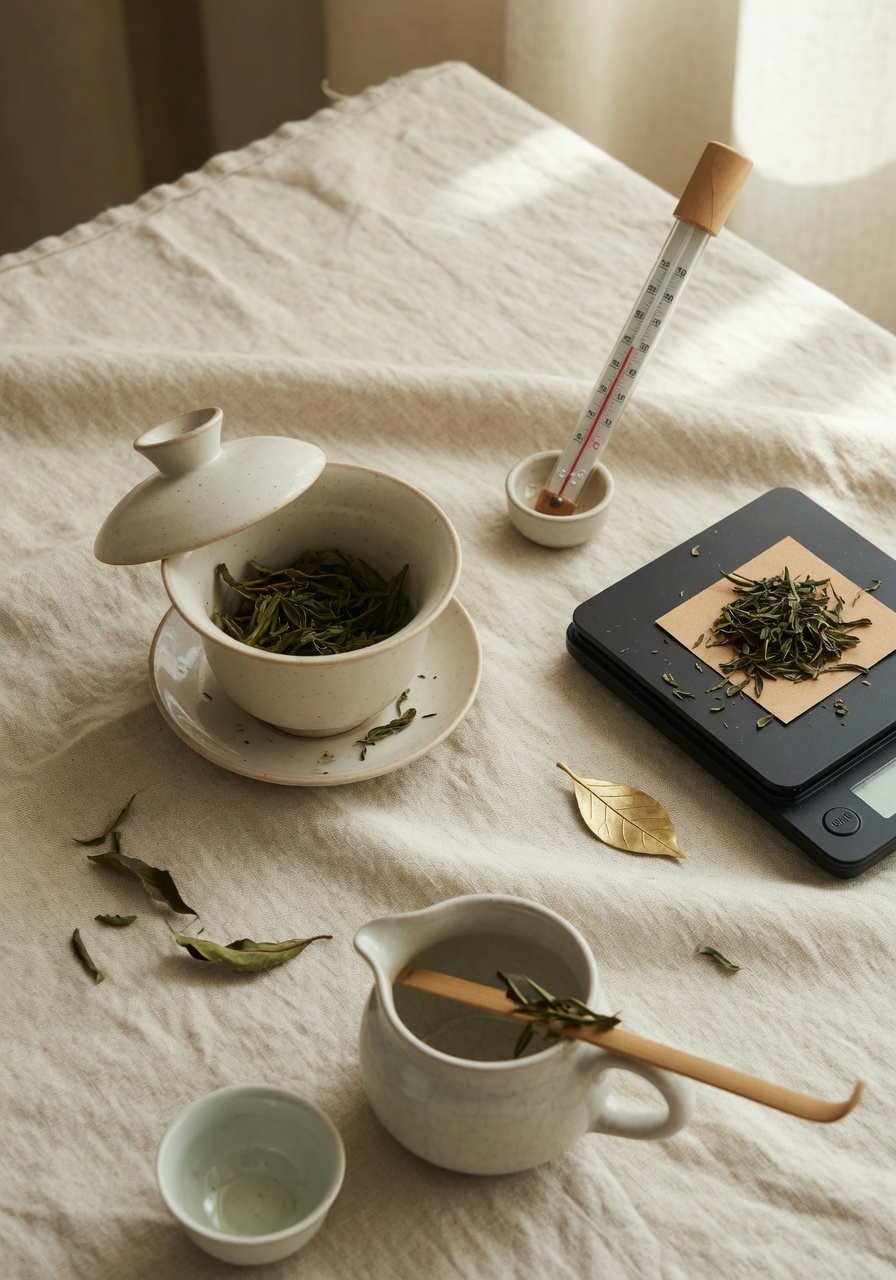
A brewing protocol is a hypothesis. When Bái Háo Yín Zhēn (白毫银针) from Fuding tastes thin one morning and honeyed the next, the cause is rarely the leaf — it is the cook holding the kettle. The four dials are leaf-to-water ratio (usually expressed as grams per 100 ml), water temperature, vessel material and volume, and steep time. Each shifts extraction along a different chemical axis: temperature governs how fast catechins, caffeine, and aromatic terpenes leave the leaf; ratio sets the saturation ceiling; vessel determines heat retention and what aromatics adsorb into the wall; time integrates the lot.
The protocol that lets you tell them apart is older than it looks. The Chinese national standard GB/T 23776-2018, Methodology of sensory evaluation of tea, codifies a single reference brew — 3 g of leaf in 150 ml of water, steeped 5 minutes — precisely because it removes three variables so a tasting panel can argue about the fourth: the leaf itself. Producer competitions at the China Tea Science Society have followed the same template since the 2009 revision. The point is not that this brew tastes best. It does not. The point is that it tastes the same in Hangzhou, Fuding, and Phoenix Mountain, so a defect in a Chaozhou dāncōng is not confused with a defect in the brewer.
For the calibrating drinker, the discipline is simpler. Pick a tea you know — Mei Yang at our Guangdong desk recommends a mid-tier Mì Lán Xiāng (蜜兰香) from Wudong village because its honey-orchid signature is loud enough to hear changes. Brew it twice. Move one dial. Brew it again. Write down what shifted. The article Temperature curves across the six categories of Chinese tea maps where each tea class sits on the thermal axis — green at 75–80 °C, yán chá rock oolongs at full boil, aged shú pǔ’ěr tolerating anything — and explains why a 5 °C error costs more in a Lóngjǐng than in a 2008 Menghai brick.
Vessel deserves its own paragraph. A 110 ml porcelain gàiwǎn (盖碗) is the laboratory glass of Chinese tea: thin walls, neutral surface, fast pour. Yixing zǐshā clay, by contrast, is a participant — it stores heat, rounds astringency, and over years builds a patina that flavours the next brew. Switching from gaiwan to clay is not a refinement of the same brew; it is a different experiment. Sommeliers at tea.community keep two of each on the bench for exactly this reason. Steep time is the most forgiving dial — most errors are recoverable on the next infusion — which is why beginners over-rely on it and ignore the other three.
Calibration is not pedantry. It is the difference between knowing a tea and merely liking it. Once the four dials are stable, the leaf has nowhere to hide, and the cup begins to tell you what the farmer did in April. For tasting rubrics that depend on this stability, see also tea.school on sensory training, and the scoring tools elsewhere on this site.