From cupping-room shorthand to a working taxonomy
Chinese tea evaluation has carried a working aroma vocabulary for at least four centuries — Lù Yǔ’s Chá Jīng already lists smoke, leather and floral notes as marks of grade — but the modern descriptor set is younger than most drinkers assume. The terms cuppers reach for today were stabilised across the 1980s and 1990s by the National Tea Research Institute in Hángzhōu and codified in the GB/T 23776 sensory-evaluation standard, finalised in 2009 and revised in 2018. That document names roughly forty primary aromas in Chinese; a working English translation circulates among export graders in Guǎngzhōu and Xiàmén, and tea.degree uses it as the spine of this topic.
Why a taxonomy at all? Because aroma sits at the intersection of biology and culture. Linalool and geraniol genuinely smell of orchid and rose to most noses, but whether a taster reaches for lán huā xiāng (orchid) or guì huā xiāng (osmanthus) depends on which reference they were trained against. A grader in Fènghuáng who grew up surrounded by Phoenix-mountain dāncōng will hear orchid in concentrations a Yúnnán-trained taster reads as honey. The vocabulary, in other words, is not a neutral list — it is a set of agreed reference samples. Our companion article Orchid vs longan aroma — telling them apart walks through the two most-confused descriptors in Chinese black and aged tea, with notes on the specific compounds (β-ionone, methyl salicylate) driving each.
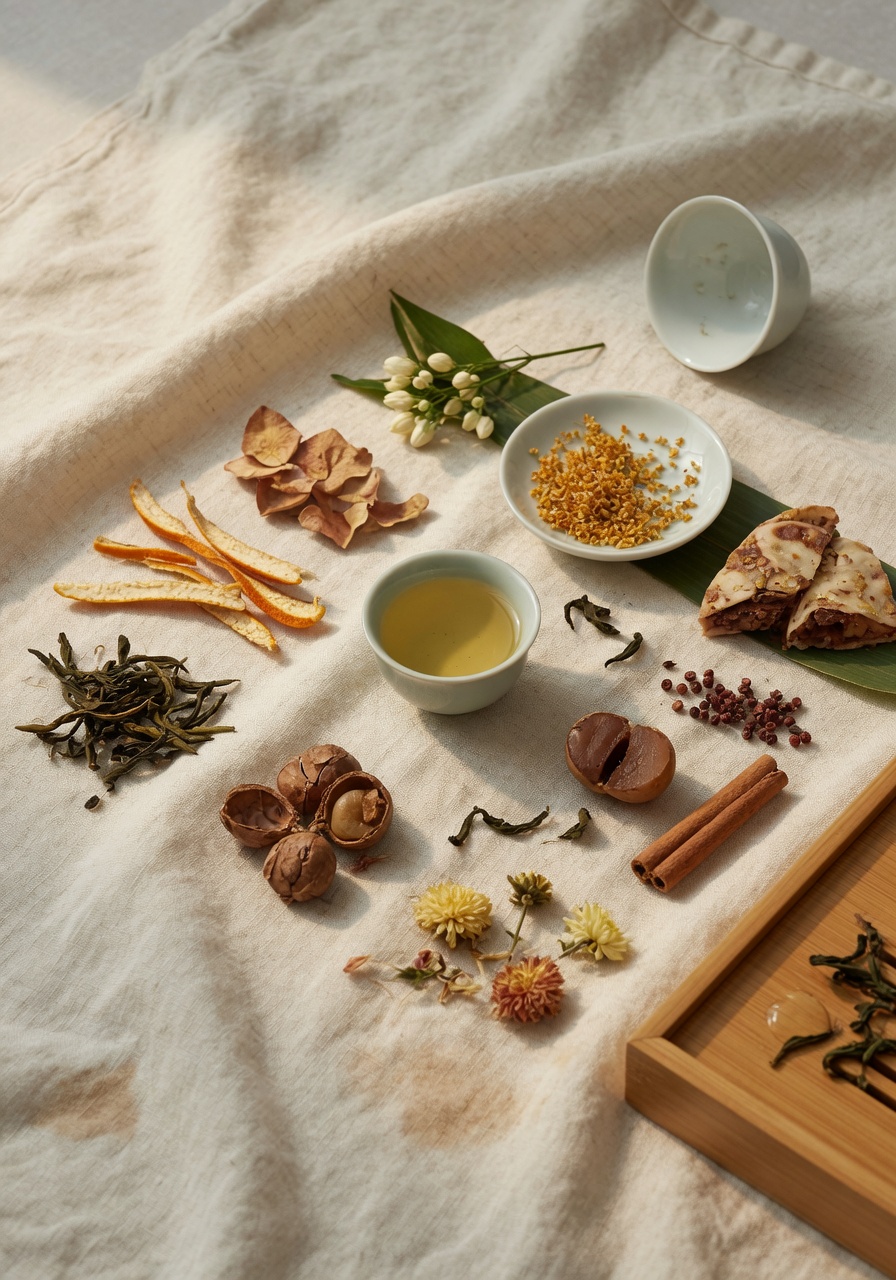
The entries collected under this topic cover six aroma families: floral (orchid, osmanthus, gardenia, mì lán xiāng honey-orchid), fruit (longan, lychee, dried apricot, guǒ xiāng), roasted (chestnut, almond, huǒ gōng fire-work), sweet (honey, brown sugar, caramel from shōu pǔ-ěr fermentation), woody-mineral (cedar, wet stone, the yán yùn rock-rhyme of Wǔyí cliffs) and aged (camphor, medicine cabinet, betel — markers of shēng pǔ-ěr past fifteen years). Each entry pairs the Chinese term, pinyin with tone marks, the dominant volatile compounds identified in published GC-MS studies, and at least one named reference tea from a verifiable farm — for instance the Xìngguǎngshān plot in Tóng Mù Guān whose pine-smoked Zhèng Shān Xiǎo Zhǒng remains the calibration sample for sōng yān xiāng across the trade.
This vocabulary is built to be used, not memorised. On tea.degree the same terms power the 64-segment sensory wheel at /wheel and the 10-axis scoring rubric at /score; the blind-tasting mode at /blind hides labels so a taster can check whether their orchid is really orchid and not a remembered one. Practitioners building service programmes will find the same terms cross-referenced into pairing notes on tea.community, and producers tracking how aroma evolves through processing can follow the cultivation-side discussion on puerh.app for shēng and shōu specifically.
A closing note on humility. The standard is a starting line, not a verdict. Mei Yang, who grades Phoenix dāncōng for our editorial board, keeps a working list of twelve aromas her teachers in Wūdòng village use that have no GB/T equivalent. Vocabulary grows when noses agree.