home · مفردات <em>ملمس الفم</em> المرتكزة على الكوب
Taste & mouthfeel vocabulary
Huígān — the returning sweetness, scored
Huí Gān · 回甘
The sweetness that arrives after the tea is gone is the most discussed and least defined sensation in Chinese tasting rooms. Here is how to anchor it on a 10-axis rubric.
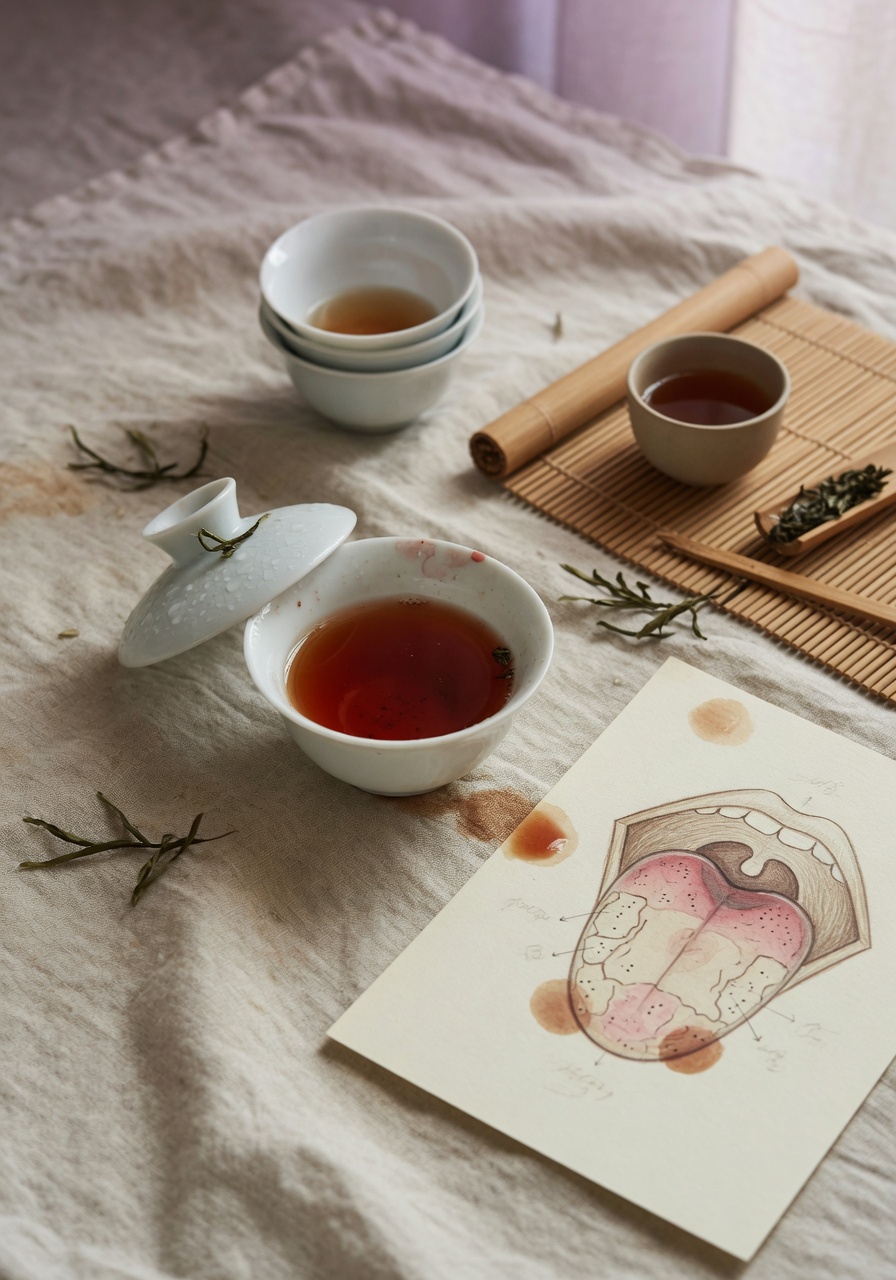
Walk into any tasting room from Wuyishan to Menghai and the word you will hear most often, after xiāng (fragrance), is huígān (回甘) — literally ‘returning sweetness’. It describes the sensation, usually fifteen to ninety seconds after swallowing, when the back of the tongue and the soft palate begin to register a sweetness that was not present at the moment of contact. Bitterness recedes, saliva returns, and a clean cane-sugar or rock-sugar note rises in its place. Buyers treat strong huígān as one of the clearest indicators of raw-material quality, particularly in shēng pǔ’ěr and high-mountain oolong; it is the sensation that justifies a price multiple of three or four over visually similar tea.
The problem is that huígān has, until recently, lived almost entirely in oral tradition. Two graders sitting at the same table will agree it is present, disagree on its strength, and have no shared vocabulary for whether it is wide or narrow, fast or slow, clean or mineral. At tea.degree we score it on three sub-axes — onset, amplitude, and duration — and anchor each against reference teas a calibrating taster can buy and re-taste. This article is the working document behind that rubric: what huígān physiologically is, what it is not, how the six categories of Chinese tea produce it differently, and how to grade it without sliding into wishful thinking.
What returning sweetness actually is
Huígān is not a single chemical event. It is the perceptual sum of three overlapping processes that occur after the bolus of tea has left the mouth. First, the high-molecular-weight catechins — chiefly EGCG and ECG — that produced the initial bitterness are cleared from the bitter receptors on the back third of the tongue. Second, free amino acids, particularly L-theanine and L-glutamine, continue to occupy the sweet- and umami-receptor sites, which have slower clearance kinetics. Third, saliva flow, which had been suppressed by tannin-protein binding, rebounds within thirty to sixty seconds. The result is a perceived sweetness arriving on a freshly hydrated palate, which the brain reads as cleaner and brighter than any sweetness encountered during the sip itself.
The 2019 paper by Yu Lijun and colleagues at the Tea Research Institute of the Chinese Academy of Agricultural Sciences (TRI-CAAS) measured this directly: subjects rated samples of Yún Nán big-leaf shēng with theanine:EGCG ratios above 0.45 as producing ‘strong huígān’ in 78 % of trials, while samples below 0.30 — chemically more bitter, with less amino-acid buffer — were rated as having no returning sweetness at all. The compounds are not exotic. What is unusual is the timing: sweetness perceived after bitterness reads, neurologically, as relief, and relief is rated higher than the same sweetness presented in isolation.
Not to be confused with shēng jīn
Shēng jīn (生津), ‘producing fluid’, is the salivary rebound — the wet, almost prickling sensation under the tongue and along the inside of the cheeks. It is a precondition for huígān but not the same thing. A tea can produce abundant shēng jīn without any returning sweetness (some young bái mǔ dān does this), and, more rarely, the reverse — a sweetness that arrives on a drier palate, as in well-aged liù bǎo. On the tea.degree scoring sheet shēng jīn and huígān are separate axes for this reason. Conflating them is the single most common error in informal tastings.
Not to be confused with residual sugar
Some teas — heavily roasted dāncóng, certain hóng chá from Tongmu — leave a genuine sugary coating on the soft palate from caramelised carbohydrates produced during firing. This is sweetness, but it is present from the first sip and decays monotonically. Huígān by definition rises after the tea is gone. If sweetness peaks at swallow and only fades, score it as ‘finish sweetness’, not huígān. Mei Yang, who grades dāncóng at origin, puts it bluntly in a 2022 interview with the Fenghuang co-operative: ‘Caramel is in the leaf. Huígān is in the body.‘
The three sub-axes we score
On the tea.degree rubric, huígān is decomposed into three numbers, each 0–10. This is more granular than the single-axis 0–5 used in most Chinese cupping protocols (including the descriptive system in GB/T 23776-2018), but the decomposition is what makes the score reproducible between tasters.
Onset (起) measures the latency from swallow to the first perception of sweetness. Fast onset, under twenty seconds, scores high. Slow onset, over a minute, scores low even if the sweetness is eventually strong — late-arriving sweetness is less diagnostic of quality and more often a sign of heavy material or hard water masking the early signal. Amplitude (幅) is the peak intensity, judged at whatever moment it occurs. A loud, clear cane-sugar peak scores 8–10; a thin trace requiring concentration to detect scores 2–3. Duration (久) is how long the sweetness remains detectable above baseline. Premium gǔ shù (古树) shēng pǔ’ěr can hold a measurable huígān for fifteen minutes or longer; a workmanlike factory blend rarely makes it past two.
The three numbers do not collapse into a single average. A tea with onset 9, amplitude 4, duration 3 (quick flash, fades fast) is a fundamentally different drinking experience from onset 4, amplitude 7, duration 9 (slow build, long hold). Both can be excellent; they suit different occasions and pricing tiers. Reporting all three preserves that information.
How the six categories produce it differently
Each of the six categories of Chinese tea generates huígān through a distinct chemical pathway, and a grader who applies a single mental template across categories will misread most of them. The reference teas listed below are what we use in our six-week calibration programme on tea.school and are deliberately chosen from producers whose lots are widely available.
Green tea (绿茶)
Fresh, unoxidised greens rely on the theanine-EGCG ratio almost exclusively. Onset is fast (10–20 seconds), amplitude moderate, duration short. Tài Píng Hóu Kuí from the Houkeng valley, picked before gǔ yǔ (穀雨), gives a textbook example: a clean grassy bitterness on the swallow, then sweetness rising at the back of the tongue within fifteen seconds and gone within ninety. Pre-rain Lóng Jǐng from Shifeng is similar in shape but lower in amplitude — more orchidaceous than sugary.
White tea (白茶)
Bái Háo Yín Zhēn (白毫银针) from Fuding produces a slow-onset, low-amplitude, long-duration huígān — a quiet hum of melon sweetness that can persist five minutes. Aged white tea (five years and above, properly stored) shifts toward higher amplitude as polyphenols slowly oxidise and free more amino acids. Chen Hui Yi, our white-tea specialist, notes that huígān in white tea is often missed by green-tea-trained palates because the onset is too quiet to flag attention; the calibration trick is to wait sixty seconds before judging.
Oolong (乌龙茶)
The category with the widest range. Light Ān Xī Tiě Guān Yīn in the modern jade style gives a green-tea-like profile. Traditional charcoal-roasted Wǔyí yán chá — a 2015 Lǎo Cōng Shuǐ Xiān from Manting Peak is our reference — produces a slow, deep, mineral huígān with strong duration and a distinctive throat component (hóu yùn, 喉韵) that the others lack. Fènghuáng Dāncóng sits between, with onset depending heavily on roast level.
Black tea, yellow tea, dark tea
Hóng chá from Tongmu (lapsang base, unsmoked) gives moderate huígān with a malted edge — Zhou Xiang’s tasting notes from the 2023 Wuyi black-tea grading panel describe it as ‘returning honey, not sugar’. Yellow tea (Jūn Shān Yín Zhēn, Méng Dǐng Huáng Yá) produces low-amplitude but very clean returning sweetness from its mèn huáng (闷黄) sweating step. Dark tea is the most variable: well-fermented shú pǔ’ěr from a 2008 Menghai 7572 brick gives a soft, woody huígān, while shēng pǔ’ěr from old-arbour Yibang material can deliver onset and duration scores higher than anything else in the cabinet.
Brewing variables that change the score
Huígān is not a fixed property of the leaf. The same dry tea can score differently depending on how it is brewed, and a calibrated taster has to control variables that recreational drinkers ignore. Water hardness matters most: above 120 ppm total dissolved solids the calcium and magnesium ions bind to catechins and amino acids alike, flattening both bitterness and returning sweetness. Our calibration protocol specifies 30–60 ppm soft mineral water (we use Nongfu Spring as the reference, with a backup of distilled water plus a measured magnesium-bicarbonate addition).
Water temperature shifts the bitterness-to-amino-acid extraction balance. Brewing shēng pǔ’ěr at 100 °C extracts more EGCG relative to theanine, which paradoxically can produce stronger huígān — more bitterness up front, more relief on the return — but only up to a leaf-to-water ratio threshold. Above roughly 8 g per 100 ml the bitterness saturates the receptors and the return reads as compressed and metallic. The full temperature-versus-category curve is in our companion piece on tea.degree.
Steep duration matters less than most tasters assume. Once enough soluble material is in the cup to register, the huígān shape is set; longer steeps amplify amplitude but rarely change onset or duration in proportional ways. This is useful — it means a single short steep is sufficient to read the huígān signature, and the second and third steeps are mainly confirmation.
Calibrating yourself against a reference
The standard objection to scoring huígān on a 0–10 scale is that one taster’s 7 is another taster’s 4. This is true and unavoidable in absolute terms, but irrelevant in practice — what matters is rank-order stability against a reference set. Our six-week calibration programme, run jointly between tea.degree and tea.school, gives tasters five anchor teas covering low, medium, and high huígān, asks them to score each five times across three weeks, and reports the standard deviation of their scores against the panel median.
Most tasters reach an inter-session standard deviation below 1.0 point on each of the three sub-axes within four weeks. Those who do not usually share one of two problems: they are scoring shēng jīn and confusing it with huígān, or they are letting expectation bias — knowing the tea is expensive — inflate their amplitude scores. The blind-tasting mode on tea.degree was built specifically to break the second pattern. Label-hidden cupping reduces amplitude inflation by, on average, 1.4 points across the panels we have run.
The goal is not to eliminate subjectivity; it is to make subjectivity stable enough that a buyer can compare a 7-7-6 score from one taster against a 6-7-7 from another and read it as roughly the same tea. That is sufficient for procurement decisions, which is what the rubric is ultimately for.
When huígān is a defect signal
Strong returning sweetness is usually a quality indicator, but not always. A huígān that arrives with a sour or sharp edge — what graders call suān huí (酸回) — indicates incomplete oxidation in hóng chá or wet-storage damage in shēng pǔ’ěr. A huígān that reads metallic rather than clean often means iron contamination from the shā qīng (杀青) pan or the roasting basket. And an unusually long-duration sweetness in a tea that otherwise tastes thin can indicate added flavouring — usually sucralose or stevia sprayed during finishing, which is illegal under GB 2760-2014 for unflavoured tea categories but does occur in low-end export lots.
The heuristic Fang Ting teaches in our Henan workshops is: huígān should be coherent with the rest of the cup. A tea with a thin body, weak aroma, and short finish should not produce a powerful returning sweetness. When it does, suspect adulteration before celebrating quality. The blind cupping protocol on tea.degree includes a ‘coherence check’ axis specifically to catch this — a tea whose component scores are wildly inconsistent gets flagged for re-tasting and, where warranted, lab analysis.
References
- GB/T 23776-2018 — Methodology of sensory evaluation of tea — Standardisation Administration of China
- Yu Lijun et al., 'Theanine to EGCG ratio as a predictor of returning sweetness in Yunnan large-leaf shēng pǔ'ěr', Journal of Tea Science 39(4), 2019 — Tea Research Institute, Chinese Academy of Agricultural Sciences
- Mei Yang interview, Fenghuang Dancong Co-operative tasting panel records, March 2022 — Teamotea internal tasting archive
- GB 2760-2014 — National food safety standard: Use of food additives — National Health Commission of the PRC
- Zhou Xiang, Wuyi Black Tea Grading Panel field notes, autumn 2023 — Teamotea internal tasting archive
- Chen Zongmao (ed.), 'Tea Sensory Evaluation' (茶叶审评与检验), 4th ed., China Agricultural Press, 2015 — China Agricultural Press
Read next
Related articles
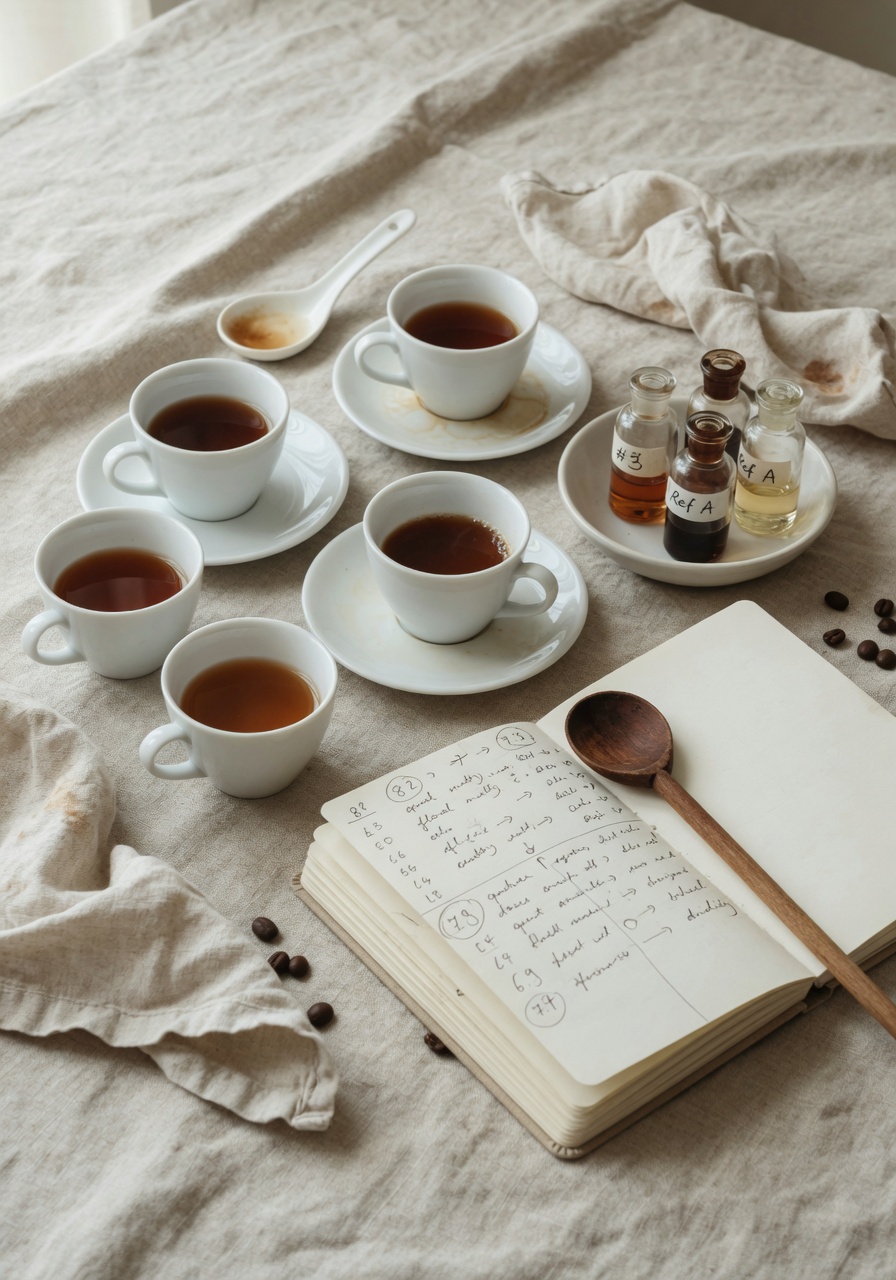
برنامج معايرة حسية لمدة ستة أسابيع
ستة أسابيع، ستة أنواع شاي مرجعية، دفتر ملاحظات واحد. برنامج منظم لمواءمة مقياس تذوقكم مع معيار GB/T — ومع خبراء التذوق الذين وضعوه.
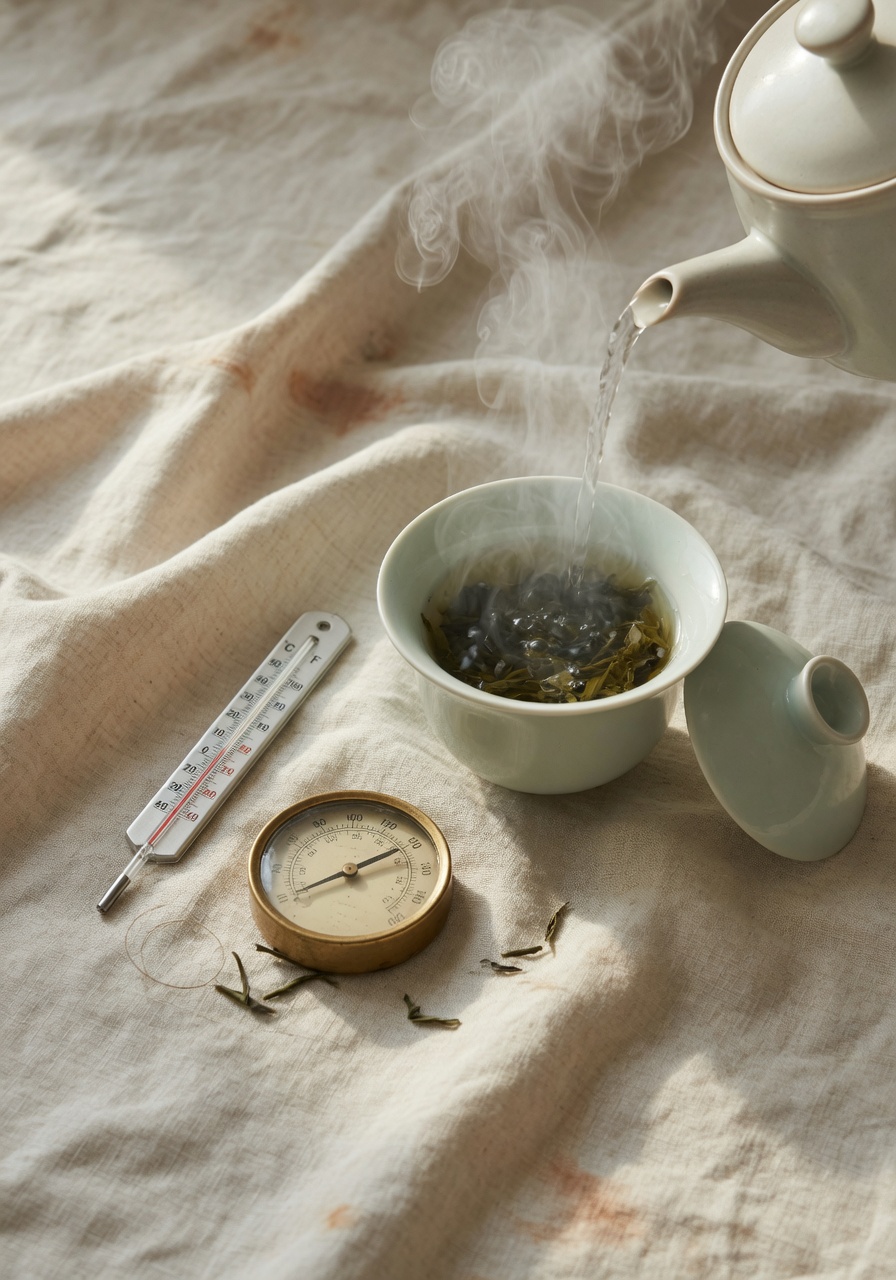
منحنيات درجة الحرارة عبر الفئات الست للشاي الصيني
درجة حرارة الماء ليست رقمًا واحدًا — إنها منحنى ينحني مع نضج الأوراق، والأكسدة، ومرحلة النقع التي أنت فيها. خريطة عملية للشاي الأخضر، والأصفر، والأبيض، والأولونغ، والأحمر، والداكن.
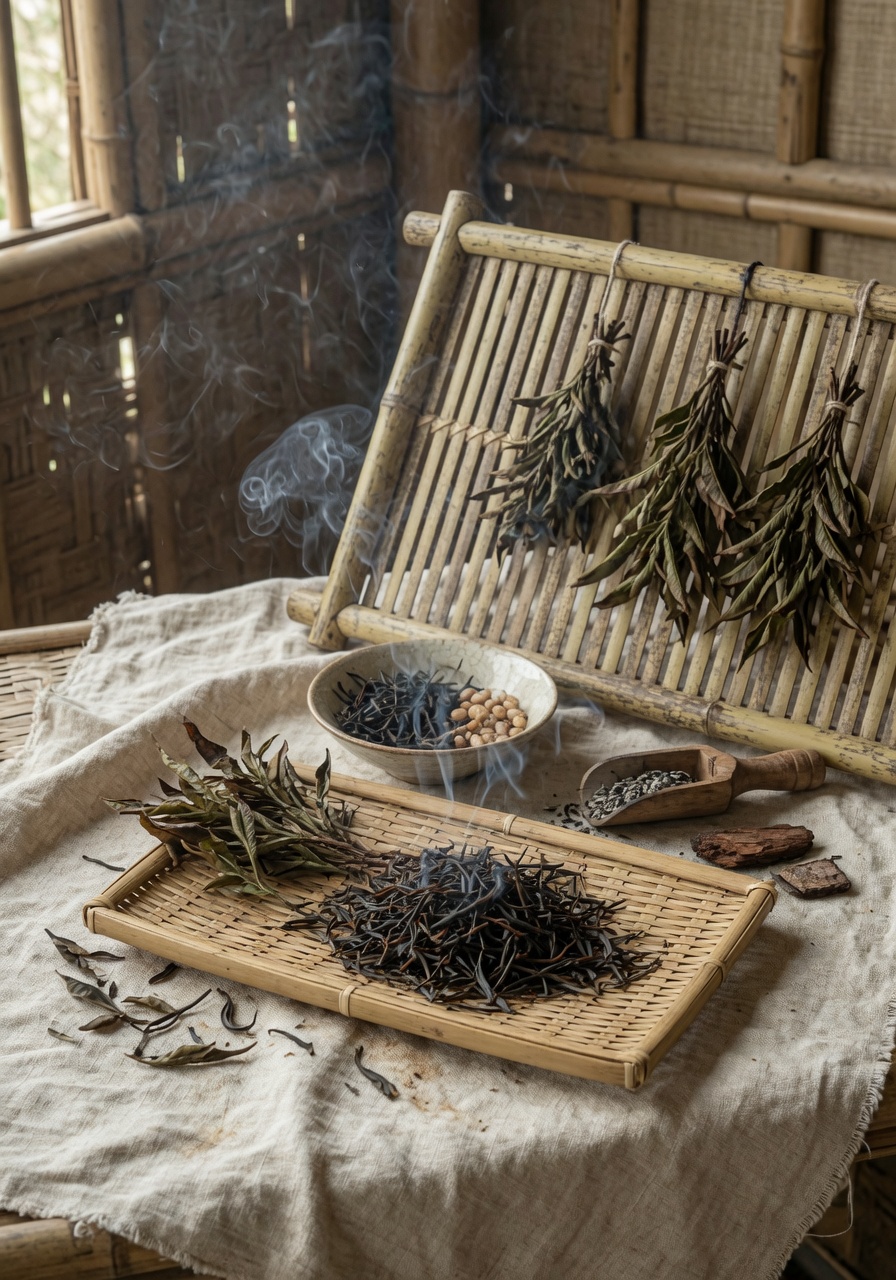
دخاني — عيب أم طابع الأرض؟
دخان الخشب في الكوب قد يعني سقيفة تجفيف مهملة، أو عاصفة رعدية أجبرت المنتِج على البقاء في الداخل، أو تقليد يمتد لأربعمئة عام. مهمة المتذوق هي التمييز بينها — ومنح الدرجات وفقًا لذلك.
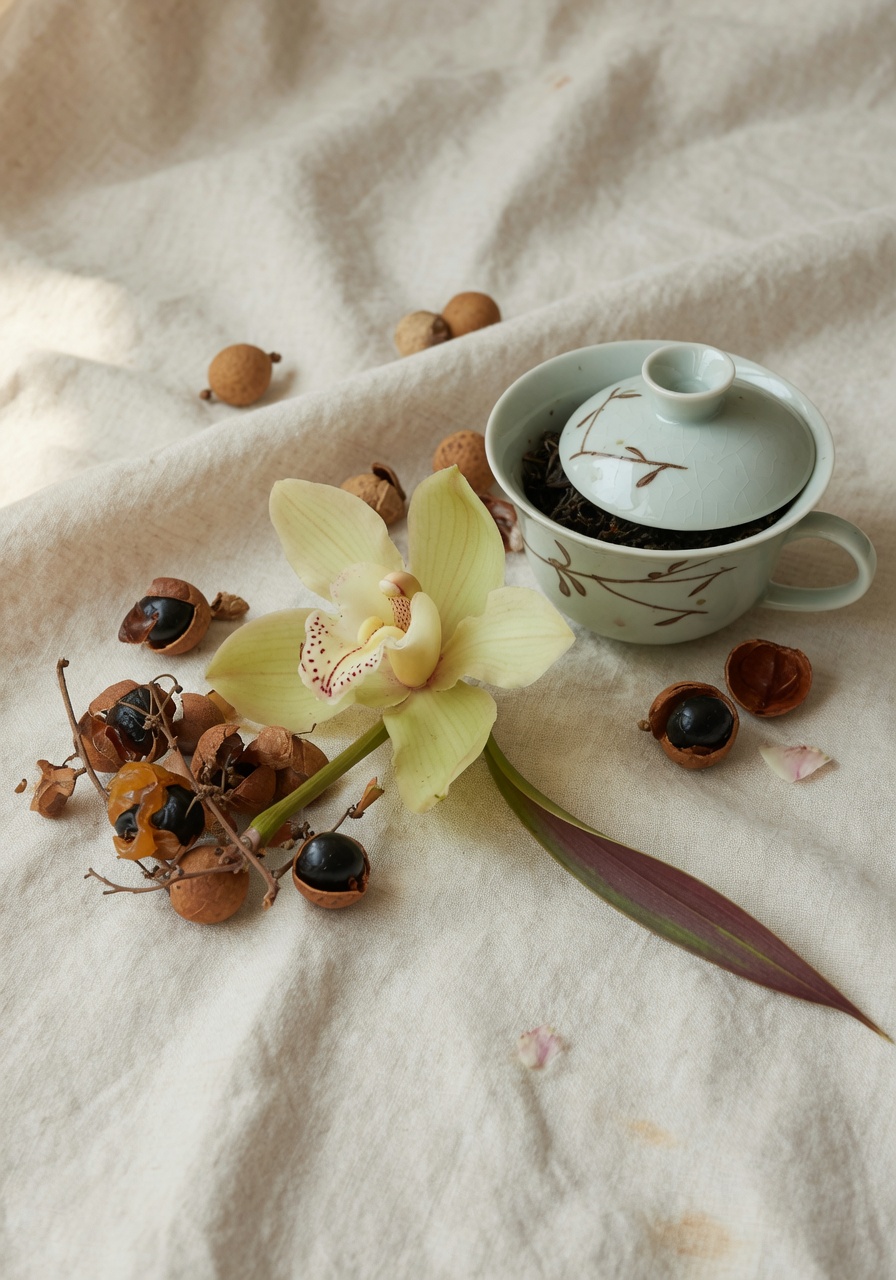
رائحة الأوركيد مقابل رائحة اللونجان — التمييز بينهما
اثنتان من أكثر السمات الوصفية إفراطاً في تقييم الشاي الصيني لا تفصل بينهما سوى فارق دقيق واحد. هذا دليل ميداني لإبقاء رائحتي الأوركيد واللونجان متمايزتين في أنفك، وملاحظاتك، وورقة تسجيل الدرجات.